Los Angeles Orthopedic

Shockwave vs Cortisone vs Surgery for chronic plantar fasciitis.

Six months in, three failed inserts deep, and the first step out of bed still feels like a nail through the heel. Here's how LAOSS podiatrists decide between extracorporeal shockwave therapy, a cortisone injection, and (rarely) plantar fascia release surgery — and which patient archetype each one actually fits.

Chronic plantar fasciitis comparison at LAOSS — board-certified Los Angeles podiatrists across eight offices
Live · Now Accepting

Three tools, one heel.

Shockwave heals. Cortisone calms. Surgery releases.

15+
Years caring
Same-day appointments
Often available
★★★★★
4.9 · 7,500+ reviews

What patients ask us most

  • I've had this for 8 months — is it ever going to get better?
  • Does shockwave actually work, or is it hype?
  • Why won't you just give me another cortisone shot?
  • How risky is the surgery, really?
  • Why isn't shockwave covered by my insurance?

What sets LAOSS apart

  • Honest framing — no overselling shockwave, no dismissing cortisone, no rushing to surgery
  • Four board-certified podiatrists who treat heel pain every day
  • Same- or next-day appointments across eight LA-area offices
  • We tell you the exact ESWT cost up front — no surprise billing
Key takeaways
  • Cortisone is fast, insurance-covered, and excellent for breaking a severe pain cycle — but repeated injections (more than 3 per year) are linked to plantar fascia rupture and fat pad atrophy.
  • Extracorporeal shockwave therapy (ESWT) is the strongest non-surgical option for plantar fasciitis past 6 months — 60–80% improvement at 3–6 months in published trials. Self-pay: roughly $200–$400 per session, ~$1,000 for the standard 3-session series.
  • Plantar fascia release surgery is reserved for refractory cases that have failed 12+ months of structured conservative care — most LAOSS podiatrists do this rarely because most cases resolve before surgery is needed.
  • For most patients past 6 months with failed conservative care, the LAOSS sequence is: confirm the diagnosis on ultrasound, one cortisone injection to break the pain cycle, shockwave series to address the underlying tissue, and surgery only if both fail.
  • Do not stack repeated cortisone shots hoping for a different outcome — the third and fourth steroid shot in a year is where the rupture and fat-pad atrophy risk lives.
Overview

Three different jobs on the same heel.

If you're reading this, you've probably already done the front-line stretches, swapped inserts twice, iced a frozen water bottle every night, and watched the morning-step pain refuse to go away. About 90% of plantar fasciitis cases resolve with structured conservative care in 6–12 months. You are in the other 10% — the chronic, refractory group where the underlying plantar fascia has shifted from an inflammation problem to a degeneration problem (technically fasciosis, not fasciitis).

That shift matters because it changes which treatments make sense. At LAOSS we have three escalating tools for this group, and they do completely different things to the tissue:

Cortisone injection suppresses the inflammatory and pain signal — fast relief, insurance-covered, but it doesn't fix the underlying tissue and overusing it actively damages the fascia and heel fat pad.

Extracorporeal shockwave therapy (ESWT) delivers focused or radial acoustic pulses into the degenerated fascia to trigger a controlled micro-injury and neovascularization — slow build, self-pay, but it's aimed at actual tissue remodeling and the benefit can last.

Plantar fascia release surgery (endoscopic or open) cuts a portion of the fascia to relieve mechanical tension — last-line, recovery is real (6–12 weeks), reserved for patients who have failed everything else.

The right answer for most patients past 6 months isn't "pick one." It's a deliberate sequence — and the wrong sequence (repeated cortisone, no shockwave, then surgery) is how patients end up with a ruptured fascia and a worse foot than they started with.

Patient education

Watch: PRP and shockwave for plantar fasciitis

Both regenerative shockwave and PRP target the underlying tissue rather than just suppressing pain. This short video walks through what to expect when conservative care has plateaued.

Animations licensed from ViewMedica · Swarm Interactive

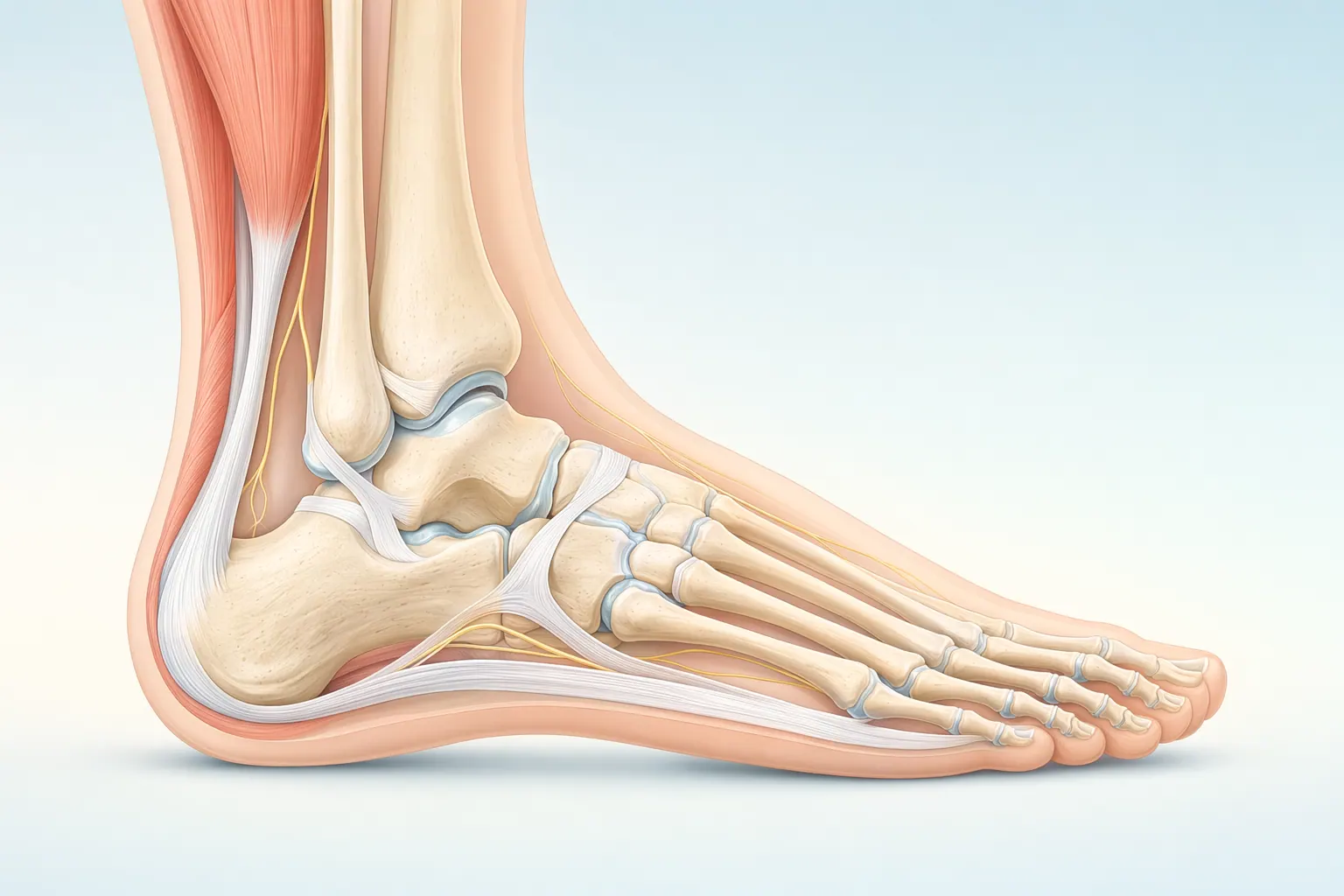
Cross-section of the foot showing the plantar fascia attaching to the calcaneus, with the chronic degeneration zone near the medial calcaneal tubercle highlighted
After 6 months, the problem is no longer acute inflammation — it's a thickened, degenerated band of fascia where the body's repair signal has stalled.
Anatomy

What's actually happening in a chronic heel.

The plantar fascia is a thick band of connective tissue that runs from the medial calcaneal tubercle (the inside-front edge of the heel bone) along the arch to the base of the toes. In a chronic case, ultrasound shows a thickened (typically >4 mm), disorganized fascia with degenerated collagen near the heel attachment — this is *fasciosis*, not *fasciitis*. That's why the late-stage conversation shifts from anti-inflammatory tools (cortisone, NSAIDs) to tissue-remodeling tools (shockwave, PRP) or mechanical decompression (surgical release).

When each option makes sense

Picking the right tool for the heel.

Symptoms

Common symptoms

  • Severe pain spike, can barely weight-bear, need to function this week — cortisone
  • 6–12 months of pain, failed PT, no prior steroid — shockwave (ESWT) first
  • Already had 1–2 cortisone shots without durable relief — shockwave, not a third shot
  • Plantar fascia rupture risk (high BMI, athlete, runner) — avoid repeat cortisone
  • 12+ months refractory pain, failed shockwave AND cortisone — surgical evaluation
  • Confirmed nerve involvement (tarsal tunnel, Baxter's neuritis) — surgery may differ
  • Heel pain plus numbness or burning — re-image, may not be classic plantar fasciitis
  • Bilateral chronic heel pain past 12 months — work-up for inflammatory arthropathy first
Causes

Common causes

  • Inflammation-dominant pain — cortisone has the leverage point
  • Tissue degeneration on ultrasound — shockwave has the leverage point
  • Failed both cortisone and shockwave at full course — surgery enters the conversation
  • Cost and insurance are hard constraints — cortisone covered, shockwave is not
  • Long-game runner or laborer — protect the fascia, prefer shockwave over repeat steroid
Decision framework

How we choose at LAOSS.

There's no universal answer — but the decision usually breaks down along four axes: how long you've had it, what you've already tried, what your insurance reality is, and what your activity goals are.

Duration and prior treatment. Past 6 months with structured conservative care already done — physical therapy, night splints, off-the-shelf and custom orthotics, NSAIDs, activity modification — you're a candidate for an interventional escalation. Past 12 months with shockwave and cortisone already failed — you're a candidate for a surgical conversation.

Pain trajectory right now. Severe, acute pain spike with measurable function loss this week often warrants a single cortisone injection to break the cycle, even if your long-term plan is shockwave. Calming the pain enough to walk, work, and tolerate PT is a legitimate goal — the trap is treating cortisone as the durable answer and stacking shots until something tears.

Insurance and cost reality. Cortisone is a $30–$100 copay. ESWT is a self-pay procedure — expect roughly $200–$400 per session, with a typical course of 3 sessions over 3 weeks (so ~$1,000 for the series). Some plans cover ESWT in specific circumstances; we check yours and quote the exact number before you commit. Surgery is covered when medically indicated.

What you're trying to protect. If you're a runner, a postal worker, a nurse, or anyone who can't accept a small but real risk of plantar fascia rupture or heel fat pad atrophy from repeated steroid exposure — your conversation skips a second cortisone shot and goes straight to shockwave or PRP.

Treatment paths

Non-surgical vs surgical paths.

Most chronic plantar fasciitis is resolved without ever opening the skin. Surgery is the last 5–10% of patients, after a real attempt at the rest. Here's how we sequence both sides.

Conservative care
Step 1

Non-surgical sequence

What most patients actually need past the 6-month mark — when conservative care has plateaued but surgery isn't yet appropriate.

  • Re-confirm the diagnosis with ultrasound — rule out heel pad atrophy, nerve entrapment, calcaneal stress reaction
  • Single cortisone injection if acute pain spike is blocking function or PT
  • Extracorporeal shockwave therapy (ESWT) — 3 sessions over 3 weeks
  • Continue structured PT with eccentric calf loading and intrinsic foot strengthening
  • Night splint and custom orthotics (or refit existing orthotics)
  • PRP injection as a regenerative alternative or adjunct to shockwave for non-responders
Surgical care
When needed

Surgical path

Plantar fascia release surgery is reserved for refractory cases — most LAOSS podiatrists do this rarely because most cases resolve before surgery is appropriate.

  • Minimum 12 months of structured conservative care, fully documented
  • Failed at least one shockwave course AND at least one cortisone injection
  • Persistent severe pain with functional disability — not mild residual ache
  • Endoscopic plantar fascia release for most candidates (smaller incisions, faster recovery)
  • Open release in select complex cases or with concurrent nerve decompression
  • Recovery: 6–12 weeks, with weight-bearing protocol and PT
Cost & coverage

What each one actually costs.

Cost is often the deciding factor between shockwave and cortisone — and unlike a lot of clinics, we quote the number before you commit.

Covered

Cortisone — insurance-covered

Cortisone injection for plantar fasciitis is a covered orthopedic service under virtually every commercial plan and Medicare. Your cost is typically just the specialist copay and a small injection fee.

  • Typical out-of-pocket: $30–$100 copay (varies by plan)
  • Covered by commercial insurance, Medicare, and most Medi-Cal plans
  • Same-day in-office procedure, no separate scheduling
  • Typically limited to no more than 3 injections per year — and we're more conservative than that
  • Ultrasound guidance covered when medically necessary
Self-pay

Shockwave (ESWT) — usually self-pay

Most commercial plans classify ESWT as investigational for plantar fasciitis, though some cover it after documented failure of conservative care. We check your coverage and quote the exact number before you commit.

  • Typical out-of-pocket: ~$200–$400 per session
  • Standard course: 3 sessions over 3 weeks (~$1,000 total)
  • Sometimes covered after documented 6–12 months of failed conservative care
  • HSA/FSA generally eligible — bring documentation
  • We verify your benefits and quote the exact number at evaluation
Timeline

How fast — and how long.

Onset and durability are where these tools diverge the most. Knowing the curve helps you plan around real life.

Fast

Cortisone — fast on, fast off

The local anesthetic gives you a few hours of immediate relief. The steroid effect builds over 24–48 hours and runs its course over weeks.

  • Hours: anesthetic effect, then it wears off
  • Day 1–2: steroid effect begins, pain drops sharply
  • Weeks 2–4: peak benefit for most patients
  • Months 2–4: benefit typically fading — and the heel often re-flares
  • Repeat: no more than every 3–4 months, and never as a routine plan
Durable

Shockwave — slow build, durable

ESWT works on tissue biology, not pharmacology. The timeline is measured in weeks of remodeling, not hours of pain relief.

  • Sessions: 3 visits, one per week, ~15–20 minutes each
  • Days 0–3 after each session: mild soreness (expected response)
  • Weeks 4–8: first meaningful improvement for most responders
  • Months 3–6: peak benefit, often durable past 12 months
  • Repeat: occasional second course at 6 months for partial responders
Evidence

What the data actually says.

We won't oversell shockwave, and we won't dismiss cortisone — and we won't rush you to surgery you don't need.

Tissue-level

Shockwave — strongest non-surgical option past 6 months

Multiple randomized trials and meta-analyses support ESWT for chronic plantar fasciitis. The benefit profile is best in the patients this page is written for: 6+ months of symptoms, failed conservative care.

  • 60–80% report meaningful improvement at 3–6 months in published trials
  • Both focused and radial ESWT show benefit; focused has marginally better data
  • Benefit typically durable to 12 months and often beyond in responders
  • FDA-cleared for plantar fasciitis since the early 2000s
  • About 20–30% are limited responders — we re-evaluate at 8–12 weeks
Short-term

Cortisone — fast short-term relief, real long-term risk

Decades of trials support cortisone for short-term pain relief in plantar fasciitis. The catch is durability and the well-documented harm of repeated injection.

  • Strong evidence for short-term pain relief (4–12 weeks)
  • By 6 months, cortisone underperforms both shockwave and PRP in head-to-head trials
  • Repeated injections (>3 in a year) raise plantar fascia rupture risk meaningfully
  • Repeat steroid exposure linked to heel fat pad atrophy — a permanent problem
  • Best used as a one-time circuit-breaker, not a long-term strategy
Candidacy

Which one fits me?

These checklists are a starting point — the final call comes at your evaluation, with ultrasound imaging and exam findings in front of us.

Shockwave

You're a shockwave candidate if

ESWT is the strongest non-surgical move for the chronic, conservative-care-failed group — and the right call when tissue remodeling matters more than fast symptom suppression.

  • 6+ months of plantar heel pain despite structured conservative care
  • Ultrasound shows a thickened, degenerated plantar fascia (fasciosis)
  • You've already used one or more cortisone shots without durable relief
  • You're a runner, athlete, or laborer protecting the fascia from steroid damage
  • You can budget for a 3-session self-pay series (~$1,000)
  • You're willing to wait 4–8 weeks for the first meaningful improvement
Cortisone

You're a cortisone candidate if

A single cortisone injection has a real, evidence-supported role — as a circuit-breaker for an acute pain spike that's blocking function and rehab.

  • Severe pain spike, function is collapsing this week
  • You've never had a steroid injection for this heel — or it's been over a year
  • Cost is a hard constraint and shockwave isn't realistic
  • You need to function for work, travel, or a family event in days, not weeks
  • You and your podiatrist agree this is one shot, not a repeated plan
  • No prior plantar fascia rupture, no significant heel fat pad atrophy
ImportantDo not stack repeated cortisone injections hoping for a different result. More than 3 plantar fascia steroid injections in a 12-month period is associated with plantar fascia rupture and heel fat pad atrophy — both of which are worse problems than the original plantar fasciitis.
Surgery

When plantar fascia release enters the conversation.

Surgery is the last 5–10% of chronic plantar fasciitis cases — but for the patients who genuinely need it, it can be the right call.

Surgical

Surgical candidacy

Plantar fascia release is appropriate for a specific patient — refractory, well-documented, and not in a rush.

  • Minimum 12 months of structured conservative care, fully documented
  • Failed at least one shockwave course AND at least one cortisone injection
  • Persistent severe pain with measurable functional disability
  • Ultrasound or MRI confirms degenerated fascia or partial tear
  • No untreated systemic driver (inflammatory arthropathy, neuropathy)
  • You understand recovery is 6–12 weeks and outcomes are not guaranteed
Technique

Endoscopic vs open release

When surgery is the right call, the technique conversation comes next. Endoscopic release fits most candidates; open release is reserved for select cases.

  • Endoscopic: smaller incisions, faster recovery, most candidates
  • Open: select complex cases, concurrent Baxter's nerve decompression
  • Partial (medial-only) release preferred to preserve arch mechanics
  • Recovery: protected weight-bearing for 2–3 weeks, PT thereafter
  • Return to walking at 4–6 weeks, sport at 10–16 weeks
  • Most LAOSS podiatrists perform this rarely — because most cases resolve before this point
Recovery

What each recovery looks like.

Recovery timelines diverge sharply across these three options — cortisone is measured in days, shockwave in weeks, surgery in months.

01Cortisone · Days 0–14

Fast onset, normal activity

Cortisone is an in-and-out office procedure. Most patients walk out and resume normal activity the same day.

  • Mild soreness at the injection site for 24–48 hours
  • Resume normal walking and activity the same day
  • Pain relief typically starts within 24–48 hours
  • Avoid impact sport for 7–10 days to reduce rupture risk
02Shockwave · Weeks 0–8

Mild soreness, slow build

ESWT triggers a controlled healing response. You'll feel sore for a day or two after each session — that's the response working.

  • Soreness for 24–72 hours after each session (expected)
  • Three sessions, one per week, ~15–20 minutes each
  • Walk normally between sessions; avoid hard impact for 48 hours after
  • First meaningful improvement typically at week 4–8 post-course
03Surgery · Weeks 0–16

Real recovery, durable result

Endoscopic plantar fascia release is a real operation. The recovery is months, not weeks — but for the right patient, the result can be durable.

  • Protected weight-bearing in a boot or hard-sole shoe for 2–3 weeks
  • Transition to normal shoe and PT at weeks 3–6
  • Return to walking comfortably at weeks 4–6
  • Return to running or impact sport at weeks 10–16
Sequencing

The honest LAOSS playbook.

For the patient this page was written for — chronic plantar fasciitis past 6 months, failed conservative care — there's a sequence we run more often than any other.

Step one is to confirm the diagnosis on ultrasound. A non-trivial number of "chronic plantar fasciitis" cases turn out to be heel fat pad atrophy, calcaneal stress reaction, tarsal tunnel syndrome, or Baxter's nerve entrapment — all of which look similar from the outside and respond to completely different treatments. We image at the evaluation visit.

Step two, if the diagnosis confirms, is usually a single ultrasound-guided cortisone injection — if you've never had one or it's been over a year, and if a pain reset would meaningfully help you tolerate PT and the shockwave course. This is not a long-term answer. It's a circuit-breaker.

Step three is a full shockwave course — 3 sessions over 3 weeks — paired with continued PT, eccentric calf work, and a night splint. We re-evaluate at week 8 and again at week 12.

Step four, if shockwave and cortisone both fail at 12+ months, is a surgical conversation about endoscopic plantar fascia release. Most LAOSS podiatrists do this rarely — not because we're philosophically opposed, but because most cases genuinely resolve before this point with the steps above. The patients who actually need surgery are a small minority, and they're better off for the deliberate work-up that got them there.

There are also situations where the answer is none of these yet — if your PT was unstructured, if the orthotic was off-the-shelf when a custom would have helped, if you stopped the night splint at three weeks, we'll tell you that too and rebuild the conservative plan before escalating.

Risks & considerations

Side-by-side risk profile.

All three options are well-tolerated when delivered by experienced specialists — but the risk profiles are very different.

Cortisone

Cortisone considerations

A single cortisone injection is low-risk. The danger is in the third and fourth shot of the year, not the first one.

  • Transient flare for 24–48 hours in some patients
  • Skin discoloration or subcutaneous fat thinning at the injection site
  • Transient blood sugar elevation (notable for diabetics)
  • Plantar fascia rupture risk with repeated injection
  • Heel fat pad atrophy with repeat exposure — permanent, makes walking worse than the original problem
Shockwave

Shockwave considerations

ESWT is one of the lowest-risk interventions in podiatry. The main considerations are cost, response variability, and a few absolute contraindications.

  • Mild soreness or redness for 24–72 hours after each session
  • Small bruise possible at the treatment site
  • Not appropriate during pregnancy or with a pacemaker over the treatment field
  • Avoid in patients on blood thinners or with active infection
  • About 20–30% of patients are limited responders — we re-evaluate at 8–12 weeks
Your care team

Meet the foot & ankle specialists at LAOSS.

Chronic plantar fasciitis at LAOSS is managed by board-certified podiatrists with deep experience in heel pain — diagnostic ultrasound, image-guided injection, shockwave therapy, and (when truly needed) surgical release. The same podiatrist who confirms the diagnosis on ultrasound is the one performing the injection or the shockwave course. No hand-offs, no marketing-driven "plantar fasciitis packages," no rushing you toward the most expensive option in the room.

Specialists

Meet your foot & ankle specialists.

4 providers
Patient reviews

What patients say about us.

★★★★★4.97,500+ Google reviews
Dr. Acosta saved me from spine surgery. I came in convinced I was going to need an operation. He laid out a non-surgical plan that's been working. So thankful.
Karina Petrosyan
Tarzana, CA · 5 December 2024
Explore related care

Find care by body area.

Heel pain is one of many conditions we treat across the foot and beyond — jump to the area that's bothering you.

FAQ

Shockwave vs cortisone vs surgery — common questions

  • Yes, for almost everyone. About 90% of plantar fasciitis cases resolve within 12 months with structured conservative care, and most of the remaining 10% improve significantly with an interventional escalation — extracorporeal shockwave therapy, a single cortisone injection, PRP, or some combination. Fewer than 5% of chronic plantar fasciitis patients ultimately need surgery. The patients who stay stuck are usually the ones running unstructured conservative care (off-the-shelf inserts, sporadic stretching, no night splint, no eccentric loading) or the ones stacking repeated cortisone shots. Confirm the diagnosis on ultrasound, structure the plan, and the heel almost always improves.
  • It works for the right patient. Extracorporeal shockwave therapy (ESWT) for chronic plantar fasciitis — defined as 6+ months of symptoms despite conservative care — has been studied in dozens of randomized trials and multiple meta-analyses. Published response rates are roughly 60–80% meaningful improvement at 3–6 months, with benefit typically durable past 12 months in responders. The catch: about 20–30% of patients see limited response, and it doesn't work as well for acute plantar fasciitis (under 6 months) — which often resolves with conservative care anyway. ESWT is the strongest non-surgical option for the chronic, refractory group this page is written for.
  • A single cortisone injection is a legitimate tool to break a severe pain cycle. The third and fourth one in a year is where things go wrong. Repeated steroid exposure to the plantar fascia is associated with plantar fascia rupture and heel fat pad atrophy. Both are worse problems than the plantar fasciitis itself — a ruptured fascia is a months-long recovery, and fat pad atrophy is essentially permanent and makes every step on a hard floor painful for the rest of your life. If your last cortisone shot wore off in 3 months and you're hoping the next one lasts longer, the pattern isn't going to change — but the risk is going up. That's the conversation we'd rather have than just refilling the shot.
  • Expect roughly $200–$400 per session out-of-pocket, with a standard course of 3 sessions over 3 weeks — about $1,000 total for the series. Some commercial plans cover ESWT after documented failure of 6–12 months of conservative care, and we check your coverage and quote the exact number before you commit. The reason most plans don't cover it: insurers point to variability in shockwave protocols (focused vs radial, energy levels, session counts) as a reason to defer coverage. HSA/FSA dollars are generally eligible. We don't markup — we tell you the cash price up front and you decide.
  • Either is reasonable for this patient profile, and we use both at LAOSS. PRP delivers concentrated growth factors directly into the degenerated fascia under ultrasound guidance; shockwave delivers acoustic energy across the tissue to trigger a controlled micro-injury and healing response. Both are aimed at tissue remodeling rather than symptom suppression, both work on similar timelines (4–12 weeks to benefit), and both are self-pay with similar evidence strength for chronic plantar fasciitis. PRP is typically a single injection at $500–$2,000; shockwave is typically 3 sessions for ~$1,000. We pick based on your diagnosis specifics, your budget, and your scheduling — and for true non-responders to one, the other is a reasonable next step.
  • Endoscopic plantar fascia release is a routine outpatient operation in experienced hands, but it isn't risk-free. Specific considerations include incomplete pain relief (10–25% of patients), arch instability if too much fascia is released (which is why we prefer partial medial release), nerve injury (Baxter's branch), wound complications, and a recovery of 6–12 weeks before you're walking comfortably and 10–16 weeks before sport. For the right patient — 12+ months of refractory pain, failed shockwave and cortisone, confirmed degenerated fascia on imaging — the math usually works. For the wrong patient — under 6 months of symptoms, never tried shockwave, never had structured PT — surgery is premature. That's why we work through the sequence first.
  • Bring three things: (1) a written summary of what you've already tried, with rough dates and whether it helped — PT, orthotics, night splint, NSAIDs, prior injections, prior shockwave; (2) any imaging you already have (ultrasound, MRI, X-ray) on disc or via your portal; (3) the shoes you spend the most time in, including any orthotics or inserts. If you can, avoid NSAIDs (ibuprofen, naproxen, aspirin) for 5–7 days before the visit if there's any chance we'll do same-day PRP or shockwave — acetaminophen is fine. We'll image the heel on-site, work through the options, and quote any self-pay procedures before you book them.
  • At your LAOSS visit we work through four things: (1) diagnosis confirmation on ultrasound — to rule out the look-alikes (fat pad atrophy, calcaneal stress reaction, tarsal tunnel, Baxter's neuritis) that don't respond to plantar fasciitis treatment; (2) your prior treatment history — what's been tried, for how long, with what structure; (3) your timeline and pain trajectory — circuit-breaker need vs long-game tissue work; and (4) cost and insurance reality. The honest answer for most patients past 6 months with failed conservative care is a single cortisone injection (if appropriate) plus a full shockwave course, with surgery reserved for the small minority who fail both. We won't sell you a procedure we don't believe fits your case.
Ready when you are

Get an honest plan for your chronic heel pain.

Book a visit at any of our eight Los Angeles-area offices. A board-certified podiatrist will examine the heel, image it on-site, and tell you straight whether shockwave, cortisone, surgery, or a sequence of the above is the right next step.

Booking now
21 specialists · 8 offices
Greater Los Angeles
On-site X-raySame visit
Most insurers acceptedIn-network
Call usBook online