Los Angeles Orthopedic

You heard a pop. Now what?

An ACL tear can stop an athlete mid-stride and leave a weekend warrior wondering if they'll ever pivot again. We diagnose quickly, walk you through every option, and build a recovery plan around the life — and the sport — you want to get back to.

Los Angeles orthopedic specialist evaluating a patient for an ACL tear — LAOSS board-certified care across eight LA offices
Live · Now Accepting

Same-week ACL evaluations.

MRI through our imaging partners and return-to-play protocols built around your sport.

15+
Years caring
Same-week MRI
Often available
★★★★★
4.9 · 7,500+ reviews

ACL injuries we treat

  • Acute ACL tears from sports — soccer, basketball, skiing, football
  • Partial ACL tears with persistent instability
  • Combined injuries — ACL with meniscus or MCL involvement
  • Failed ACL reconstructions needing revision
  • Chronic ACL deficiency in active adults

What sets LAOSS apart

  • Same- or next-day appointments at eight Los Angeles–area offices
  • Same-week MRI through our imaging partners
  • Sports-medicine surgeons who reconstruct ACLs every week
  • Return-to-sport testing — not just calendar dates
Key takeaways
  • An ACL tear is a sudden injury — most patients hear or feel a pop, then the knee swells within hours and feels unstable on pivoting.
  • MRI confirms the tear; the bigger decision is whether you need surgery, which depends on age, activity level, and how unstable the knee feels.
  • Sedentary patients and partial tears often do well with bracing, physical therapy, and activity modification. Active patients with full tears typically need reconstruction.
  • ACL reconstruction uses your own tendon (hamstring or patellar) as a graft. Return to sport is usually 9–12 months, gated by strength testing — not the calendar.
Overview

What is an ACL tear?

The anterior cruciate ligament — the ACL — is one of four ligaments that hold your knee together. It runs diagonally through the middle of the joint, connecting the femur to the tibia, and its job is to keep the knee from sliding forward and rotating out of place when you pivot, plant, or land from a jump.

Most ACL tears happen in a split second. A soccer player plants a foot and twists. A skier catches an edge. A basketball player lands awkwardly from a rebound. There's often a popping sound or sensation, followed by swelling within a few hours and a knee that suddenly feels unreliable — like it can't be trusted on stairs, slopes, or quick changes of direction.

The injury falls on a spectrum. Partial tears leave some of the ligament intact and may stabilize with rehab. Complete tears — the more common scenario — don't heal on their own, because the ACL lives in a fluid-filled joint that prevents the kind of clotting that heals other ligaments. Whether a complete tear needs surgery is a separate question, and it depends entirely on what you want to do with the knee.

At LAOSS, our sports-medicine surgeons treat ACL injuries every week. We don't push surgery on patients who don't need it, and we don't undertreat athletes who do. The conversation starts with an exam, an MRI when warranted, and an honest look at your goals.


Patient education

Watch: Anterior Cruciate Ligament Tear (ACL Tear)

This injury is a tearing of the ACL ligament in the knee joint. The ACL ligament is one of the bands of tissue that connects the femur to the tibia. An ACL tear can be painful. It can cause the knee to become unstable.

Animations licensed from ViewMedica · Swarm Interactive

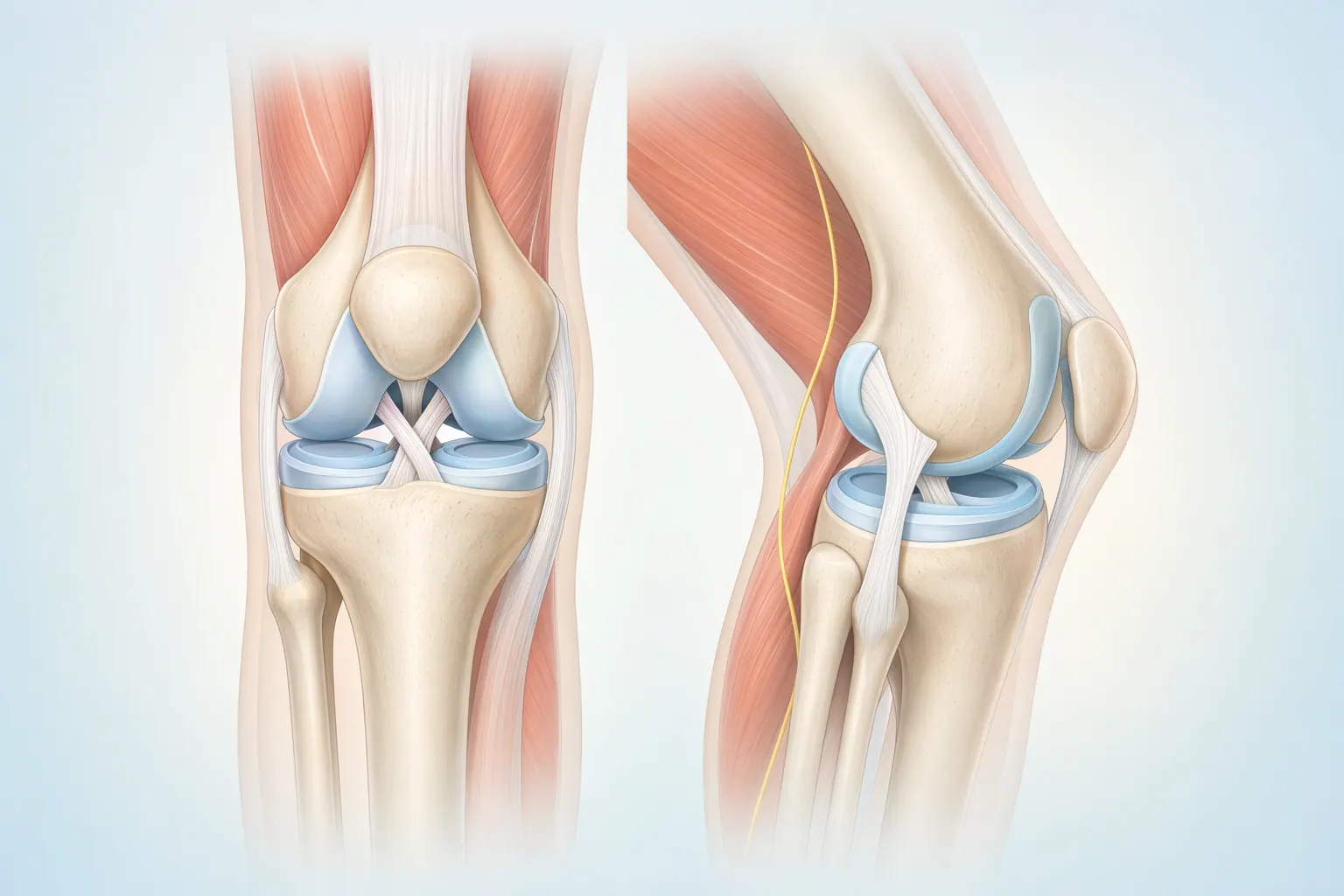
Anatomical illustration of the knee showing the anterior cruciate ligament running diagonally through the joint
The ACL runs diagonally inside the knee joint, connecting the femur to the tibia and resisting forward translation and rotational forces.
Anatomy

Inside the ACL.

The anterior cruciate ligament is a short, dense band of tissue — about the size of your little finger — that crosses the inside of the knee. Together with the PCL it forms an X shape that controls how the femur and tibia move on one another. When it tears, the bones can shift in ways the body wasn't built for, which is what creates the giving-way feeling so many ACL patients describe.

Self-orient

When an ACL tear shows up.

Symptoms

Common symptoms

  • A popping sound or sensation at the moment of injury
  • Rapid swelling within the first few hours
  • Pain deep inside the knee, often worse with bearing weight
  • A feeling that the knee is loose, wobbly, or about to give out
  • Difficulty fully straightening or bending the knee
  • Trouble pivoting, cutting, or changing direction
  • Knee buckling on stairs or uneven ground
  • Persistent instability weeks or months after the initial injury
Causes

Common causes

  • Sudden pivoting or cutting movements in sports like soccer, basketball, and football
  • Awkward landings from jumps — volleyball, basketball, gymnastics
  • Skiing falls where the ski stays planted while the body twists
  • Direct blows to the knee from contact sports or accidents
  • Sudden deceleration — stopping hard while running
  • Hyperextension of the knee beyond its normal range
Diagnostics

How we diagnose an ACL tear.

Most ACL tears are diagnosed in clinic, not on a scan. The story is often unmistakable — a pivot, a pop, a swollen knee — and a careful exam confirms it. We use specific maneuvers like the Lachman test, anterior drawer, and pivot shift to feel directly for the laxity that a torn ACL produces. In experienced hands, these tests are remarkably accurate.

We then confirm with imaging. Weight-bearing X-rays rule out fracture and tell us about the bones. MRI shows the ligament itself, plus the menisci, cartilage, and bone bruise pattern that often comes with an ACL injury. About half of ACL tears come with a meniscus injury, and many show bone bruising on the femur and tibia where the bones collided as the ligament gave way — both of which change the treatment plan.

Your first visit at LAOSS is built to give you answers, not a maze of referrals. Most ACL patients leave with a confirmed working diagnosis, an MRI scheduled within the week, and a clear next step — whether that's a surgical consult or a structured rehab plan with your in-network physical therapist.

Treatment options

How we treat ACL tears.

Not every ACL tear needs surgery. The right path depends on the tear pattern, your activity goals, the condition of the rest of the knee, and how unstable it feels day-to-day. We lay out every option, the trade-offs of each, and the realistic timeline before you decide.

Conservative care
Step 1

Conservative care

For partial tears, less active patients, and people who can structure their lives around a stable knee, non-surgical care can work — and works best when started early and followed consistently.

  • Bracing with a functional ACL brace for sports or work demands
  • Structured physical therapy focused on hamstring and quad strength
  • Neuromuscular retraining to protect against giving-way episodes
  • Activity modification — avoiding cutting and pivoting sports
  • PRP or biologic injections in selected partial-tear cases
  • Coordinated PT through your in-network provider
Surgical care
When needed

ACL reconstruction

For active patients, athletes, and anyone whose knee continues to give out, reconstruction restores the ligament with a graft and gets you back to the activities you care about.

  • Hamstring tendon autograft — your own hamstring as the new ligament
  • Patellar tendon (BTB) autograft — the classic athlete's reconstruction
  • Quadriceps tendon autograft — increasingly favored in revisions
  • Allograft reconstruction for select older or lower-demand patients
  • Combined ACL + meniscus repair when both are injured
  • Revision ACL reconstruction after a previous graft failure
Surgeon expertise

Why experience matters with ACLs.

Volume changes outcomes

ACL reconstruction is one of the most technique-sensitive operations in orthopedics. Tunnel placement, graft tensioning, and addressing companion injuries all sit within millimeters of right and wrong.

  • Anatomic tunnel placement — the single biggest predictor of long-term success
  • Graft choice matched to your sport, age, and prior injuries
  • Meniscus preserved whenever possible, repaired when needed
  • Surgeons who do ACLs every week, not every quarter

The LAOSS approach

Our sports-medicine team moves stepwise — diagnose accurately, treat conservatively when it fits, and reconstruct with the precision the knee deserves when surgery is the right call.

  • Same-week MRI through imaging partners
  • PT coordinated in your insurance network
  • Board-certified sports-medicine surgeons performing the procedures themselves
  • Return-to-sport testing before clearance — not just a calendar date
Candidacy

Am I a candidate?

If most of these match your situation, an evaluation with a sports-medicine knee specialist is the next step.

You may be

You may be a candidate if

These signs typically point toward an in-person evaluation with a knee specialist.

  • You heard or felt a pop in your knee during an injury
  • Your knee swelled rapidly within hours of the injury
  • Your knee feels unstable, loose, or like it might give out
  • You can't return to pivoting or cutting sports with confidence
  • An MRI elsewhere showed an ACL tear and you want a second opinion
  • A previous ACL reconstruction has failed or feels unstable again
Evaluation

What evaluation includes

Your first visit is built to give you an answer the same day, not just another referral.

  • Detailed history — mechanism of injury, sport demands, prior knee history
  • Hands-on ligament exam — Lachman, anterior drawer, pivot shift
  • On-site weight-bearing X-rays to rule out fracture
  • MRI scheduled within the week if not already done
  • Clear plan with conservative and surgical options laid side-by-side
ImportantSeek urgent evaluation for an inability to bear any weight, a knee that's locked and can't be straightened, severe pain unrelieved by ice and elevation, numbness, or signs of a blood clot (calf pain or swelling, shortness of breath).
Recovery

Your ACL recovery roadmap.

ACL recovery isn't a straight line — but it is predictable. These are the phases nearly every reconstructed knee moves through on the way back to sport.

01Weeks 0–6

Protect & restore motion

The first six weeks are about calming the joint, protecting the new graft, and getting the knee fully straight. Full extension early is non-negotiable.

  • Weight-bearing as tolerated with crutches initially
  • Full passive extension by week 1–2 — the most important early milestone
  • Quad activation and patellar mobility drills
  • Swelling control with ice, elevation, and compression
02Months 2–6

Rebuild strength

Targeted physical therapy rebuilds the hamstring and quad strength the graft depends on, plus the neuromuscular control that protects you from re-injury.

  • Progressive strengthening — squats, lunges, hip work
  • Stationary bike, then elliptical, then straight-line running around month 4
  • Single-leg stability and balance work
  • Coordinated PT through your in-network provider
03Months 6–12

Return to sport

Return-to-sport clearance is earned, not given by the calendar. We use objective strength and hop testing to confirm the knee is ready before you go back to cutting and pivoting.

  • Sport-specific cutting, pivoting, and jumping progressions
  • Quad strength within 90% of the opposite leg before clearance
  • Hop test symmetry and movement-quality screening
  • Functional ACL brace for the first season back if desired
Risks & considerations

What to weigh before you decide.

We talk through the risks and benefits with every ACL patient — informed consent is a conversation, not a form.

General

General considerations

Every reconstruction carries a small set of standard surgical risks. We screen, prepare, and monitor for these on every patient.

  • Infection (uncommon with modern technique and prophylaxis)
  • Blood clot risk — mitigated by early mobilization
  • Reaction to anesthesia or medications
  • Bleeding, bruising, or scar tissue at the incisions
Specific

ACL-specific considerations

A few risks are specific to ACL reconstruction itself. We discuss each in detail so you can weigh them against the benefits.

  • Graft re-tear — roughly 5–10% in young athletes returning to cutting sports
  • Stiffness or loss of full motion if rehab isn't followed closely
  • Donor-site discomfort at the hamstring or kneecap graft area
  • Long-term arthritis risk — present with or without surgery after ACL injury
Your care team

Meet the ACL specialists at LAOSS.

ACL reconstruction is a sports-medicine subspecialty, and our team treats it that way. The surgeons listed below operate on ACLs every week, train in the same fellowships that produced the team physicians for major professional and collegiate programs, and follow their patients personally from the first visit through full return to sport. You don't get handed off to a different doctor for each step.

Patient reviews

What patients say about us.

★★★★★4.97,500+ Google reviews
Tore my ACL playing rec-league soccer at 34 and was convinced my season was over for good. Dr. Longacre walked me through every graft option, did the reconstruction, and I was back to non-contact training by month seven. Cleared for games at ten months. Couldn't ask for more.
David Aguilar
Echo Park, CA · 18 March 2025
Explore related care

Find care by body area.

Jump to a nearby condition page and compare treatment paths across the body.

FAQ

Common ACL questions

  • Sometimes, yes. Partial tears, lower-demand lifestyles, and people willing to give up cutting and pivoting sports can often manage with bracing and structured physical therapy. But for active patients with a complete tear — especially anyone who wants to return to soccer, basketball, skiing, or any cutting sport — reconstruction is usually the right answer, because the ACL doesn't heal itself in the joint fluid. We'll walk you through both paths honestly so you can decide.
  • Most patients return to cutting and pivoting sports between 9 and 12 months after ACL reconstruction. Straight-line running often comes back around month 4–5, sport-specific drills around month 6–7. The exact timing depends on graft choice, your strength recovery, and how you do on objective return-to-sport testing — we don't clear anyone purely based on the calendar. Quad strength within 90% of the opposite leg and clean hop-test symmetry are the gates.
  • For most patients, yes — a well-reconstructed and well-rehabbed ACL knee feels nearly identical to the uninjured side at one year out. Some patients describe a slight awareness of the knee, especially in the first season back, which is why many wear a functional brace for that first year. The bigger long-term issue is the cartilage and meniscus damage that often happens at the moment of injury, which is a separate conversation about long-term joint health.
  • There's no single best graft — there's a best graft for you. Patellar tendon (BTB) has the longest track record in high-level athletes and may have slightly lower re-tear rates, but causes more kneecap-area discomfort in the first few months. Hamstring autograft has an easier early recovery but a slightly higher re-tear rate in young cutting athletes. Quadriceps tendon is gaining popularity for revisions and larger patients. We match the graft to your sport, age, body type, and prior knee history.
  • Within a few days is ideal. Early evaluation helps confirm the diagnosis, rule out a fracture, identify combined injuries like meniscus tears, and get you started on the pre-operative rehab ("prehab") that improves outcomes if you do end up needing surgery. If the knee is locked, can't bear any weight, or has signs of a blood clot, go to urgent care or the ER instead.
  • Most patients are on crutches for 1–2 weeks, off pain medication within a week, driving by 2–4 weeks (depending on the side and your car), and back to a desk job by 1–2 weeks. The first six weeks focus on getting the knee fully straight and waking up the quad. From there it's months of progressive strengthening with your PT, and the patients who do best are the ones who treat rehab like the second half of the surgery — not optional homework.
  • Honest answer: ACL injuries do raise the long-term risk of knee arthritis — and that risk is present whether you have surgery or not. The damage often happens at the moment of injury, especially the bone bruise and meniscus tear that frequently come with an ACL rupture. What you can control is preserving as much meniscus as possible, rebuilding strong quads and hamstrings, and managing weight and activity over the long run. We'll talk through all of this at your visit.
  • Yes. Failed ACL grafts happen — about 5–10% of reconstructed ACLs in young athletes returning to cutting sports re-tear, and not every primary reconstruction holds up. Revision is more complex because of existing tunnels and graft choices, often benefits from a different graft (frequently quadriceps tendon), and sometimes requires a staged approach with bone grafting first. Our surgeons handle these regularly.
Ready when you are

Don't wait on an unstable knee.

Book an ACL evaluation at any of our eight Los Angeles–area offices. Same-week MRI available through our imaging partners.

Booking now
21 specialists · 8 offices
Greater Los Angeles
On-site X-raySame visit
Most insurers acceptedIn-network
Call usBook online