Los Angeles Orthopedic

Tennis elbow: conservative care vs surgery.

Roughly 85–90% of tennis elbow resolves without surgery — if you commit to the physical therapy program. Surgery is real, it works, and it's the last move after a year or more of well-executed conservative care has failed. Here's how LAOSS elbow specialists draw that line.

LAOSS elbow specialist evaluating a patient with lateral epicondylitis — board-certified orthopedic care across eight Los Angeles offices
Live · Now Accepting

Conservative-first, always.

Surgery only after 12+ months of real PT.

85–90%
Resolve without surgery
Same-day appointments
Often available
★★★★★
4.9 · 7,500+ reviews

What patients ask us most

  • How long should I really try PT before considering surgery?
  • Are cortisone shots helping or hurting my long-term outcome?
  • Does PRP work — and when is it worth the out-of-pocket cost?
  • What does the surgery actually do, and how long is recovery?
  • How do you know when conservative care has truly failed?

What sets LAOSS apart

  • Honest framing — we won't sell surgery you don't need
  • Board-certified upper-extremity specialists, not generalists
  • Same- or next-day appointments at eight LA-area offices
  • Coached eccentric loading (Tyler twist), not just a printout
Key takeaways
  • Roughly 85–90% of tennis elbow resolves with conservative care in 6–12 months — eccentric loading (Tyler twist), a counterforce brace, activity modification, and patience.
  • Cortisone gives fast short-term relief but doesn't change long-term outcomes — and repeated shots have been linked to worse 6- and 12-month results than no injection at all.
  • PRP has moderate evidence for refractory cases and outperforms cortisone at 6+ months for tennis elbow specifically. Out-of-pocket cost is the trade-off.
  • Surgery (open or arthroscopic ECRB release) is reserved for cases that have failed 12+ months of well-executed conservative care. Recovery is 6–8 weeks; outcomes are 80–90% improvement.
  • The single biggest predictor of avoiding surgery is committing to the PT program for the full 12 weeks — not skipping the Tyler twist after the pain calms down.
Overview

Conservative vs surgical: a wide gap.

Tennis elbow — clinically lateral epicondylitis, more accurately lateral epicondyle tendinosis — is one of the most common upper-extremity conditions we see. And it's one where the gap between conservative care and surgery is unusually wide.

Conservative care — physical therapy with eccentric loading, a counterforce brace, activity modification, and time — resolves roughly 85–90% of cases in 6–12 months. That's not us being optimistic; that's what the orthopedic literature shows when patients actually commit to the program. The catch is the timeline: 6–12 months is a long stretch to live with elbow pain, and most patients try to push through it without changing the activity that's driving it. That's why most "failed conservative care" cases haven't actually failed conservative care — they've failed to do conservative care.

Surgery — open or arthroscopic release/debridement of the ECRB (extensor carpi radialis brevis) origin — is the last-line option. It's reserved for patients who've completed 12+ months of well-executed conservative care (real PT, real eccentric loading, ergonomic change, often a trial of injection) and still have disabling pain. When indicated, it works: 80–90% of patients see meaningful improvement, with a 6–8 week recovery to most activities.

The honest framing at LAOSS is this: most patients who come in convinced they need surgery actually need a better conservative plan. And the small group who genuinely need surgery deserve to have it offered without a year of half-hearted treatment first. The trick is telling those two groups apart — that's what your evaluation is for.

Patient education

Watch: Lateral epicondylitis (tennis elbow)

Tennis elbow is a breakdown of the tendons that connect the forearm muscles to the outside of the elbow. This short video walks through the anatomy, why repetitive loading drives it, and what successful treatment actually does to the tendon.

Animations licensed from ViewMedica · Swarm Interactive

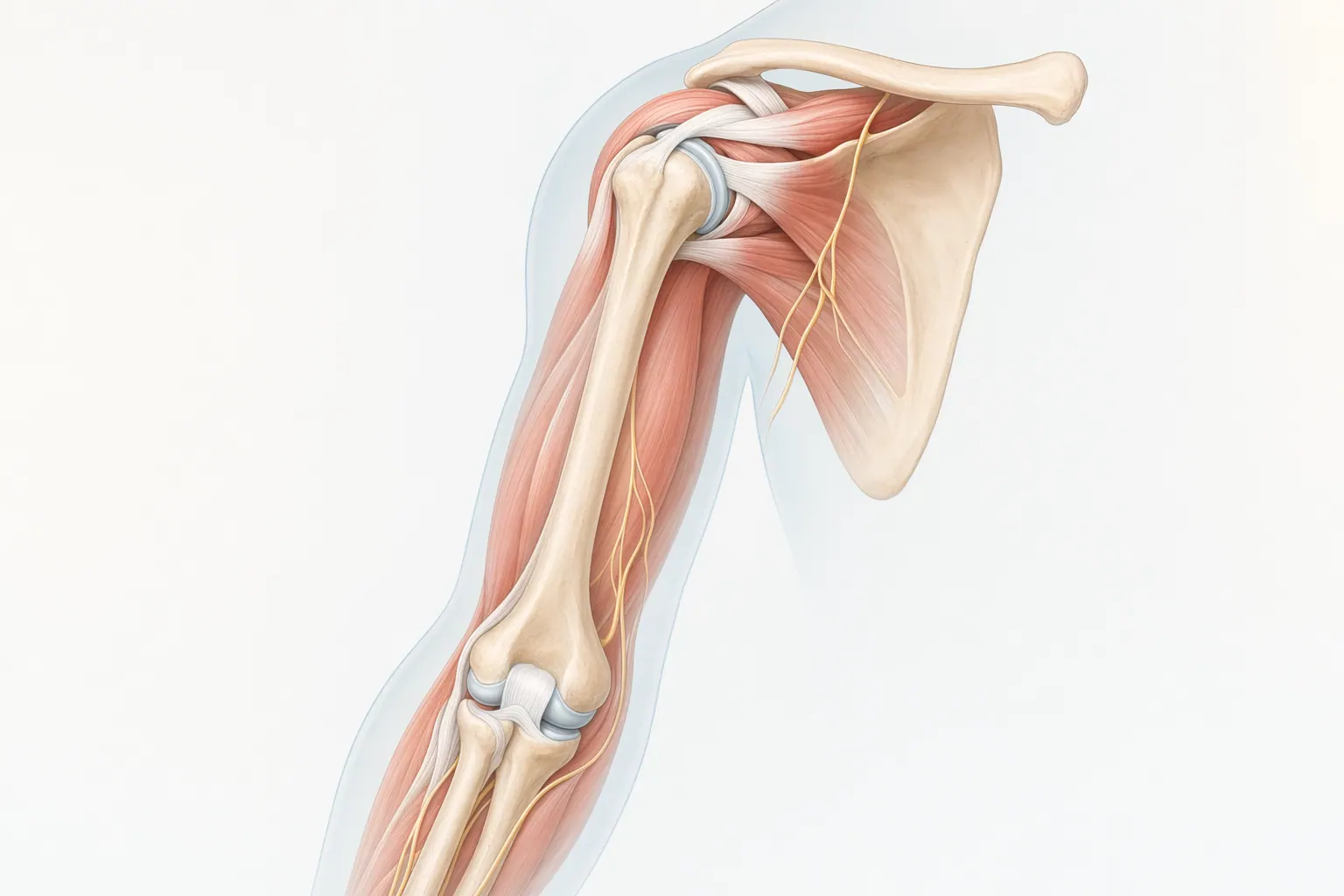
Anatomical illustration of the lateral elbow showing the lateral epicondyle and the ECRB tendon origin — target of conservative care and surgical release
The ECRB (extensor carpi radialis brevis) tendon attaches at the lateral epicondyle — both PT and surgery target this same spot.
Anatomy

What's happening at the tendon.

Despite the old "-itis" name, tennis elbow isn't really inflammation. It's tendinosis — microscopic tearing and disorganized collagen at the ECRB origin where it attaches to the outside of the elbow. That distinction matters: it's why pure anti-inflammatories don't fix it, and why the tendon needs to be loaded correctly to remodel and heal. Conservative care drives that remodeling biologically. Surgery removes the diseased tendon tissue mechanically so healthy tissue can fill in. Two different routes to the same biological endpoint — healthy collagen at the ECRB origin.

When each option makes sense

Picking the right path for your case.

Symptoms

Common symptoms

  • New tennis elbow (under 6 weeks) — conservative care, no question
  • Persistent pain at 3 months despite rest — start coached PT and bracing
  • 6 months in, still hurting, no PT yet — real PT is the next step, not surgery
  • 12+ months of disciplined PT, brace, ergonomic change — escalate to PRP or surgery
  • Failed cortisone + PT + PRP after 12+ months — surgical release is reasonable
  • Symptoms after a discrete trauma (fall, lift) — image first to rule out partial tear
  • Numbness or tingling in the hand — work up for nerve, not tendon (radial tunnel)
  • MRI shows full-thickness tendon tear — surgical repair conversation
Causes

Common causes

  • Pain is the dominant complaint, function is preserved — conservative wins
  • Function is collapsing (can't work, can't lift) despite real PT — escalate
  • Tendon imaging shows tendinosis, not full tear — conservative or PRP first
  • MRI shows discrete tear or large defect — surgical conversation
  • Patient hasn't actually done the eccentric program — that's the missing variable
  • Patient has done everything for 12+ months without relief — surgery is on the table
Decision framework

How we choose at LAOSS.

The decision usually breaks down along four axes: time in conservative care, quality of that care, function, and imaging.

Time in conservative care. Six to twelve months is the standard threshold before surgery becomes a reasonable conversation. Under 6 months, the answer is almost always more conservative care. Over 12 months with disciplined effort, the conversation shifts.

Quality of that care. This is where most decisions actually get made. "I rested it and took ibuprofen" is not conservative care. Real conservative care includes coached eccentric loading (the Tyler twist, done correctly, 3 sets of 15 daily for at least 6–12 weeks), a counterforce brace during aggravating activity, ergonomic change at work and home, and usually a course of PT through your in-network provider. If you haven't actually done that yet, your conservative care hasn't failed — it hasn't started.

Function. Pain alone isn't usually a surgical indication for tennis elbow. Pain that's collapsing function — you can't do your job, you can't sleep, you can't grip — is. We separate the two carefully at the visit.

Imaging. Most tennis elbow doesn't need MRI. But if the story doesn't fit (discrete trauma, weakness out of proportion to pain, numbness, a snapping or popping), we image to look for a partial or full-thickness tear, a ligament injury, or radial tunnel syndrome. A confirmed tendon tear or refractory tendinosis on imaging is part of the surgical conversation; an unremarkable MRI usually pushes us back toward better-executed conservative care.


Treatment paths

Conservative-first vs surgical release.

These aren't equal-weight options. Conservative care is the default for virtually every patient. Surgery is the exception, reserved for cases that have genuinely run out of non-surgical road.

Conservative care
Step 1

Conservative care (almost everyone)

The first 6–12 months belong here. Done right, this resolves the large majority of tennis elbow without surgery.

  • Coached eccentric loading — the Tyler twist with a FlexBar, 6–12 weeks
  • Counterforce brace during aggravating activity (not all day)
  • Activity and ergonomic modification — grip size, mouse, technique
  • Physical or occupational therapy through your in-network provider
  • Topical and short-course oral NSAIDs for symptom control
  • Selective cortisone — fast relief, but doesn't change long-term outcomes
  • PRP for refractory cases — moderate evidence, better at 6+ months than cortisone
Surgical care
When needed

Surgical release (last-line)

Reserved for patients who've completed 12+ months of disciplined conservative care and still have disabling pain. Outpatient procedure, regional or general anesthesia.

  • Open ECRB release — small incision over the lateral epicondyle
  • Arthroscopic ECRB release — small-camera technique, similar outcomes
  • Debridement of the diseased tendon tissue at the ECRB origin
  • Outpatient — same-day discharge, sling for comfort 1–2 weeks
  • Recovery: 6–8 weeks to most activities, 3–4 months to full strength
  • Outcomes: 80–90% meaningful improvement; not zero pain in every patient
Cost & coverage

What each path actually costs.

Conservative care is largely insurance-covered. Surgery is too, but the total spend (and time off work) is meaningfully higher.

Covered

Conservative care — covered

Office visits, PT, bracing, and cortisone are covered under virtually every commercial plan and Medicare. PRP is the one outlier.

  • Specialist visit: $30–$100 copay (varies by plan)
  • Counterforce brace and FlexBar: $20–$40 out-of-pocket, often HSA/FSA eligible
  • PT: copay or coinsurance per visit, typically 6–12 sessions
  • Cortisone injection: covered, small injection-fee copay
  • PRP: usually NOT covered — $500–$1,500 per injection, 1–3 injection course
  • Total typical out-of-pocket: a few hundred dollars for most patients
Covered

Surgery — covered, but bigger spend

ECRB release is a covered orthopedic procedure under virtually every plan. The headline number is the deductible and coinsurance, not the procedure being denied.

  • Outpatient surgical facility: subject to your deductible and coinsurance
  • Surgeon fee, anesthesia, and facility fee billed separately
  • Pre-op visit, post-op visits, and PT included in the recovery arc
  • Time off work: typically 1–2 weeks for desk jobs, 4–8 weeks for manual work
  • We quote your specific out-of-pocket estimate before scheduling
  • Workers' comp pathway available where applicable
Timeline

How fast — and how durable.

Conservative care is slow but durable. Surgery is a defined event with a recovery curve. Knowing the shape of each helps you plan.

85–90%

Conservative — slow on, slow off

Tendons heal in months, not weeks. The curve is predictable when the program is followed consistently.

  • Weeks 0–4: activity modification, brace, gentle mobility, calm it down
  • Weeks 4–12: Tyler twist daily, PT progression, real loading work
  • Months 3–6: most patients see meaningful resolution
  • Months 6–12: remaining patients usually resolve in this window
  • 85–90% resolved by 12 months when the program is actually done
  • Durability: very high — the tendon has remodeled
80–90%

Surgery — defined event

Surgery resets the local tendon biology by removing diseased tissue. Recovery follows a defined arc.

  • Day 0: outpatient procedure, sling for comfort, home the same day
  • Weeks 1–2: incision care, gentle elbow range of motion
  • Weeks 2–6: PT — progressive wrist and forearm strengthening
  • Weeks 6–8: return to most daily activities and desk work
  • Months 3–4: return to full strength, lifting, sport
  • Outcomes: 80–90% meaningful improvement at 6–12 months
Evidence

What the data actually says.

We won't oversell surgery and we won't dismiss it. Here's the honest read on the orthopedic literature.

Strong

Conservative — strong evidence

The strongest single-condition evidence in tennis elbow research is for eccentric loading and natural-history resolution.

  • Roughly 85–90% of tennis elbow resolves within 6–12 months without surgery
  • Eccentric loading (Tyler twist) has the strongest single-exercise evidence
  • Counterforce bracing provides modest symptomatic relief during activity
  • Cortisone: short-term relief but multiple trials show worse outcomes at 6 and 12 months vs no injection
  • PRP: moderate evidence, outperforms cortisone at 6+ months for tennis elbow specifically
  • Wait-and-see consistently beats cortisone alone at the 1-year mark
Last-line

Surgery — last-line, but it works

Surgical release has decades of outcomes data. The catch is that the evidence base is largely in patients who genuinely failed extended conservative care.

  • Open and arthroscopic ECRB release have comparable outcomes in published series
  • 80–90% of carefully selected patients report meaningful improvement
  • Recovery to full activity typically 3–4 months
  • Best results in patients who completed 12+ months of conservative care first
  • Worse results when surgery is offered before conservative care is exhausted
  • Complication rates are low (under 5%) in experienced hands
Candidacy

Which path fits me?

These checklists are a starting point — the final call comes at evaluation, with exam findings and (when needed) imaging in front of us.

Conservative

You're a conservative candidate if

Almost everyone with tennis elbow starts here. The question is what hasn't been tried yet — not whether to skip it.

  • Symptoms under 12 months without disciplined PT yet
  • You haven't done a real eccentric loading program for 6–12 weeks
  • You haven't tried a counterforce brace or fixed your work setup
  • Imaging shows tendinosis, not a full-thickness tear
  • Function is preserved enough to do PT and modify activity
  • You're willing to commit to the 12-week program (most patients underestimate this)
Surgical

You're a surgical candidate if

Surgery is reasonable when conservative care has genuinely failed — not when it hasn't been attempted.

  • 12+ months of disciplined PT, bracing, and activity modification
  • Trial of cortisone and/or PRP without lasting relief
  • Function is collapsing — can't work, can't sleep, can't grip
  • Imaging shows refractory tendinosis or a partial/full-thickness tear
  • Other diagnoses ruled out (radial tunnel, arthritis, ligament injury)
  • You understand recovery is 6–8 weeks and outcome isn't guaranteed zero pain
ImportantMost "failed conservative care" cases haven't actually failed conservative care — they've failed to do conservative care. Before any surgical conversation, we make sure the eccentric loading program (Tyler twist daily for 6–12 weeks), the counterforce brace, and ergonomic change have all genuinely been tried. Repeat cortisone injections (more than 1–2 in a year) have been linked to worse long-term outcomes for tennis elbow and shouldn't be the only thing that's been tried.
Recovery

What each recovery looks like.

Conservative recovery is gradual and self-driven. Surgical recovery is a defined arc with PT milestones. Both end at the same place: a healthier tendon.

01Conservative · Weeks 0–12

Coached loading, real change

The first three months are where conservative care either works or doesn't — and the difference is almost always whether the program was actually done.

  • Weeks 0–4: brace, ergonomic change, gentle mobility, calm it down
  • Weeks 4–12: Tyler twist 3 sets of 15 daily, PT, progressive loading
  • Reassess at 6 weeks — escalate if no progress on a real program
  • Months 3–6: most patients meaningfully improved; maintenance program
02Surgery · Weeks 0–6

Outpatient, sling, progressive

Open or arthroscopic ECRB release is a same-day procedure. The first six weeks focus on healing and gradual return of motion.

  • Day 0: outpatient surgery, sling for comfort, home the same day
  • Week 1: incision care, gentle elbow and shoulder mobility
  • Weeks 2–4: PT starts — wrist and forearm range of motion
  • Weeks 4–6: progressive strengthening, return to desk work
03Surgery · Weeks 6 to 4 months

Strength, return, durability

The second half of surgical recovery rebuilds the wrist and forearm strength that supports the elbow long-term.

  • Weeks 6–12: progressive loading — same eccentric principles as conservative
  • Months 3–4: return to lifting, sport, manual labor
  • Maintenance forearm program 2–3x weekly indefinitely
  • Permanent ergonomic changes — the loading problem that caused it has to stay fixed
The honest middle

Where injections fit between the two.

Between conservative care and surgery, two injection options come up often: cortisone and PRP (platelet-rich plasma). Neither is a substitute for the loading program, but each has a role.

Cortisone is fast, cheap, insurance-covered, and excellent at giving 4–12 weeks of pain relief. The honest catch: multiple high-quality studies show that patients who get cortisone for tennis elbow often do worse at 6 and 12 months than patients who got no injection at all — and patients who get multiple cortisone shots tend to do the worst. We use cortisone selectively when a patient genuinely needs short-term function back (an important deadline, a wedding, a trip) and we pair it with the strengthening program. We don't use it as a substitute for the program, and we're conservative about repeating it.

PRP uses your own concentrated platelets to trigger tendon healing. The evidence for tennis elbow specifically is among the strongest in orthopedic PRP literature: PRP underperforms cortisone at 6 weeks and outperforms it at 6 months and beyond. The trade-offs are real — it's sore for 5–7 days after the shot, takes 6–12 weeks to show its full effect, and is usually not insurance-covered (typical out-of-pocket $500–$1,500 per injection, often 1–3 in a course). For patients who've done the loading program for 3–6 months without enough relief, PRP is often the next step before the surgical conversation.

And there are cases where the right answer is none of the above yet — the loading program just hasn't been done long enough or correctly enough. We'll tell you that too.

Risks & considerations

Side-by-side risk profile.

Conservative care has very low risk. Surgery is well-tolerated but is still surgery — and the risk profile is meaningfully different.

Low risk

Conservative considerations

The risks of conservative care are mostly about time and consistency, not adverse events.

  • Patience required — tendon remodeling is measured in months
  • Brace skin irritation if worn too tight or for too long
  • NSAID stomach or kidney effects with prolonged use
  • Cortisone (if used): possible skin/fat thinning, worse long-term outcomes with repeat shots
  • PRP (if used): 5–7 days of post-injection soreness, $500–$1,500 out-of-pocket per injection
  • Real risk: under-dosing the program and assuming it doesn't work
Defined risks

Surgical considerations

ECRB release is one of the most-studied tennis elbow surgeries with low complication rates — but no surgery is risk-free.

  • Infection (under 1% in published series with sterile technique)
  • Bleeding or hematoma at the surgical site
  • Persistent or recurrent pain — 10–20% don't see full resolution
  • Stiffness, especially without adherence to the PT program
  • Nerve irritation (posterior interosseous nerve) — rare but recognized
  • Time off work: 1–2 weeks for desk roles, 4–8 weeks for manual work
Your care team

Meet the elbow specialists at LAOSS.

Tennis elbow care at LAOSS is led by board-certified upper-extremity and sports-medicine surgeons who see this condition every week. Volume matters — it's the difference between a six-week recovery and a six-month one. Our specialists handle the entire arc: the diagnosis, the coached eccentric loading, the brace fit, the injection decision, and (when genuinely needed) the surgical release. The person diagnosing you is the person treating you.

Specialists

Meet your elbow specialists.

4 providers
Patient reviews

What patients say about us.

★★★★★4.97,500+ Google reviews
Dr. Bastian figured out my elbow in 15 minutes after months of being told it was just "tennis elbow, rest it." Brace, the FlexBar exercise, and a PRP injection later — I'm back to lifting and typing without pain.
Marcus Johnson
Long Beach, CA · 19 March 2025
Explore related care

Find care by body area.

Tennis elbow often shares root causes with shoulder, wrist, and hand problems — jump to the area that fits.

FAQ

Conservative care vs surgery — common questions

  • The standard threshold is 12 months of well-executed conservative care — meaning coached eccentric loading (Tyler twist daily for at least 6–12 weeks), a counterforce brace during aggravating activity, real ergonomic and activity modification, and usually a course of PT through your in-network provider. Many patients also try a cortisone or PRP injection along the way. Under 6 months, surgery is almost never the right answer. Between 6 and 12 months, we'll have an honest conversation about whether the conservative program has actually been done. Over 12 months of disciplined effort with persistent disabling pain, surgical release becomes a reasonable conversation.
  • Roughly 85–90% within 6–12 months when patients actually do the program. That's not LAOSS being optimistic — it's what the published literature consistently shows. The catch is the conditional: "when patients actually do the program." Most of the cases that look like "failed conservative care" haven't truly failed — the patient never did a real eccentric loading course for 6–12 weeks, never wore the brace correctly, or never changed the work setup that's driving the tendon. Doing the program correctly is the single biggest predictor of avoiding surgery.
  • Possibly, especially with repeat use. Multiple high-quality trials in tennis elbow specifically have shown that patients who received cortisone often did worse at 6 and 12 months than patients who got no injection at all, and patients who received multiple shots tended to do the worst. Cortisone is excellent at giving 4–12 weeks of pain relief, and we use it selectively when a patient genuinely needs short-term function back. But we pair it with the strengthening program — never as a substitute for it — and we're conservative about repeating it. If you've had 2+ cortisone shots without lasting relief, repeating a third is rarely the right move.
  • PRP (platelet-rich plasma) sits between conservative care and surgery. The evidence for tennis elbow specifically is among the strongest in orthopedic PRP literature — PRP underperforms cortisone at 6 weeks but outperforms it at 6 months and beyond. We typically consider PRP for patients who've done the loading program and bracing for at least 3–6 months without enough relief, or for patients who've had relief from cortisone but it didn't last. The trade-offs are real: 5–7 days of post-injection soreness, 6–12 weeks to feel the full effect, and usually $500–$1,500 per injection out-of-pocket (1–3 injections in a course). For many patients, PRP is the next step before the surgical conversation.
  • Tennis elbow surgery — usually called an ECRB release or debridement — is an outpatient procedure where the surgeon removes the diseased, degenerated portion of the ECRB (extensor carpi radialis brevis) tendon at the lateral epicondyle. It can be done open (small incision) or arthroscopically (small camera ports); both have comparable outcomes in published series. The healthy tendon tissue heals in over the damaged area, which essentially resets the local tendon biology. It is not a tendon repair (there's typically nothing torn to repair) — it's a debridement and release.
  • Most patients return to desk work and daily activities in 1–2 weeks, return to most activities at 6–8 weeks, and reach full strength and unrestricted activity at 3–4 months. The first week is a sling for comfort and incision care. PT typically starts at week 2 with gentle range of motion, progresses to wrist and forearm strengthening through weeks 4–8, and finishes with progressive loading (similar to the conservative program) through weeks 8–12. Manual laborers and athletes often need the full 3–4 months. We coordinate the recovery arc with your in-network PT provider.
  • Published series consistently show 80–90% of carefully selected patients report meaningful improvement at 6–12 months after ECRB release. That's a strong number for a last-line procedure, but two caveats are important. First, "meaningful improvement" is not the same as "zero pain in every patient" — 10–20% of patients have residual symptoms even after a technically perfect surgery. Second, the success rates apply to carefully selected patients who genuinely failed extended conservative care; the outcomes are worse when surgery is offered before the conservative program has been completed. Patient selection is the whole game.
  • We hear this often, and the honest answer is: surgery doesn't actually fix it "now" either. Even surgical recovery is 6–8 weeks to most activities and 3–4 months to full strength — and the outcome is best when we've ruled out other diagnoses and the conservative program has been genuinely tried. If you need shorter-term function back, the right move is usually a selective cortisone injection paired with the loading program (to buy 4–12 weeks of function while the tendon rebuilds) or a PRP course (slower onset but better durability). Skipping conservative care to get to surgery faster usually doesn't get you out of pain faster — it just changes which 6–12 weeks the pain happens in.
  • Absolutely — it's one of the most common drivers we see, especially after the shift to long work-from-home days. A mouse that's too small forces a sustained grip. A keyboard angled wrong puts the wrist in extension all day. An armrest too high makes the forearm muscles work to hold the hand in place. A racquet with a too-tight grip or wrong handle size loads the ECRB every swing. We walk through your specific setup at the visit and prescribe specific changes — most under $50 — that meaningfully reduce the daily load on the tendon. Without that change, both conservative care and surgery are working against a daily re-injury.
  • At your LAOSS visit we work through four things: (1) duration of symptoms and what's actually been tried so far; (2) function — pain alone isn't usually a surgical indication, but pain that's collapsing function often is; (3) imaging — ultrasound and (selectively) MRI, looking for tendinosis vs partial/full-thickness tear and ruling out the mimics like radial tunnel syndrome; and (4) goals — what you need to do with this elbow and when. We won't sell a procedure that doesn't fit, and we won't sit on conservative care that's genuinely failed. The first visit ends with a diagnosis and a clear plan — including the specific changes you need to make that week.
Ready when you are

Get an honest answer on which path fits.

Book a visit at any of our eight Los Angeles-area offices. We'll examine the elbow, image it on-site when needed, and tell you straight whether conservative care, an injection, or surgery is the right next step — and what hasn't been tried yet.

Booking now
21 specialists · 8 offices
Greater Los Angeles
On-site X-raySame visit
Most insurers acceptedIn-network
Call usBook online