Los Angeles Orthopedic

Trusted Tennis Elbow Care in Los Angeles

When the outside of your elbow hurts every time you grip a coffee mug, shake a hand, or turn a doorknob, it's not in your head — and it usually isn't tennis. We get you the right diagnosis and a plan that actually calms it down.

Los Angeles orthopedic specialist evaluating a patient for tennis elbow — LAOSS board-certified care across eight LA offices
Live · Now Accepting

Experts in elbow care.

Conservative-first treatment for tennis elbow at LAOSS.

15+
Years caring
Same-day appointments
Often available
★★★★★
4.9 · 7,500+ reviews

Common tennis elbow signs we treat

  • Sharp or burning pain on the outside of the elbow
  • Weak grip — trouble lifting a mug, jug, or briefcase
  • Pain when shaking hands or turning a doorknob
  • Soreness that lingers after typing, mousing, or lifting
  • Symptoms that haven't budged after weeks of rest

What sets LAOSS apart

  • Same- or next-day appointments at eight Los Angeles–area offices
  • On-site imaging; PT coordinated with your in-network provider
  • Conservative-first care, procedures only when needed
  • Board-certified upper-extremity specialists, not generalists
Key takeaways
  • Tennis elbow (lateral epicondylitis) is a tendon problem at the outside of the elbow — and most patients aren't tennis players.
  • It's driven by repetitive gripping and wrist extension: keyboards, mice, tools, paintbrushes, racquets, and weights are common culprits.
  • Most cases improve with conservative care — eccentric strengthening (the Tyler twist), a counterforce brace, ergonomic changes, and time.
  • When pain persists, PRP injections have better long-term evidence than cortisone. Surgery is rarely needed.
  • Same-day or next-day appointments available at all eight LAOSS offices.
Overview

What is tennis elbow?

Tennis elbow — clinically called lateral epicondylitis or, more accurately, lateral epicondyle tendinosis — is one of the most common elbow conditions we see at LAOSS. It's the pain you feel on the bony bump on the outside of the elbow, and it has a tendency to derail simple things: typing, lifting a jug of milk, shaking a hand, even holding a coffee mug.

First, the name. Most of our tennis elbow patients have never played a set of tennis in their lives. The condition was named in the 1880s after lawn-tennis players, but today we see it just as often in office workers, plumbers, painters, carpenters, chefs, hairstylists, and new parents. Anything that involves repetitive gripping or repetitive wrist extension can light it up. The mechanism — not the activity — is what matters.

What's actually happening is a breakdown in the common extensor tendon where it attaches to the outside of the elbow. Despite the old "-itis" name, modern research shows there's very little inflammation at play. Instead, the tendon develops microscopic tears and disorganized collagen — a degenerative process called tendinosis. That distinction matters, because it changes the treatment. Pure anti-inflammatories and steroid injections can mask the pain for weeks, but they don't fix a tendon that needs to remodel. Loading the tendon correctly is what actually helps it heal.

The good news: roughly 80–90% of tennis elbow improves with conservative care within 6–12 months. The bad news: that timeline is long, and most people try to push through it without changing what's causing it. We focus on shortening that timeline.


Patient education

Watch: Lateral Epicondylitis (Tennis Elbow)

This condition, commonly called tennis elbow, is a breakdown of the tendons that connect the forearm muscles to the elbow. The pain is felt at the lateral epicondyle — the bony bump on the outside of the elbow — and is triggered by gripping and lifting. Watch how the anatomy works and why repetitive loading is the root cause.

Animations licensed from ViewMedica · Swarm Interactive

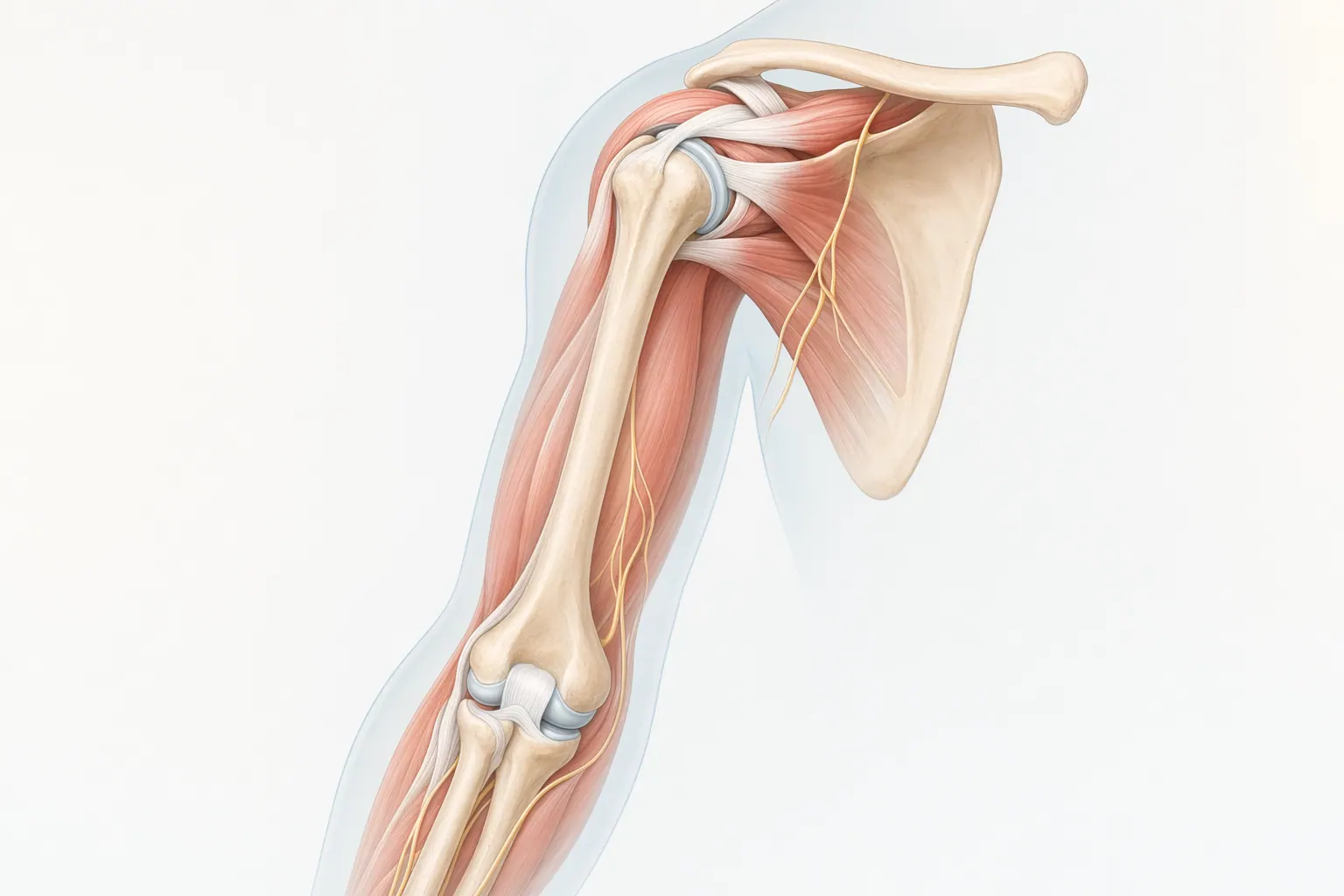
Anatomical illustration of the lateral elbow showing the lateral epicondyle and common extensor tendon insertion
Anatomy of the lateral elbow — the common extensor tendon attaches at the lateral epicondyle, with the ECRB (extensor carpi radialis brevis) the most commonly involved.
Anatomy

Inside the elbow.

The outside of your elbow is where the muscles that lift your wrist and fingers all share a single attachment point — the lateral epicondyle. The biggest contributor in tennis elbow is a tendon called the ECRB (extensor carpi radialis brevis). Every time you grip, type, or lift with your palm down, that tendon is loaded. Repeat it enough without recovery and the fibers start to break down faster than they can rebuild.

Self-orient

When tennis elbow shows up.

Symptoms

Common symptoms

  • Sharp, burning, or aching pain at the outside of the elbow
  • Tenderness right on the bony bump (lateral epicondyle)
  • Weak grip — dropping things, struggling to open jars
  • Pain shooting down into the forearm with use
  • Pain shaking hands, turning doorknobs, or lifting with palm down
  • Stiffness in the morning that eases briefly, then returns
  • Pain that wakes you when you roll onto the arm at night
  • Soreness that lingers hours after typing, mousing, or lifting
Causes

Common causes

  • Repetitive gripping at work (tools, knives, hairdressing scissors)
  • Long hours on a keyboard and mouse, especially with poor wrist posture
  • Racquet sports — particularly with a too-tight grip or heavy racquet
  • Manual trades: painting, plumbing, carpentry, electrical work
  • Sudden ramp-up in lifting or strength training (curls, rows, deadlifts)
  • Age-related tendon changes — most common in patients 30 to 50
  • Carrying car seats, strollers, or toddlers in a chronic palm-down grip
Diagnostics

How we diagnose tennis elbow.

Diagnosing tennis elbow is largely a clinical decision — meaning most of the work is done at your visit, not in the imaging suite. Our specialists palpate the lateral epicondyle to find the exact spot of tenderness, then run a few provocative tests: resisted wrist extension with the elbow straight (Cozen's test), resisted middle-finger extension (Maudsley's test), and resisted forearm rotation (Mill's test). If those reproduce your pain, you almost certainly have tennis elbow.

We still take X-rays at your first visit at most of our offices. Not because they show tennis elbow — they don't — but because they rule out things that mimic it: arthritis, a loose body in the joint, a stress reaction in the bone, or calcium deposits in the tendon. Ultrasound is a quick, in-office way to see the tendon itself and grade the degree of tendinosis or any partial tearing. MRI is reserved for cases that have been going on for many months, haven't responded to treatment, or where we suspect something else — like a partial tear of the common extensor origin, a ligament injury, or radial tunnel syndrome (a nerve compression that can masquerade as tennis elbow).

The other thing we look for is what's actually driving it. Tennis elbow is almost always a mechanical loading problem. We ask about your work setup, your grip style, your training, what you do with your hands all day. That's not chitchat — it's the difference between treating the pain and fixing the cause. You'll leave your first visit with a diagnosis, a clear treatment plan, and the specific changes you need to make today.

Treatment options

How we treat tennis elbow.

The overwhelming majority of tennis elbow patients get better without surgery. Our job is to compress the timeline from "a year of nagging pain" to "meaningful relief in a few months." We start conservative, escalate only when needed, and reserve procedures for the cases that genuinely call for them.

Conservative care
Step 1

Conservative care first

Tendon problems heal with controlled loading and time, not pure rest. The plan is built around both.

  • Activity and ergonomic modification — desk setup, grip size, technique
  • Counterforce brace (the small strap worn just below the elbow)
  • Wrist extensor splint at night for severe cases
  • Eccentric strengthening — the Tyler twist with a FlexBar
  • Physical or occupational therapy through your in-network provider
  • Ice and short courses of NSAIDs for symptom control
  • Topical anti-inflammatories (diclofenac gel) for targeted relief
Surgical care
When needed

Procedures when needed

If 3–6 months of conservative care hasn't moved the needle, we have several next steps before we ever get near an operating room.

  • Corticosteroid injection — short-term relief, used selectively
  • PRP (platelet-rich plasma) injection — better long-term evidence than steroid
  • Ultrasound-guided percutaneous tenotomy (TenJet / Tenex)
  • Botulinum toxin injection in select refractory cases
  • Open or arthroscopic debridement of the ECRB tendon (rare)
  • Repair of full-thickness tendon tears (uncommon presentation)
Surgeon expertise

Why experience matters.

Why experience matters

Tennis elbow looks simple from the outside. In practice, it's a condition where the difference between "a year of frustration" and "meaningful relief in three months" comes down to specifics — brace fit, exercise dosing, injection choice, ergonomic detail.

  • Accurate diagnosis (and ruling out the mimics: radial tunnel, arthritis)
  • Coaching on the Tyler twist done correctly, not just prescribed
  • Ergonomic guidance specific to your actual job or sport
  • Injection selection — knowing when PRP outperforms cortisone, and when neither is right

The LAOSS approach

Our upper-extremity specialists move stepwise — start with the least-invasive option that fits your situation, escalate only when it doesn't.

  • Same-day evaluation and imaging at most offices
  • Direct PT coordination through your in-network provider
  • Board-certified surgeons performing any procedure themselves
  • Direct access to your specialist between visits
Candidacy

Am I a candidate?

If most of these match your situation, an evaluation with an elbow specialist is the next step.

You may be

You may be a candidate if

These signs typically point toward an in-person evaluation with an elbow specialist.

  • Outside-of-elbow pain that has lasted more than two weeks
  • Weak grip, dropping objects, or pain shaking hands
  • Pain that flares with typing, lifting, or sport and won't settle
  • Tried rest and over-the-counter measures with no real improvement
  • Previous treatment (including injections) that didn't fully resolve it
Evaluation

What evaluation includes

Your first visit is built to give you an answer the same day, not just another referral.

  • Detailed history — onset, work setup, sport, daily aggravators
  • Hands-on exam with provocative testing of the elbow and forearm
  • On-site X-ray and ultrasound at most offices
  • Clear plan with options from bracing and PT to injection or surgery
  • Same-day or next-day scheduling for any follow-up imaging
ImportantSeek urgent evaluation for sudden severe elbow pain after trauma, numbness or tingling in the hand that won't resolve, progressive weakness in the fingers, or any sign of infection (fever, spreading redness or swelling).
Self-care that works

Two things to start today.

Before your appointment — and during treatment — these two changes do more than almost anything else.

Exercise

The Tyler twist (eccentric loading)

This is the single best-supported exercise for tennis elbow in the orthopedic literature. It uses a rubber FlexBar to load the tendon eccentrically — the part of muscle work that drives tendon remodeling.

  • Hold the FlexBar vertically with the painful arm, palm facing you
  • Grip the top with the other hand and twist the bar so both wrists are flexed
  • Now straighten both elbows out in front of you, bar held horizontally
  • Slowly let the painful side untwist over 3–4 seconds — that's one rep
  • 3 sets of 15, once a day, for 6–12 weeks. Mild soreness is expected and OK.
Brace

The counterforce brace

A small strap worn about two finger-widths below the elbow. It changes how force travels through the tendon, taking load off the painful insertion.

  • Wear it during the activity that aggravates the elbow — not all day
  • Position the pad over the muscle belly of the forearm, not the bone
  • Snug, not tight — you should be able to fit a finger underneath
  • Most patients feel a difference the same day they start using it
  • Use it as a bridge while the tendon rebuilds — not as a permanent fix
Recovery

Your tennis elbow recovery roadmap.

Tendons heal slower than muscle or bone — but with the right loading plan, the curve is predictable. Here's what to expect.

01Weeks 0–4

Calm it down

The first month is about quieting the tendon enough to start loading it. We modify the loads that are driving it and start the basics.

  • Activity modification — adjust grip, posture, desk setup
  • Counterforce brace during aggravating activities
  • Ice 10–15 minutes after use; topical or oral NSAIDs as needed
  • Begin gentle wrist mobility and forearm stretching
02Weeks 4–12

Rebuild the tendon

This is where the real healing happens. Eccentric loading remodels the tendon — but only if it's done consistently.

  • Daily Tyler twist (FlexBar) progression — 6–12 week course
  • Progressive grip and forearm strengthening with PT
  • Sport- or job-specific re-training (technique, grip size, ergonomics)
  • Reassessment at 6 weeks — escalate to injection if no progress
03Months 3+

Return and prevent

Once pain is gone and grip strength is back, the focus shifts to staying there — and catching any recurrence early.

  • Gradual return to full sport, training, or work load
  • Maintenance forearm program 2–3x per week
  • Permanent ergonomic changes (grip size, mouse, racquet tension)
  • Direct line back to your specialist if symptoms creep back
Risks & considerations

What to weigh before you decide.

We talk through risks and benefits with every patient — informed consent is a conversation, not a form.

General

General considerations

Most tennis elbow treatment carries very low risk. The trade-offs are mostly about time and which intervention to pick.

  • NSAID side effects (stomach, kidney) with prolonged use
  • Brace skin irritation if worn too tight or for too long
  • PT progress requires consistency — skipped weeks set the timeline back
  • Patience: tendon remodeling is measured in months, not weeks
Specific

Injection & procedure-specific

When we move to a procedure, the risk profile shifts — and so does the conversation about which to choose.

  • Cortisone: fast short-term relief, but worse long-term outcomes and possible skin/fat thinning at the site
  • PRP: stronger long-term evidence, but more upfront soreness for 5–7 days
  • Tenotomy procedures: small risk of nerve irritation, bleeding, or incomplete relief
  • Surgery (rare): typical risks of infection, stiffness, or incomplete pain relief
Your care team

Meet the elbow specialists at LAOSS.

At LAOSS, you'll find personalized, accessible elbow care led by board-certified orthopedic surgeons with deep expertise in tendon disorders, sports injuries, and upper-extremity reconstruction. Many of our shoulder and elbow specialists trained in busy sports-medicine fellowships and see tennis elbow every week — which matters, because experience is what separates a six-week recovery from a six-month one. From your first evaluation through treatment, our team will explain what's actually happening at the tendon, what you can do today, and what comes next if it doesn't settle.

Patient reviews

What patients say about us.

★★★★★4.97,500+ Google reviews
Dr. Bastian figured out my elbow in 15 minutes after months of being told it was just "tennis elbow, rest it." Brace, the FlexBar exercise, and a PRP injection later — I'm back to lifting and typing without pain.
Marcus Johnson
Long Beach, CA · 19 March 2025
Explore related care

Find care by body area.

Jump to a nearby condition page and compare treatment paths across the body.

FAQ

Common tennis elbow questions

  • Usually no — and complete rest often doesn't help anyway. Tendons heal in response to controlled loading, not complete unloading. We'll have you modify the activity (grip size, technique, total volume, racquet string tension, mouse position, tool grip) rather than stop it cold. The exception is the first 1–2 weeks of a really acute flare, where dialing back significantly can help calm things down before you start the strengthening program.
  • Most cases do eventually resolve — research suggests roughly 80–90% improve within 6–12 months without any specific treatment. The problem is that 6–12 months is a long time to live with pain, and during that window most patients keep doing the thing that's causing it. Treatment doesn't just "hope for healing" — it actively shortens the timeline through eccentric strengthening, bracing, and ergonomic change, and identifies the patients who need more than that.
  • Sometimes — but the evidence has shifted significantly. Cortisone is excellent at giving fast, short-term relief (a few weeks to a few months). But the best long-term studies show patients who receive cortisone often do worse at 6 and 12 months than patients who received no injection or who received PRP. We use cortisone selectively — usually when a patient absolutely needs short-term function back (an important event, a critical work deadline) and we're pairing it with a strengthening program.
  • For tennis elbow specifically, yes — the long-term evidence favors PRP (platelet-rich plasma). PRP works with the tendon's natural healing process rather than just suppressing inflammation. The trade-off is that PRP is more sore for the first 5–7 days, takes 6–12 weeks to show its full effect, and is often not covered by insurance. We talk through whether it's the right call for your situation at your visit.
  • The Tyler twist — done with a rubber FlexBar — has the strongest evidence of any single exercise for tennis elbow. It works because it loads the tendon eccentrically (during the slow, controlled lengthening of the muscle), and eccentric loading is what triggers tendon remodeling. Done correctly for 6–12 weeks, it resolves a meaningful percentage of cases. We'll demonstrate it at your visit and coordinate with PT to make sure you're doing it right — bad form is the most common reason it "didn't work."
  • Tendons heal slowly. They don't have the rich blood supply muscle has, so the remodeling process is measured in months, not days. On top of that, most patients never change what's loading the tendon in the first place — the mouse, the grip, the technique, the volume. Without that change, every day of "healing" is followed by another day of re-injury. The reason tennis elbow that's been there a year often resolves quickly once you see a specialist isn't magic — it's that we identify and fix the loading problem the same week we diagnose it.
  • Almost never. Fewer than 10% of tennis elbow patients ultimately go to surgery, and we only consider it after 6–12 months of well-executed conservative care has failed. When it is needed, it's usually a debridement of the diseased part of the ECRB tendon, done either open or arthroscopically. Recovery is typically 3–6 months back to full activity. Most patients who come to us thinking they need surgery actually need a better conservative plan.
  • Absolutely — it's one of the most common drivers we see, especially since the shift to long work-from-home days. A mouse that's too small for your hand forces a sustained grip. A keyboard angled the wrong way puts the wrist in extension all day. An armrest that's too high makes the forearm muscles work to hold the hand in place. We'll walk through your setup at the visit and give you specific changes — most of them free or under $50 — that can meaningfully reduce the daily load on the tendon.
Ready when you are

Don't wait on elbow pain.

Book a visit with an elbow specialist at any of our eight Los Angeles–area offices. Most tennis elbow patients leave their first visit with a diagnosis, a brace, and the exact exercise plan that starts working that week.

Booking now
21 specialists · 8 offices
Greater Los Angeles
On-site X-raySame visit
Most insurers acceptedIn-network
Call usBook online