Los Angeles Orthopedic

MACI vs Microfracture for knee cartilage repair

Two very different operations for focal knee cartilage defects — and the right answer is almost always about your lesion size, your age, and your activity goals. LAOSS sports-medicine surgeons walk through the decision honestly: when microfracture is enough, when MACI is worth the two-stage commitment, and when neither is the right call.

MACI vs microfracture comparison for knee cartilage repair — LAOSS board-certified sports surgeons in Los Angeles
Live · Now Accepting

Both have a role.

We match the technique to your lesion, not the other way around.

15+
Years caring
Same-day appointments
Often available
★★★★★
4.9 · 7,500+ reviews

Patients who ask this question typically have

  • A focal cartilage defect on MRI (not widespread arthritis)
  • Failed conservative care — PT, injections, rest
  • Pain, catching, or swelling that limits running or sport
  • A prior microfracture that didn't hold up
  • A surgeon who recommended one option without explaining the other

What LAOSS brings to the decision

  • Board-certified sports surgeons doing both procedures routinely
  • MRI read and lesion-matched plan at your first visit
  • Honest framing — neither operation is universally better
  • Insurance pre-authorization handled in-house
Key takeaways
  • Microfracture is a single arthroscopic procedure that drills the subchondral bone to recruit marrow cells. It heals the defect with fibrocartilage (not true hyaline). Best for small defects under 2 cm² in younger patients. Lower cost, insurance-covered, 6–9 month recovery, durability often declines after 2–5 years.
  • MACI is a two-stage procedure: an arthroscopic biopsy of healthy cartilage, then six weeks of lab culture on a collagen membrane, then a mini-arthrotomy to implant the membrane. It produces hyaline-like cartilage. Best for defects 2–10 cm². Insurance typically covers when criteria are met; 9–12 month recovery; more durable long-term.
  • Both operations require an intact meniscus and proper alignment. Concurrent procedures — meniscus repair, ligament reconstruction, or an osteotomy — are often needed in the same setting and dramatically affect the outcome.
  • Defect size is the most decisive variable. Under ~2 cm² and microfracture is usually reasonable. Over ~4 cm² and MACI is usually the more durable choice. The 2–4 cm² range is a judgment call driven by age, activity, alignment, and prior surgery.
Overview

Microfracture and MACI, side by side.

Microfracture and MACI are both joint-preserving operations for focal articular cartilage defects in the knee — usually on the femur (top of the thigh bone) or the patella (kneecap). They share a goal (restore the smooth cartilage surface so the joint glides again) and a population (active patients with a defined cartilage hole, not widespread arthritis). They differ in almost everything else.

Microfracture is the older of the two. The surgeon arthroscopically cleans up the defect and then makes small holes in the underlying subchondral bone using an awl or drill. Those holes release marrow cells that form a clot in the defect. Over the following months, the clot remodels into fibrocartilage — a repair tissue that looks similar to native cartilage but is mechanically inferior. It's covered by insurance, done in one operation, and recovery runs about 6–9 months. The downside: fibrocartilage tends to wear down faster, and outcomes for many patients decline noticeably between years 2 and 5, especially for larger defects.

MACI (Matrix-Induced Autologous Chondrocyte Implantation) is a two-stage procedure. Stage one is an arthroscopic biopsy where your surgeon harvests a small piece of healthy cartilage from a non-weight-bearing area. That sample is shipped to a specialty lab, where your own chondrocytes are grown for about six weeks on a porcine collagen membrane. Stage two is a mini-arthrotomy — a small open incision — to implant the cell-seeded membrane into the prepared defect. The repair tissue that grows in is hyaline-like cartilage, far closer to your native cartilage in structure and durability. The trade-offs: two surgeries, a longer 9–12 month recovery, higher cost, and insurance pre-authorization. The upside is a more durable repair, especially for larger defects (roughly 2–10 cm²).

The honest answer to which is better is: it depends on the lesion. A 1 cm² defect in a 25-year-old usually does fine with microfracture. A 6 cm² defect in a 45-year-old who wants to keep running marathons is almost always better served by MACI. The 2–4 cm² range is where the conversation gets nuanced — and where having a surgeon who does both routinely matters most.

Patient education

Watch: Autologous Chondrocyte Implantation (ACI)

MACI is the modern, membrane-based evolution of ACI. This animation shows the two-stage workflow — biopsy, lab culture, then implantation — that distinguishes cell-based cartilage repair from marrow-stimulation techniques like microfracture.

Animations licensed from ViewMedica · Swarm Interactive

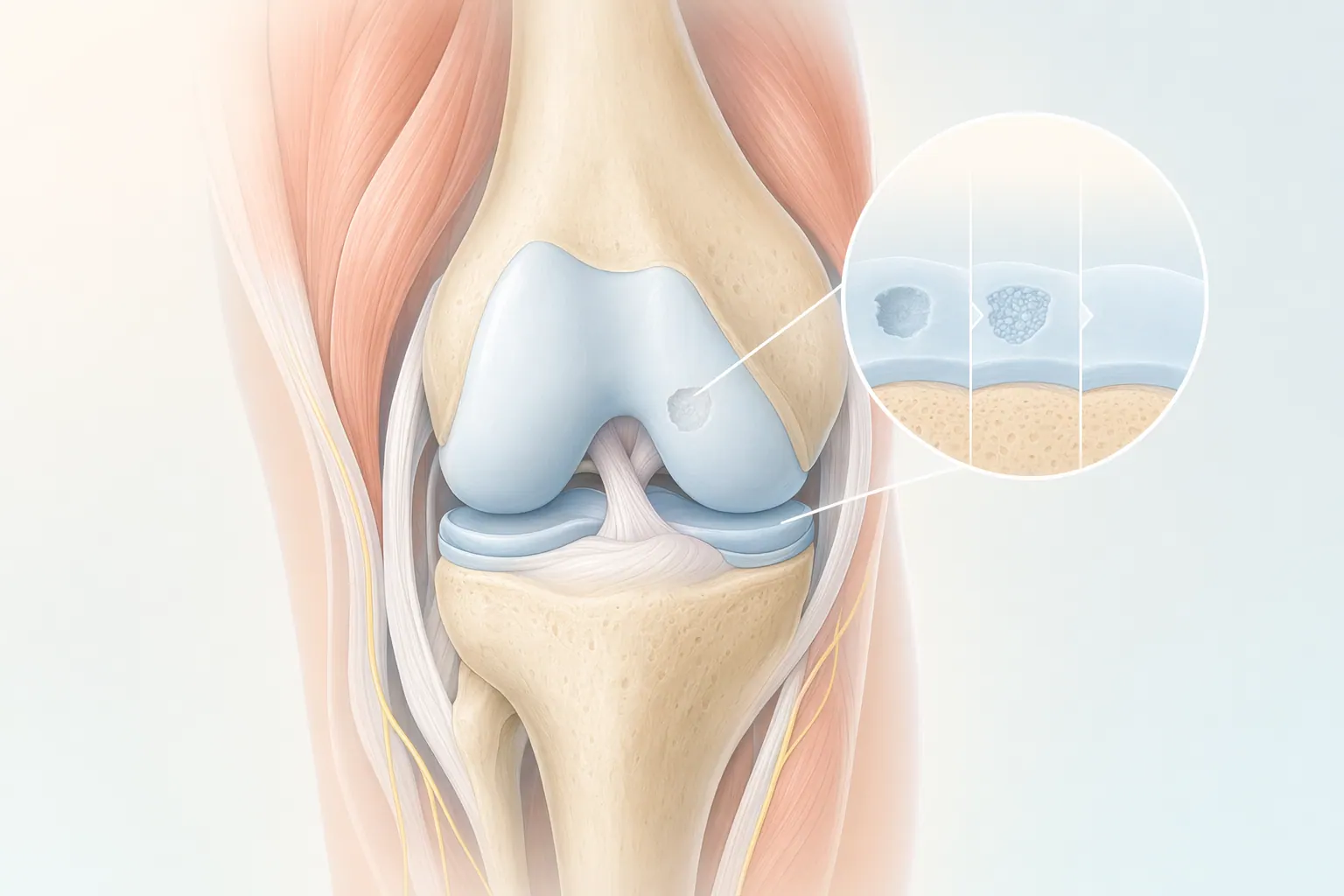
Illustration comparing microfracture marrow stimulation and MACI membrane implantation for knee cartilage repair
Microfracture vs MACI — same goal, very different biology.
How they work

Two ways to rebuild cartilage.

Microfracture works from the bottom up: by penetrating the subchondral bone, the surgeon releases pluripotent marrow cells that form a clot in the defect and remodel into fibrocartilage over 6–9 months. MACI works from the top down: your own chondrocytes are harvested, expanded for six weeks on a collagen membrane, and then implanted into the prepared defect — where they organize into hyaline-like cartilage that more closely matches your native joint surface. Hyaline cartilage is what was there before; fibrocartilage is the body's best attempt at a substitute.

Self-orient

When you might need cartilage reconstruction.

Symptoms

Common symptoms

  • Focal cartilage defect identified on MRI
  • Persistent knee pain after a pivoting or impact injury
  • Catching, locking, or giving way in the joint
  • Swelling that returns with activity
  • Osteochondritis dissecans (OCD) lesion
  • Loose body or unstable cartilage flap on imaging
  • Failed prior microfracture with recurrent symptoms
  • Full-thickness chondral damage on the femur, tibia, or patella
Causes

Common causes

  • Acute sports injury — soccer, basketball, skiing, football
  • ACL or meniscus tear that overloaded the cartilage before it was treated
  • Childhood or adolescent osteochondritis dissecans that progressed
  • Patellar dislocation that sheared cartilage off the kneecap or trochlea
  • Repetitive high-impact loading over years that wore through to bone
Diagnostics

How we decide which operation fits.

Both microfracture and MACI start with the same diagnostic workup, because the decision is driven by what we actually see on imaging.

Your first visit includes a focused history (mechanism of injury, prior surgeries, what aggravates symptoms, your activity goals), a hands-on knee exam, and same-day X-ray to assess alignment, joint space, and any underlying bony causes. When a focal cartilage lesion is suspected, we order an MRI with cartilage-specific sequences — typically a 3T scan with high-resolution mapping that lets us measure the defect in two dimensions and assess the depth and the state of the underlying subchondral bone.

The MRI gives us the four variables that drive the decision: size (in cm²), depth (chondral only vs. osteochondral), location (femoral condyle, trochlea, patella, tibial plateau), and the rest of the joint (meniscus status, alignment, ligament integrity, any kissing lesion on the opposing surface). With those numbers in hand, the technique choice is usually straightforward — and we walk you through the reasoning, not just the recommendation.


Decision framework

Microfracture-first vs MACI-first decision framework

Neither operation is universally better. The decision turns on the lesion itself, the rest of the joint, and what you want to be doing in five and ten years. Here's the framework LAOSS surgeons use — the same one we'll walk through with you at your visit.

Conservative care
Step 1

Microfracture-first profile

Microfracture is the right starting point when the defect is small, the patient is younger, and a single straightforward operation is the priority.

  • Defect under ~2 cm² (sometimes considered up to 2.5 cm² in lower-demand patients)
  • Younger patient — typically under 30–35 — with healthy surrounding cartilage
  • Lower-demand activity goals or willingness to modify high-impact sport
  • Intact subchondral bone (no significant bone involvement)
  • Single procedure preferred, with the lower up-front cost and shorter timeline to surgery day
  • Insurance covers it without pre-authorization friction
Surgical care
When needed

MACI-first profile

MACI is worth the two-stage commitment when the defect is larger, the patient wants durable repair tissue, and a higher-demand activity life is on the table.

  • Defect 2–10 cm² (the sweet spot for MACI is roughly 3–8 cm²)
  • Active patient who wants to keep running, lifting, or pivoting long-term
  • Multiple focal defects can be addressed in one MACI operation
  • Prior microfracture that failed — MACI is a well-established salvage
  • Patellar or trochlear defects, where fibrocartilage often doesn't hold up under shear load
  • Patient is willing to commit to a 9–12 month recovery for a more durable result
Cost & insurance

What you'll actually pay.

Cost is rarely the deciding factor for cartilage reconstruction — both procedures are typically covered when medical necessity is documented — but it does shape the timeline. Here's how the two compare in practice.

Microfracture

Microfracture — cost & coverage

Microfracture is the lower-friction option financially and administratively, which is why it's still often the first cartilage operation a patient is offered.

  • Insurance covered by nearly every commercial and Medicare plan — usually no pre-authorization required
  • Single arthroscopic procedure, typically day-surgery
  • Lower facility and surgeon fees than MACI
  • No lab biopsy step, no cell-culture cost, no second operation
  • Out-of-pocket cost depends on your deductible, copay, and any concurrent procedures
MACI

MACI — cost & coverage

MACI is more expensive on paper, but in our experience it's covered for the majority of medically appropriate patients — with paperwork the LAOSS team handles in-house.

  • Pre-authorization required by most insurers; cash list price for the cells alone runs roughly $30,000–$50,000
  • Two operations (arthroscopic biopsy, then mini-arthrotomy implantation about six weeks later)
  • Coverage criteria typically: documented focal full-thickness defect, failed conservative care, appropriate size, no advanced arthritis
  • Our team submits pre-auth and tracks it to a decision before scheduling stage two
  • If MACI is denied, we'll tell you up front — we don't proceed to biopsy without coverage clarity
Candidacy

Am I a candidate for one — or either?

Both procedures share the same baseline candidacy criteria. The split happens after that, on lesion size and durability priorities.

You may be

Patient archetypes

These rough profiles are how we think about candidacy in clinic — not a hard rule, but the pattern we see most often.

  • Under 30, 1 cm² femoral defect, weekend basketball — microfracture is reasonable
  • 32 years old, 3 cm² trochlear defect, recreational runner — MACI usually wins on durability
  • 45 years old, 6 cm² femoral defect, wants to keep skiing for 20 more years — MACI
  • 28 years old, failed microfracture two years ago, defect now 4 cm² — MACI as salvage
  • 55 years old with diffuse arthritis on imaging — neither; the conversation shifts to other joint-preserving or replacement options
Evaluation

What evaluation includes

We'll give you a real answer the same day — including a candid read on whether either operation actually fits your case.

  • Detailed history — mechanism, prior surgeries, activity goals, what you've already tried
  • Hands-on knee exam — alignment, tracking, ligament integrity, effusion
  • Same-day X-ray; MRI ordered with cartilage-specific protocol when needed
  • Lesion measurement and a recommendation: microfracture, MACI, OATS, allograft, or none
  • Insurance verification and timeline for whichever path you choose
ImportantSeek urgent evaluation for sudden severe knee pain after an injury, locking that won't release, rapid swelling, or any sign of infection (fever, increasing redness, or warmth at a surgical site).
Recovery

Recovery timeline, side by side.

Both operations follow a protected-loading model — the repair has to mature before it can take full weight. MACI runs about three months longer end-to-end, but the phase structure is similar.

01Weeks 0–6

Protected phase — both

Early protection is non-negotiable for both procedures. The repair tissue (fibrocartilage clot for microfracture, cell-seeded membrane for MACI) is at its most fragile in the first six weeks.

  • Crutches with protected weight-bearing — typically 4–6 weeks per surgeon protocol
  • Continuous passive motion or daily range-of-motion work from day one
  • Brace per protocol; ice and elevation; pain managed without high-dose NSAIDs (which can blunt healing)
  • Quad activation and gentle hip strengthening start immediately
02Weeks 6–16

Progressive rehab — both

Load increases on a schedule. MACI typically lags microfracture by 2–4 weeks at each milestone because the membrane takes longer to integrate.

  • Progressive weight-bearing and gait normalization
  • Strengthening, proprioception, neuromuscular control
  • Stationary cycling, pool work, elliptical added in
  • PT coordinated through your in-network provider
03Months 4–12

Return to activity — diverges

Microfracture patients often clear for light running around month 4–5 and sport around 6–9. MACI patients clear for running closer to month 6 and sport at 9–12 — with a one-year MRI to confirm repair maturation.

  • Microfracture: run 4–5 mo, sport 6–9 mo, durability re-checked at 2 years
  • MACI: run 6 mo, sport 9–12 mo, one-year MRI standard
  • Functional benchmarks (single-leg squat, hop testing) gate each milestone
  • Maintenance plan to protect the joint long-term — alignment, strength, load management
Risks & considerations

What to weigh before you decide.

Both operations are safe in experienced hands, but each has its own profile of risks and failure modes. These are part of every pre-op conversation at LAOSS.

Microfracture

Microfracture — risks & limits

Microfracture is technically straightforward, but its biology has real ceilings — especially for larger defects and higher-demand patients.

  • Fibrocartilage repair tissue is mechanically weaker than native hyaline
  • Outcomes often decline between years 2 and 5, especially for defects over 2 cm²
  • Subchondral bone changes (intralesional osteophytes, cysts) can develop and complicate future MACI
  • Generally not recommended for patellar or trochlear lesions in active patients — shear loads are unforgiving on fibrocartilage
  • Standard arthroscopic risks: infection (rare), stiffness, swelling, DVT
MACI

MACI — risks & limits

MACI's failure modes are more about logistics and the two-stage timeline than the biology itself, which is generally more favorable than fibrocartilage.

  • Two operations, two anesthetics, six-week wait between biopsy and implantation
  • Mini-arthrotomy (small open incision) rather than purely arthroscopic — slightly longer recovery from the skin incision itself
  • Cell-culture failure is rare but possible; graft hypertrophy or delamination occurs in a small percentage
  • Pre-authorization can delay or — uncommonly — deny coverage; we resolve this before stage two
  • Standard surgical risks: infection (rare), stiffness, swelling, DVT
Your care team

The LAOSS surgeons who do both.

Cartilage reconstruction is one of the most technique-dependent operations in orthopedics — and the surgeons who do it well do both microfracture and MACI routinely, so the recommendation isn't biased by what they're comfortable performing. At LAOSS, our sports-medicine team matches the procedure to your MRI and your goals, not to a preferred technique.

Patient reviews

What patients say about us.

★★★★★4.97,500+ Google reviews
5 stars. Got in same day for a soccer injury, X-ray right there in the office, had a plan before I left. Couldn't ask for more.
Diego Martinez
Boyle Heights, CA · 22 April 2025
Explore related care

Find care by body area.

Jump to a nearby condition page and compare treatment paths across the body.

FAQ

MACI vs microfracture — common questions

  • Defect size is the single most decisive variable. Under about 2 cm², microfracture is usually reasonable — especially in younger, lower-demand patients. Between 2 and 4 cm², it's a judgment call driven by age, activity level, location (femoral condyle vs. patella/trochlea), and whether the underlying bone is involved. Above 4 cm² — and certainly in the 4–10 cm² range — MACI is almost always the more durable choice. Your surgeon measures the defect in two dimensions on MRI before recommending, so the conversation is grounded in actual numbers, not impressions.
  • Yes — failed microfracture is one of the most common indications we see for MACI. The catch is that microfracture changes the subchondral bone underneath the defect (intralesional osteophytes and cysts can develop), and that bone bed makes the subsequent MACI technically harder and sometimes less durable than a primary MACI on a virgin defect. Studies show MACI after failed microfracture still works, but outcomes are modestly worse than MACI as the first operation. That's why we have a candid conversation up front about whether microfracture is really the right starting point for your specific lesion.
  • For microfracture, most patients clear for light running around 4–5 months and recreational sport around 6–9 months, depending on the defect and your progression through PT benchmarks. For MACI, the same milestones come about three months later: light running around 6 months and pivoting or contact sport around 9–12 months, typically gated by a one-year MRI confirming repair maturation. Pushing those timelines doesn't speed healing — it's the most common way patients compromise the result.
  • Maybe — but the goal of either operation is to delay or avoid that conversation by a decade or more, not to guarantee you never need it. A well-selected, well-executed cartilage reconstruction in a young patient can buy 10–20+ years of native joint function. MACI tends to be more durable than microfracture for larger defects, but both can fail eventually, especially if alignment, weight, or activity load isn't managed. If diffuse arthritis develops later, partial or total knee replacement is still on the table — and you'll have spent the intervening years on your own joint, which is the whole point.
  • MACI is covered by most commercial and Medicare plans when medical-necessity criteria are met — typically a documented focal full-thickness defect of appropriate size, failed conservative care, and no advanced arthritis. Coverage almost always requires prior authorization, which our team submits and tracks before scheduling stage two. The cash list price for the cells alone is roughly $30,000–$50,000, but in our practice the large majority of medically appropriate patients are covered. If pre-auth comes back as denied or ambiguous, we tell you before the biopsy — we don't proceed without coverage clarity.
  • MACI has a real advantage here — multiple focal defects can be treated in the same operation by harvesting one biopsy and culturing enough cells to cover all of them. Microfracture can also treat multiple defects in one setting, but the fibrocartilage repair is independently weaker at each site, so the durability calculus gets worse the more defects you have. If you have two or more focal defects, the conversation usually leans MACI — especially if any one of them is over 2 cm².
  • Reasonable published estimates: microfracture has good short-term outcomes (1–2 years) but failure rates climb to roughly 20–40% by 5 years for defects over 2 cm², and higher for patellar/trochlear lesions. MACI has 5-year success rates in the 80–90% range for appropriate candidates, with durable outcomes documented out to 10+ years in long-term registries. 'Failure' here usually means persistent or recurrent symptoms severe enough to warrant another procedure — not necessarily catastrophic graft loss. Your individual risk depends on lesion size, location, alignment, your weight, and your activity load.
  • Because the cells have to be harvested before they can be grown. Stage one is a short arthroscopic procedure to biopsy a small piece of healthy cartilage from a non-weight-bearing area of your knee. That sample goes to a specialty lab, where your own chondrocytes are expanded over about six weeks on a porcine collagen membrane — there's no way to skip this step. Stage two is the actual implantation: a mini-arthrotomy (small open incision) to prepare the defect and secure the cell-seeded membrane in place. The two-stage timeline is the price of admission for getting hyaline-like repair tissue instead of fibrocartilage.
Ready when you are

Get a real answer on your defect.

Book a visit with a cartilage reconstruction specialist at any of our eight Los Angeles–area offices. We'll review your MRI, measure the defect, and walk through microfracture vs MACI for your specific case.

Booking now
21 specialists · 8 offices
Greater Los Angeles
On-site X-raySame visit
Most insurers acceptedIn-network
Call usBook online