Los Angeles Orthopedic

Genicular nerve ablation vs steroid injection for knee arthritis pain.

You've already tried physical therapy, NSAIDs, and probably a cortisone shot or two — and you're not ready (or not eligible) for a knee replacement. Here's how LAOSS pain management specialists decide between a repeat steroid injection and radiofrequency genicular nerve ablation when chronic knee OA pain won't quit.

Genicular nerve ablation vs cortisone injection for chronic knee arthritis pain at LAOSS — board-certified Los Angeles pain management physicians
Live · Now Accepting

Two procedures, very different timelines.

Cortisone calms the joint for weeks. Ablation quiets the nerves for months.

6–12 mo
Ablation duration
Same-day appointments
Often available
★★★★★
4.9 · 7,500+ reviews

What patients ask us most

  • How long does radiofrequency ablation actually last?
  • Will my insurance cover genicular nerve ablation?
  • If cortisone stopped working, will ablation work?
  • Is ablation a way to avoid knee replacement?
  • What is the diagnostic nerve block — and do I have to do it?

What sets LAOSS apart

  • Pain management physicians fellowship-trained in image-guided procedures
  • Diagnostic genicular nerve block first — we don't ablate blindly
  • Honest framing — ablation isn't a cure, and we say so
  • Eight LA-area offices with on-site ultrasound and fluoroscopy access
Key takeaways
  • Cortisone injection lasts 4–12 weeks. Radiofrequency genicular nerve ablation lasts 6–12 months. Same goal — pain relief — very different timelines.
  • Neither procedure cures knee arthritis. The cartilage damage keeps progressing. Both are pain management, not disease modification.
  • Both are typically covered by commercial insurance and Medicare when conservative care has failed. Ablation requires a diagnostic nerve block first to predict response.
  • Genicular nerve ablation is best for patients who aren't ready for total knee replacement (too young, too active, want to defer) or can't have TKR (medical contraindication).
  • About 70–80% of properly selected patients get at least 50% pain relief from ablation. The nerves regrow over 6–12 months, so the procedure is repeatable.
Overview

Two ways to quiet a painful knee.

If you've been living with chronic knee osteoarthritis pain — the kind that hasn't given way to physical therapy, oral medications, or activity modification — there's a decent chance you've already had at least one cortisone injection. Maybe it helped for a couple of months. Maybe it helped less than the time before. And the conversation has started to drift toward knee replacement.

For patients who aren't ready for a total knee replacement, aren't candidates for one (because of age, medical comorbidities, or surgical risk), or simply want to defer the operation as long as possible, there's a middle option that often gets overlooked: radiofrequency genicular nerve ablation.

Cortisone injection delivers a potent anti-inflammatory steroid directly into the knee joint. It calms the inflammatory chemistry driving your pain. It's been the workhorse of nonsurgical knee OA care for decades — fast, cheap, covered, and effective for 4–12 weeks.

Radiofrequency genicular nerve ablation (RFA) is different. Instead of going after inflammation inside the joint, RFA uses radiofrequency energy to interrupt the sensory nerves that carry pain signals from the knee to the brain — specifically the superior medial, superior lateral, and inferior medial genicular nerves. The joint is still arthritic. The nerves that report it to the brain are quieted. Relief lasts 6–12 months in most responders, after which the nerves regrow and the procedure can be repeated.

This page walks through how LAOSS pain management specialists choose between them — honestly, without overselling either option.

Patient education

Watch: Treating chronic knee pain

A short overview of how image-guided procedures — from joint injections to nerve-targeted treatments — fit into the treatment ladder for knee osteoarthritis pain.

Animations licensed from ViewMedica · Swarm Interactive

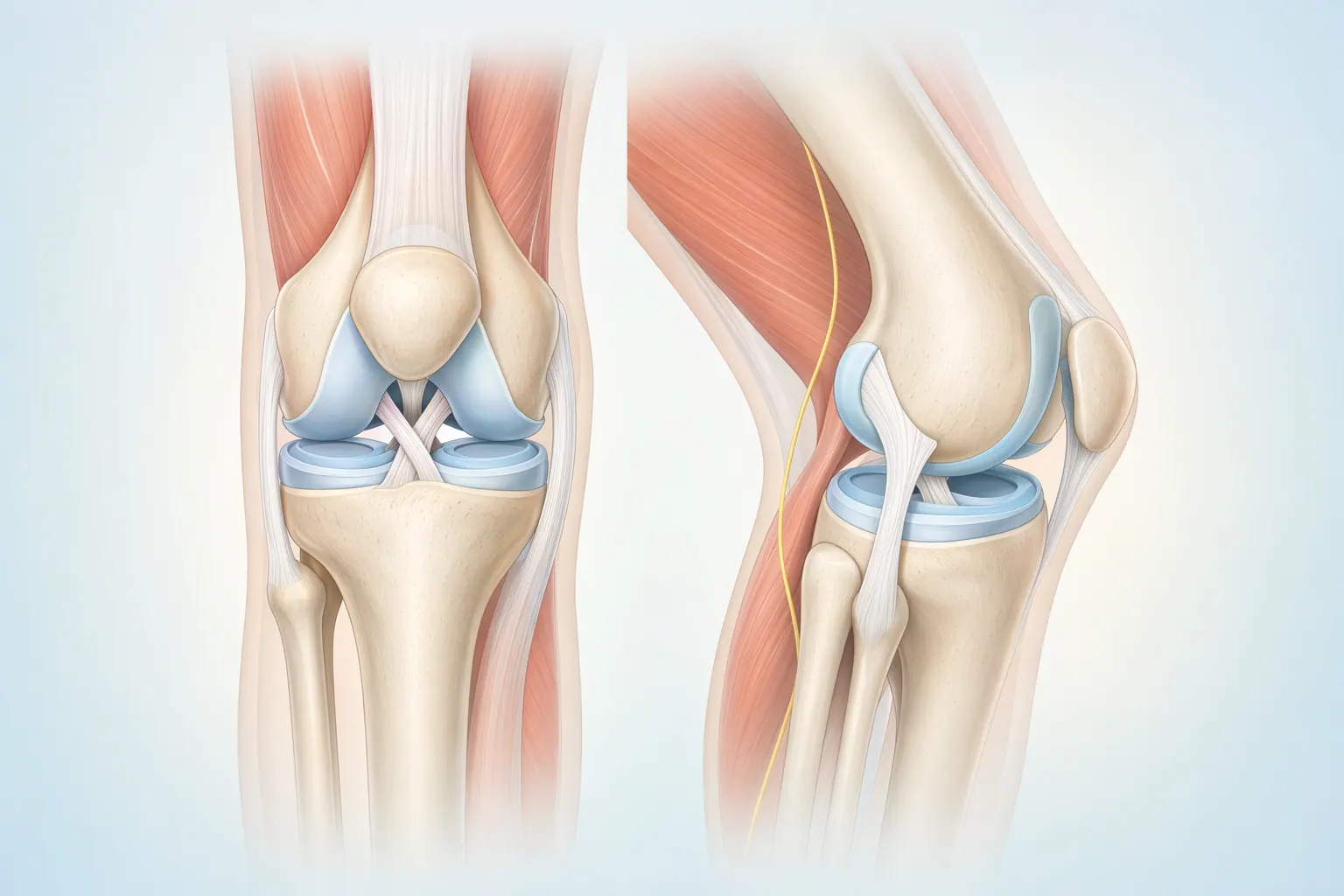
Anatomy of the knee joint showing the genicular nerves — superior medial, superior lateral, and inferior medial — that carry pain signals from the knee
Cortisone targets the inflamed joint. Ablation targets the genicular nerves that report pain from that joint to the brain.
Anatomy

Why the genicular nerves matter.

Three small sensory nerves — the **superior medial, superior lateral, and inferior medial genicular nerves** — carry most of the pain signal from the front of the knee to the spinal cord and brain. They run in predictable bony locations around the knee, which makes them targetable with ultrasound or fluoroscopic guidance. A cortisone injection puts medication inside the joint to calm inflammation. Radiofrequency ablation places needle probes alongside these specific nerves and heats their tip to roughly 80°C for 90 seconds, creating a controlled lesion that interrupts the pain signal. The joint itself isn't touched. The cartilage damage is unchanged. What changes is how loudly the knee can complain.

When each option makes sense

Matching the procedure to your situation.

Symptoms

Common symptoms

  • Acute knee OA flare with significant swelling — cortisone for fast inflammatory control
  • Chronic, plateaued knee OA pain after cortisone has stopped working — ablation
  • Pain most days for 6+ months despite PT and oral medications — ablation candidate
  • You're under 60 and not ready for knee replacement — ablation is the bridge
  • You've already had 3–4 cortisone shots this year — avoid more steroid, consider ablation
  • Significant medical comorbidities make TKR high-risk — ablation as a long-term option
  • Bone-on-bone arthritis but you want to delay surgery 1–3+ years — ablation
  • Post-knee-replacement pain in a small subset of patients — ablation can sometimes help
Causes

Common causes

  • Fast functional relief needed in 48 hours — cortisone
  • Durability matters more than speed of onset — ablation (6–12 months vs 4–12 weeks)
  • You've used multiple steroid shots and they've stopped working — ablation
  • You can't take steroid (poorly controlled diabetes, infection risk) — ablation
  • You're trying to defer or avoid total knee replacement — ablation is the strategic tool
Decision framework

How we choose at LAOSS.

There's no universal answer — but the decision usually breaks down along four axes: how long relief needs to last, what came before, what your surgical timeline looks like, and what your insurance will cover.

How long relief needs to last. If you need to function in 48 hours — for work, a family event, travel — cortisone wins on speed. Onset is 24–48 hours, peak relief at 2–4 weeks. If you want one procedure to hold for 6 months or more, ablation is the structural answer. The lesion doesn't fade like a steroid effect; the nerves have to physically regrow before the pain signal returns.

What came before. If cortisone has worked durably and you've only had 1–2 shots, the simplest move is another well-timed injection. If you've used 3–4 cortisone shots in the past year and the benefit is getting shorter each time, we treat that as a signal — the inflammatory model isn't carrying you anymore, and it's time to consider a nerve-targeted approach.

What your surgical timeline looks like. If you and your surgeon have decided knee replacement is happening in the next few months, neither procedure is going to change that. If you're trying to defer TKR for 1–3+ years (you're young, you're active, you're not done with the knee yet, or you're a poor surgical candidate), ablation buys real time. We can repeat the ablation when the nerves grow back, often indefinitely.

Insurance. Both are typically covered, but the path is different. Cortisone is a same-visit decision. Ablation requires prior authorization plus a diagnostic genicular nerve block — a temporary numbing injection that predicts whether the radiofrequency procedure will actually work for you. We don't ablate without that data.


Procedure paths

Cortisone path vs ablation path.

Most patients don't have to pick one and never touch the other — these procedures often sequence over years of knee OA care. Here's how each path actually looks.

Conservative care
Step 1

Cortisone path

When pain is acute, inflammatory, or you're early in the knee OA journey — cortisone is usually the right first move.

  • Acute knee OA flare with severe pain and effusion
  • Need fast functional relief in days, not weeks
  • You haven't already maxed out steroid for the year
  • Strong inflammatory component on exam (warmth, swelling, effusion)
  • Pre-surgical bridge — but not within 3 months of planned TKR
  • First-line interventional option after PT and oral medications fail
Surgical care
When needed

Ablation path

When durability matters more than speed, or when cortisone has stopped pulling its weight — ablation is the structural answer.

  • Chronic knee OA pain present on most days for 6+ months
  • Cortisone benefit has shortened or disappeared
  • You've already had 3+ steroid injections in the past 12 months
  • You're not ready for or can't have knee replacement
  • Goal is 6–12 months of relief from a single procedure
  • Diagnostic genicular nerve block confirms ≥50% pain relief
Cost & coverage

What each one actually costs.

Both procedures are typically covered when conservative care has failed — but the authorization process is very different.

Covered

Cortisone — covered, same-visit

Knee cortisone injection is a standard orthopedic service covered by virtually every commercial plan and Medicare. Often performed at the same visit as your evaluation.

  • Typical out-of-pocket: $30–$100 copay (varies by plan)
  • Covered by commercial insurance, Medicare, and most Medi-Cal plans
  • Same-day in-office procedure, no prior authorization typically required
  • Usually limited to 3–4 injections per knee per year
  • Ultrasound or fluoroscopic guidance often covered when medically necessary
Covered + PA

Ablation — covered with prior auth

Radiofrequency genicular nerve ablation is covered by most commercial plans and Medicare when conservative care has failed and a diagnostic block has confirmed candidacy.

  • Typical out-of-pocket: specialist copay + procedure coinsurance
  • Covered by Medicare and most commercial plans (with prior auth)
  • Diagnostic genicular nerve block required first — also covered
  • Performed under image guidance in our procedure suite
  • Authorization typically takes 5–10 business days
Timeline

How fast — and how long.

Onset and duration are where these two procedures diverge most. Knowing the curve helps you plan around real life.

Weeks

Cortisone — fast on, fast off

The local anesthetic gives you a few hours of immediate relief. The steroid kicks in over 24–48 hours and runs its course over weeks.

  • Immediate (hours): anesthetic effect, then it wears off
  • Day 1–2: steroid effect begins, inflammation drops
  • Weeks 2–4: peak benefit for most responders
  • Weeks 4–12: benefit typically fading
  • Repeat: every 3–4 months max, 3–4 per joint per year
Months

Ablation — slower on, much longer

Ablation works by interrupting nerve signal, not by drug pharmacology. The benefit builds over 2–4 weeks and holds for the better part of a year.

  • Days 0–7: soreness at the probe sites, ice and acetaminophen
  • Weeks 2–4: pain relief settles in as the nerve lesions mature
  • Months 2–9: peak benefit for responders
  • Months 9–12: nerves begin regrowing, pain may return
  • Repeat: often performed every 9–18 months indefinitely
Evidence

What the data actually says.

We won't oversell ablation, and we won't dismiss cortisone. Here's the honest read on the published literature for chronic knee OA.

Short-term

Cortisone — strong short-term, limited durability

Decades of trials support cortisone for short-term knee OA pain. The catch is durability and what repeated use does to the joint.

  • Strong evidence for short-term knee OA pain relief (4–12 weeks)
  • Meaningful relief in the majority of patients within 1–2 weeks
  • Benefit typically does not extend past 3 months
  • Repeated knee injections (>3–4/year) associated with cartilage loss
  • Avoid in 3 months before planned knee replacement (infection risk)
Durable

Ablation — strong durability, careful selection

Multiple randomized trials show radiofrequency genicular nerve ablation outperforms repeat cortisone at 6 and 12 months — when patients are selected with a diagnostic block.

  • ~70–80% of properly selected patients get ≥50% pain relief
  • Relief typically lasts 6–12 months, sometimes longer
  • Outperforms intra-articular cortisone at 6 and 12 months in RCTs
  • Diagnostic genicular nerve block is the key predictor of success
  • Doesn't modify disease — cartilage damage continues underneath
Candidacy

Which one fits me?

These checklists are a starting point — the final call comes at your evaluation, with imaging and exam findings in front of us.

Cortisone

You're a cortisone candidate if

Cortisone is usually the right first move when symptoms are acute, inflammatory, and you need to function quickly.

  • Acute knee OA flare with significant swelling or pain
  • You need fast functional relief — 48 hours, not 4 weeks
  • You haven't already had multiple steroid injections this year
  • Strong inflammatory component on exam (warmth, effusion)
  • You're not within 3 months of a planned knee replacement
  • You're early in the knee OA journey and haven't yet exhausted injections
Ablation

You're an ablation candidate if

Ablation is the better call when cortisone has plateaued, you're not ready for TKR, and you want one procedure to hold for months.

  • Chronic knee OA pain on most days for 6+ months
  • Failed conservative care — PT, NSAIDs, multiple cortisone shots
  • You're not ready for or not a candidate for total knee replacement
  • Goal is 6–12 months of meaningful pain relief
  • Diagnostic genicular nerve block produces ≥50% temporary relief
  • No active infection, no pacemaker contraindication, no bleeding disorder
ImportantGenicular nerve ablation is a pain management procedure — it does not stop the underlying arthritis from progressing. The cartilage damage continues during the months of pain relief. We make sure every patient understands this before scheduling. Avoid cortisone in the 3 months before a planned knee replacement (raises infection risk). Patients with active joint infection, uncontrolled bleeding disorders, or pacemakers may not be candidates for radiofrequency ablation.
Recovery

What each recovery looks like.

Cortisone recovery is measured in hours. Ablation recovery is measured in days to weeks. Both let you drive yourself home the same day.

01Cortisone · Days 0–14

Fast onset, normal activity

Cortisone is an in-and-out office procedure. Most patients walk out and resume normal activity the same day.

  • Mild soreness for 24–48 hours at the injection site (normal)
  • Resume normal activity the same day — no restrictions
  • Pain relief typically starts within 24–48 hours
  • Ice and acetaminophen if injection-site soreness flares
02Ablation · Days 0–14

Local soreness, gradual build

Ablation creates small thermal lesions on the genicular nerves — expect 3–7 days of soreness around the probe sites as the lesions mature.

  • Soreness at the probe sites for 3–7 days (expected, not a complication)
  • Ice 20 minutes on, 20 off for the first 48 hours
  • Acetaminophen is fine; avoid heating pads for 48 hours
  • Walking and light activity from day 1; full activity within a week
03Weeks 2 to Months 9+

Pair with PT either way

Physical therapy pairs with both procedures. With cortisone, PT works during the inflammation-quiet window. With ablation, PT happens during a longer pain-free window — and the goal is to actually rebuild strength.

  • Cortisone: PT to capitalize on the pain-free window (weeks 1–8)
  • Ablation: progressive strengthening and conditioning (weeks 2–24)
  • Coordinated through your in-network PT provider
  • Re-evaluation at 6–12 weeks to plan next steps
How they sequence

Often the same patient, over years.

Most patients we see for genicular nerve ablation have already had cortisone injections — sometimes for years. That's not a failure of cortisone. That's the natural arc of progressive knee osteoarthritis: PT and oral medications first, then cortisone when those plateau, then a stronger interventional option when cortisone plateaus.

A common LAOSS sequence for a 58-year-old with bilateral knee OA who isn't ready for replacement:

  1. PT + NSAIDs + weight management as the foundation, ongoing.
  2. Cortisone injection every 3–4 months when the inflammatory component flares.
  3. After 12–18 months, when cortisone benefit shortens, diagnostic genicular nerve block — a temporary numbing test that predicts ablation success.
  4. If the diagnostic block produces ≥50% temporary relief, radiofrequency genicular nerve ablation for 6–12 months of durable pain control.
  5. Repeat ablation when the nerves regrow and pain returns — often every 9–18 months.
  6. Knee replacement when the patient and the surgeon both agree it's time.

We also occasionally use a single cortisone shot inside an ablation course — for example, if a patient develops an acute inflammatory flare 4 months into a successful ablation. The procedures don't fight each other; they target different mechanisms in the same knee.

And there are situations where the answer is neither yet — for early arthritis, structured PT and weight management often outperform either procedure. We'll tell you that too.

Risks & considerations

Side-by-side risk profile.

Both procedures are well-tolerated when delivered by experienced specialists under image guidance — but the risk profiles are different.

Cortisone

Cortisone considerations

Cortisone is one of the most-studied orthopedic interventions. Risks are well-characterized and most are short-lived.

  • Post-injection flare (steroid flare) for 24–48 hours in some patients
  • Skin discoloration or subcutaneous fat thinning at the injection site
  • Transient blood sugar elevation (notable for diabetics)
  • Cartilage thinning with repeated knee injections (>3–4/year)
  • Joint infection (rare with sterile technique)
  • Increased infection risk if performed within 3 months of joint replacement
Ablation

Ablation considerations

Genicular nerve ablation is a low-complication procedure in experienced hands — most of the risks are local and short-lived.

  • Soreness at the probe sites for 3–7 days (expected response)
  • Bruising or small hematoma at probe insertion points
  • Temporary numbness in a small skin patch near the knee
  • Rare: incomplete ablation requiring repeat (preventable with image guidance)
  • Rare: infection at probe sites (very low with sterile technique)
  • Not appropriate during active joint infection, with pacemakers in some cases, or with active bleeding disorders
Your care team

Meet the pain management specialists at LAOSS.

Both cortisone injections and genicular nerve ablation at LAOSS are performed by board-certified pain management physicians with fellowship training in image-guided interventional procedures. Every ablation candidate gets a diagnostic genicular nerve block first — performed by the same physician who will do the ablation — so the person reading the diagnostic response is the person doing the procedure. No hand-offs, no marketing-driven packages, no ablation without confirmed candidacy.

Specialists

Meet your pain management specialists.

3 providers
Patient reviews

What patients say about us.

★★★★★4.97,500+ Google reviews
Dr. Acosta saved me from spine surgery. I came in convinced I was going to need an operation. He laid out a non-surgical plan that's been working. So thankful.
Karina Petrosyan
Tarzana, CA · 5 December 2024
Explore related care

Find care by body area.

Image-guided injections and nerve-targeted procedures are used throughout the body — jump to the area that's bothering you.

FAQ

Ablation vs cortisone — common questions

  • Often yes — and that's actually one of the strongest indications for ablation. When cortisone wears off faster and faster with each injection, it usually means the inflammatory model isn't carrying your pain anymore. Ablation works by interrupting the nerve signal itself, which is a completely different mechanism. The data behind the prediction comes from your diagnostic genicular nerve block — a temporary numbing injection we do before scheduling ablation. If you get at least 50% pain relief during the few hours the numbing medication is active, you have roughly a 70–80% chance of meaningful relief from the radiofrequency procedure itself.
  • For responders, relief typically lasts 6–12 months — and sometimes longer. The radiofrequency probe creates small thermal lesions on the genicular nerves that carry pain from your knee. Those nerves regrow over time, which is why the relief isn't permanent. The good news: because the nerves regrow, the procedure can be repeated, often every 9–18 months indefinitely. We've had patients in their 60s and 70s who've used repeat ablation to defer knee replacement for years.
  • It's a way to defer knee replacement — and for the right patient, that's a meaningful distinction. Ablation doesn't fix the underlying arthritis. The cartilage damage keeps progressing. But for patients who are too young for TKR, too active to want one yet, or medically poor candidates for major surgery, ablation can buy years of meaningful pain control. For patients with end-stage bone-on-bone arthritis whose function has collapsed despite injections and lifestyle changes, the more honest answer is usually that knee replacement is the right next step. We'll tell you which camp your imaging and exam put you in.
  • Yes — we don't ablate without it. The diagnostic genicular nerve block is a quick in-office procedure where we inject a small amount of local anesthetic alongside the three target genicular nerves under ultrasound or fluoroscopic guidance. The anesthetic lasts a few hours. During that window, you go about your day and track how much your knee pain improves. If you get ≥50% pain relief, you're a candidate for radiofrequency ablation with a ~70–80% chance of durable response. If you get less than 50% relief, ablation is unlikely to help, and we won't recommend it. It's a small test that prevents a much larger procedure from being a waste.
  • Most commercial insurance plans and Medicare cover both the diagnostic block and the radiofrequency procedure when conservative care has failed — which typically means at least 3–6 months of physical therapy, oral medications, and usually one or more cortisone injections. The diagnostic block is generally a routine prior authorization. The radiofrequency procedure usually requires documented response to the diagnostic block before authorization. Our team handles the authorization for you, and we tell you exactly what your out-of-pocket will be before we schedule.
  • The procedure itself is done under local anesthetic, often with light sedation if you prefer it. You'll feel pressure during probe placement and a deep warmth during the lesion creation, but most patients describe it as uncomfortable rather than painful. Afterward, expect 3–7 days of soreness at the probe sites — ice, acetaminophen, and normal walking from day 1. You can drive yourself home if you skipped sedation, or have someone drive you if you had sedation. Most patients are back to normal activity within a week. The pain relief itself usually starts settling in around weeks 2–4 as the nerve lesions mature.
  • Sometimes — and we make that call case by case. The most common pattern is that ablation handles your baseline chronic pain for 6–12 months, and you don't need additional cortisone during that window. If an acute inflammatory flare develops 4–5 months into a successful ablation course (an awkward landing, an unusually intense weekend, a weather change), a single cortisone shot can be added without conflict — the procedures target different mechanisms. What we generally avoid is layering frequent cortisone shots on top of a working ablation, because the cumulative steroid load adds the same cartilage-thinning concern it would in any knee.
  • Both are low-risk in experienced hands. Cortisone's main risks are post-injection flare, transient blood sugar elevation in diabetics, skin or fat thinning at the injection site, and cumulative cartilage thinning if used too often. Ablation's main risks are 3–7 days of probe-site soreness, occasional bruising or small hematoma, and rare temporary numbness in a small skin patch near the knee. Infection is rare for both with sterile technique. Ablation is not appropriate during active joint infection or in patients with certain pacemakers or bleeding disorders — we screen for these at your evaluation.
  • At your LAOSS visit we work through four things: (1) where you are in the knee OA journey — early-flare patients lean cortisone, plateaued chronic-pain patients lean ablation; (2) what came before — many cortisone shots already this year is a signal to consider ablation; (3) your surgical timeline — defer-the-TKR patients benefit most from ablation; and (4) whether your diagnostic genicular nerve block confirms candidacy for ablation. We don't sell packages, we don't ablate without the diagnostic block, and we won't push either procedure if structured PT and weight management are still moving the needle for you.
Ready when you are

Get an honest answer on which one fits.

Book a visit at any of our eight Los Angeles-area offices. We'll examine the knee, review your imaging, and tell you straight whether another cortisone shot, a diagnostic block followed by ablation, regenerative options, or a surgical referral is the right next step.

Booking now
21 specialists · 8 offices
Greater Los Angeles
On-site X-raySame visit
Most insurers acceptedIn-network
Call usBook online