Los Angeles Orthopedic

Cervical Disc Replacement vs ACDF for your neck.

Two anterior cervical surgeries through the same small incision — one preserves motion at the level we operate on, the other fuses it solid. Here's how LAOSS spine specialists decide which one fits your imaging, your alignment, and your goals.

Cervical disc replacement vs ACDF fusion comparison at LAOSS — board-certified Los Angeles spine surgeon across eight offices
Live · Now Accepting

Same incision, different physics.

ACDR preserves motion. ACDF fuses it solid.

15+
Years caring
Same-day appointments
Often available
★★★★★
4.9 · 7,500+ reviews

What patients ask us most

  • Will I really keep my neck motion with disc replacement?
  • Does ACDR actually prevent the next disc from breaking down?
  • Is cervical disc replacement covered by insurance now?
  • How much faster is recovery with ACDR vs ACDF?
  • Can I have ACDR at two levels, or do I need a fusion?

What sets LAOSS apart

  • Fellowship-trained spine surgeon performs both procedures — not a one-tool shop
  • Honest framing of adjacent-segment disease evidence, not marketing claims
  • On-site MRI and flexion-extension X-rays at the evaluation
  • Same- or next-day appointments at eight LA-area offices
Key takeaways
  • ACDR (cervical disc replacement / arthroplasty) and ACDF (anterior cervical discectomy and fusion) use the same anterior approach and remove the same diseased disc — the difference is what goes in afterward.
  • ACDR implants a motion-preserving artificial disc (Mobi-C, Prestige LP, M6-C, Simplify and other FDA-approved devices). ACDF uses bone graft plus plate/screws or a stand-alone interbody to fuse the two vertebrae.
  • ACDR preserves motion at the operated level and may reduce adjacent-segment disease over 5–10 years in well-selected patients — but it is not the right call for everyone, and the magnitude of the ASD benefit is debated.
  • ACDF is still the right choice for multi-level disease, severe facet arthropathy, instability, ossified posterior longitudinal ligament (OPLL), kyphosis correction, advanced osteoporosis, and many older patients.
  • Cervical disc replacement at one or two levels is now mainstream and routinely insurance-approved when FDA indications are met. The decision is driven by your imaging and exam — not by which device is newest.
Overview

ACDR vs ACDF: same incision, different physics.

Both procedures begin the same way. A small (≈2-inch) incision is made in a natural crease on the front of the neck, the surgeon works between the muscles and the airway to reach the front of the spine, and the diseased disc is fully removed. Any bone spurs pressing on the spinal cord or nerve roots are decompressed under microscope magnification. What happens next is where the procedures diverge.

ACDR — Anterior Cervical Disc Replacement (cervical arthroplasty) implants a motion-preserving artificial disc between the two vertebrae. The FDA has approved several devices for one- and two-level cervical use, including Mobi-C, Prestige LP, M6-C, Simplify, Secure-C, PCM, and ProDisc-C. Each is designed to allow the operated level to keep flexing, extending, and rotating roughly the way a healthy disc does. The headline argument is motion preservation now and (potentially) reduced adjacent-segment disease later.

ACDF — Anterior Cervical Discectomy and Fusion uses bone graft (or a synthetic interbody cage) plus a small titanium plate and screws — or a stand-alone interbody device — to fuse the two vertebrae into one solid unit. Over 3–6 months the bone grows together. ACDF has been the gold standard for cervical radiculopathy and myelopathy for decades, with millions of cases and excellent symptom relief. The trade-off is loss of motion at the fused level and a small but real increase in the rate of degeneration at the next disc over 10–20 years.

Neither procedure is universally better. The right call depends on how many levels are involved, the quality of your facet joints, your cervical alignment, your bone density, and what's driving the pain. That's the conversation we have at your evaluation.

Patient education

Watch: Anatomy of the cervical spine

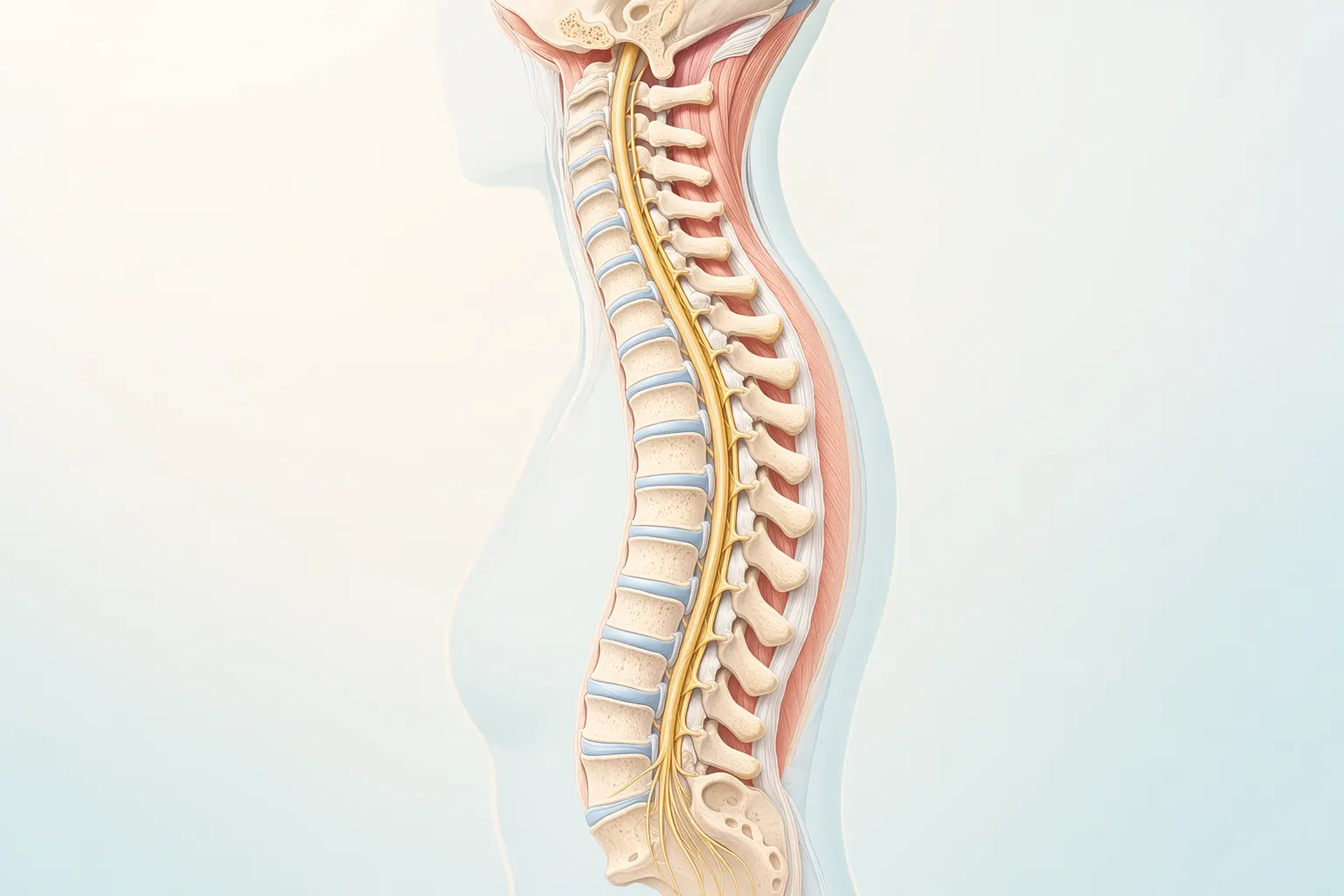
The cervical spine is seven vertebrae stacked between your skull and your shoulders, cushioned by intervertebral discs. Understanding the anatomy makes the ACDR vs ACDF decision much clearer.

Animations licensed from ViewMedica · Swarm Interactive

Illustration of the cervical spine showing vertebrae, intervertebral discs, facet joints, and exiting nerve roots — the anatomy relevant to ACDR vs ACDF decision-making
ACDR keeps motion at the operated disc level. ACDF welds it solid, transferring load to the discs above and below.
Anatomy

What's happening in your cervical spine.

A cervical disc lives between two vertebrae and lets the neck flex, extend, and rotate. When it tears, herniates, or collapses, it can pinch a nerve root (radiculopathy — pain, numbness, weakness down the arm) or the spinal cord itself (myelopathy — hand clumsiness, balance trouble, gait change). After the diseased disc is removed, the question is what to put in its place. An artificial disc preserves the motion segment. A fusion eliminates it but stabilizes the level definitively — useful when the bones are already loose, the facets are shot, or the alignment is kyphotic and needs to be locked into a corrected position.

When each option makes sense

Matching the tool to the problem.

Symptoms

Common symptoms

  • Single-level soft disc herniation with arm pain (radiculopathy) — strong ACDR candidate
  • Two-level cervical disc disease in a younger active patient — ACDR if facets are healthy and alignment is preserved
  • Three or more levels of degenerative disease — ACDF (multi-level ACDR is off-label)
  • Severe facet joint arthritis at the same level — ACDF (the facets can't be motion-preserved)
  • Cervical kyphosis that needs to be corrected — ACDF (the construct holds the correction)
  • Cervical instability or spondylolisthesis on flexion-extension X-rays — ACDF
  • Ossification of the posterior longitudinal ligament (OPLL) — ACDF (often posterior, sometimes anterior)
  • Significant osteoporosis or inflammatory arthritis (RA, AS) — ACDF
Causes

Common causes

  • Soft disc herniation — the disc is the problem, the bones are healthy: leans ACDR
  • Hard disc + endplate spurs + collapsed disc height: often still ACDR-eligible after decompression
  • Multi-level degeneration with facet involvement: leans ACDF
  • Loss of cervical lordosis or frank kyphosis: leans ACDF
  • Bone-quality concerns (DEXA T-score worse than -1.5): leans ACDF
  • Patient priority is keeping motion and avoiding the next surgery: leans ACDR
  • Patient priority is the most-studied, most-predictable solution: leans ACDF
Decision framework

How we decide at LAOSS.

There are five axes that drive the ACDR vs ACDF decision — and we walk through every one of them at your evaluation, with your MRI and flexion-extension X-rays on the screen.

1. How many levels are involved. ACDR is FDA-approved for one or two contiguous levels. Three or more cervical levels and you are in ACDF territory — hybrid constructs (ACDR at one level, ACDF at the adjacent level) are technically possible but case-by-case and not appropriate for everyone.

2. The condition of the facet joints. ACDR only works if the back of the spinal segment — the facet joints — can still carry motion. Significant facet arthropathy at the same level means the implant will load joints that hurt, and ACDF is the better answer.

3. Cervical alignment. A patient with preserved cervical lordosis is an arthroplasty candidate. A patient with kyphosis (the neck has lost its normal curve) usually needs ACDF — the construct holds the corrected alignment in a way an artificial disc cannot.

4. Bone quality and inflammatory disease. Significant osteoporosis, rheumatoid arthritis, ankylosing spondylitis, or other inflammatory conditions push us toward ACDF. The implant needs healthy endplate bone to seat against; the fusion bypasses that concern.

5. What the patient values. A 38-year-old graphic designer who plays tennis on weekends is wired differently than a 67-year-old with three levels of disease and stenosis. Both deserve an honest read on what the trade-offs actually look like in their case — and that's what your evaluation is for.

Treatment paths

ACDR-leaning patient vs ACDF-leaning patient.

Most patients fit fairly clearly into one camp once we have the imaging on screen. Here's how the two patient archetypes break down.

Conservative care
Step 1

ACDR-leaning patient

Single- or two-level disease, healthy facets and bone, motivated to keep motion. ACDR is on the table.

  • One or two contiguous cervical levels of disease
  • Soft disc herniation or contained disc with arm-dominant pain
  • Preserved cervical lordosis on standing X-rays
  • Facet joints look healthy on MRI and CT
  • Bone density is good (no significant osteoporosis)
  • No rheumatoid arthritis, ankylosing spondylitis, or OPLL
  • Under ≈60 in most cases, no severe degenerative collapse
  • Patient priority: preserve motion, possibly delay future degeneration
Surgical care
When needed

ACDF-leaning patient

Multi-level disease, facet or alignment issues, bone-quality concerns. ACDF is the proven workhorse for these patients.

  • Three or more cervical levels of significant disease
  • Severe facet arthropathy at the target level
  • Kyphosis that needs to be corrected and held
  • Cervical instability or spondylolisthesis
  • Ossified posterior longitudinal ligament (OPLL)
  • Significant osteoporosis or inflammatory arthritis
  • Hard disc with collapsed disc height and large osteophytes
  • Patient priority: most-studied, most-predictable construct
Motion & adjacent-segment disease

The headline trade-off, honestly framed.

Motion preservation and adjacent-segment disease (ASD) are the two pieces of the ACDR pitch most worth scrutinizing.

ACDR

ACDR — motion preserved

FDA IDE trials show ACDR maintains roughly normal motion at the operated level out through 7–10 years of follow-up in patients selected by the original indications. Long-term published series support a lower rate of secondary surgery at the adjacent level compared with ACDF.

  • Operated level keeps ≈7–10° of flexion-extension in most patients
  • Total cervical motion is preserved closer to baseline
  • Lower reported rate of adjacent-segment reoperation at 5–10 years
  • Magnitude of the ASD benefit varies by study and patient selection
  • Not a guarantee — some patients still develop adjacent-level disease
  • Real-world results depend heavily on candidate selection
ACDF

ACDF — motion at the level traded for fusion

ACDF eliminates motion at the operated segment by design. Over 10–20 years a subset of patients develop adjacent-segment degeneration, and a smaller subset go on to need a second surgery.

  • Operated level fuses solid by 3–6 months in most patients
  • Small loss of overall cervical range of motion
  • Adjacent-segment degeneration on imaging is common over decades
  • Symptomatic adjacent-segment disease requiring reoperation is less common
  • Reported reoperation rates: roughly 2–3% per year at the adjacent level
  • Multi-level fusions transfer more load to neighboring discs than single-level
We do not promise that ACDR will prevent the next disc from breaking down — we tell you what the published evidence actually shows, what is still uncertain, and where your specific anatomy and history fit on that curve.
Recovery

How fast can I get back to life?

Both procedures are typically same-day or 23-hour-stay surgeries. The big differences are collar use and return-to-activity timing.

ACDR

ACDR — faster return

Motion preservation removes the need to wait for bone to fuse, which compresses the recovery timeline meaningfully.

  • Walking the same day, usually home that day or the next morning
  • Soft collar 1–2 weeks, often optional after the first few days
  • Driving at 1–2 weeks once off narcotics and pain is controlled
  • Office / desk work at 1–2 weeks
  • Light gym and cardio at 4 weeks, lifting at 6 weeks
  • No fusion to wait on — the implant is load-bearing from day one
ACDF

ACDF — the bone has to fuse

The construct is solid from the moment you leave the OR, but the biology of bone healing sets the pace for full clearance.

  • Walking the same day, usually home that day or the next morning
  • Soft collar 4–6 weeks (some surgeons skip; we discuss case-by-case)
  • Driving at 2–3 weeks once off narcotics and collar isn't limiting
  • Office / desk work at 2–4 weeks
  • Light cardio at 6 weeks, lifting and impact at 3 months
  • Fusion typically solid on X-ray at 3–6 months
Coverage

Insurance, in plain language.

Both procedures are routinely covered when indications are met. Pre-authorization timelines differ.

ACDR

ACDR — mainstream coverage

One- and two-level cervical disc replacement is covered by virtually all commercial plans and Medicare when the patient meets FDA indications and the device is one of the approved options.

  • Covered by most commercial plans and Medicare for 1–2 levels
  • Pre-authorization typically required — we handle the paperwork
  • Documentation of failed conservative care for 6+ weeks is standard
  • MRI confirmation of the level-specific pathology required
  • Three-level and hybrid constructs are case-by-case and may not be covered
  • Out-of-pocket is your standard surgical copay / deductible
ACDF

ACDF — fully covered, decades of precedent

ACDF has been a standard-of-care procedure for decades and is covered without controversy across plans.

  • Covered by all commercial plans, Medicare, and Medi-Cal
  • Pre-authorization required by most plans but rarely contested
  • Multi-level fusions covered with appropriate documentation
  • Stand-alone interbody vs plate-and-cage is a surgical choice, both covered
  • Bone-morphogenetic protein (BMP) use is case-by-case under some plans
  • Out-of-pocket is your standard surgical copay / deductible
We quote benefits and out-of-pocket before you commit — our team verifies coverage, submits the pre-auth, and walks you through the response before scheduling.
Candidacy

Which one fits me?

Use these checklists as a starting point. The final call comes at evaluation with imaging and flexion-extension X-rays in front of us.

ACDR

You're an ACDR candidate if

ACDR is the better tool when the disc is the problem, the bones and facets are healthy, and you want to keep motion at that level.

  • One or two contiguous levels of cervical disc disease
  • Soft disc herniation or contained protrusion on MRI
  • Preserved cervical lordosis on standing X-rays
  • Facet joints look clean on MRI and CT
  • No significant osteoporosis, RA, ankylosing spondylitis, or OPLL
  • Typically under 60, motivated to preserve motion
  • Failed 6–12 weeks of conservative care (PT, injections, meds)
ACDF

You're an ACDF candidate if

ACDF is the right tool for multi-level disease, advanced facet involvement, kyphosis, or bone-quality concerns — and it remains an excellent operation.

  • Three or more levels of significant cervical disease
  • Severe facet arthropathy or instability at the target level
  • Cervical kyphosis that needs surgical correction
  • Bone density issues, RA, ankylosing spondylitis, or OPLL
  • Hard disc with collapsed height and large endplate spurs
  • Older patients or those who value the most-studied construct
  • Failed 6–12 weeks of conservative care with progressive symptoms
ImportantUrgent surgical evaluation is warranted for progressive arm or hand weakness, hand clumsiness, balance change or unsteady gait, or any loss of bowel or bladder control. These signal myelopathy and should not wait on conservative care.
Recovery timeline

What each recovery actually looks like.

Both procedures share a same-day or 23-hour-stay format. Where they diverge is collar use, return-to-activity speed, and how long until full clearance.

01Days 0–14

First two weeks

The first two weeks look similar between the procedures. The biggest practical difference is how much you wear the collar.

  • ACDR: soft collar 1–2 weeks, optional after a few days for many patients
  • ACDF: soft collar 4–6 weeks for many surgeons (some skip with stand-alone interbody)
  • Walking the day of surgery; stairs ok
  • Sore throat for 3–7 days, voice changes occasionally
  • Pain controlled with short-course narcotics, then transitioned
02Weeks 2–6

Return to life

This is where the timelines really separate. ACDR patients are often back to office work and light gym; ACDF patients are still in collar and waiting on fusion.

  • ACDR: driving 1–2 weeks, office work 1–2 weeks, light cardio 4 weeks
  • ACDF: driving 2–3 weeks, office work 2–4 weeks, no impact yet
  • PT starts at 2–4 weeks for both, focused on posture and gentle ROM
  • Surveillance X-rays at 2–6 weeks to confirm position and alignment
03Months 3–6

Full clearance

By 3–6 months ACDF patients are seeing fusion on X-ray and clearing impact and lifting; ACDR patients have been fully cleared for some time.

  • ACDR: full clearance for lifting and impact typically by 6 weeks
  • ACDF: fusion solid on X-ray at 3–6 months, clearance by 3–4 months
  • Return-to-sport (contact) is case-by-case for both procedures
  • Long-term follow-up at 6 months, 1 year, then as needed
Honest framing

Why ACDF is still done if ACDR is "better".

Cervical disc replacement is a real and meaningful advance — but the framing that ACDR is universally better than ACDF is overselling the data. Here's the honest read.

ACDF works. The procedure has been done for more than 50 years, the outcome data on radiculopathy and myelopathy is excellent, and most patients do well. The argument against it is mechanical: fusing two vertebrae transfers slightly more motion-related stress to the discs above and below, and over 10–20 years a subset of patients develop adjacent-segment degeneration. Some of those patients become symptomatic; a smaller subset go on to need a second surgery.

ACDR addresses that mechanical argument by preserving motion at the operated level. In well-selected single- and two-level patients, FDA IDE follow-up data through 7–10 years supports lower rates of adjacent-segment reoperation compared with ACDF. The catch is patient selection. ACDR demands healthy facet joints, preserved cervical alignment, decent bone density, and the right kind of disc pathology. Drop any of those requirements and the math changes.

For multi-level disease, kyphosis, instability, osteoporosis, OPLL, or severe facet arthritis, ACDF remains the right operation, and trying to make ACDR fit those cases creates new problems. The decision is not "ACDR if it's available, ACDF if it isn't" — the decision is which physics fit your anatomy.

That's the conversation we have with every spine patient at LAOSS — not which device is newest, but which approach the imaging and exam are actually telling us to do.


Risks & considerations

Side-by-side risk profile.

Both procedures share an anterior approach — so they share most of the same risks. Where they diverge is what happens at the disc level over time.

ACDR

ACDR considerations

Anterior approach risks plus implant-specific considerations. Long-term implant survivorship is excellent in published series.

  • Sore throat and transient swallowing change (common, days to weeks)
  • Hoarseness from recurrent laryngeal nerve irritation (usually transient)
  • Heterotopic ossification — bone forming around the implant, reducing motion
  • Implant subsidence, migration, or wear over very long term (uncommon)
  • Revision to ACDF possible if the implant fails or symptoms recur
  • Adjacent-segment degeneration still possible, just at a lower rate in studies
ACDF

ACDF considerations

The most-studied cervical operation in the world. Risks are well-characterized and most are short-lived.

  • Sore throat and transient swallowing change (common, days to weeks)
  • Hoarseness from recurrent laryngeal nerve irritation (usually transient)
  • Pseudarthrosis (failure to fuse) — small percentage, more common in smokers and multi-level cases
  • Hardware-related symptoms occasionally (plate prominence, screw issues)
  • Adjacent-segment degeneration over 10–20 years in a subset of patients
  • Slightly reduced overall cervical range of motion
ImportantSmoking dramatically increases pseudarthrosis risk after ACDF and is a relative contraindication. We require nicotine cessation before fusion surgery and recommend it before ACDR as well. Diabetes control, vitamin D status, and osteoporosis treatment are also addressed pre-op.
Your care team

Meet the spine team at LAOSS.

At LAOSS, ACDR and ACDF are performed by Dr. Siamak Yasmeh, our fellowship-trained orthopedic spine surgeon. Dr. Yasmeh performs both procedures regularly and selects between them based on imaging, exam, and patient goals — not device preference. Before surgery is even on the table, our board-certified pain management physicians (Dr. Jose Acosta, Dr. Raj Desai, Dr. Jason Kaushik) deliver image-guided epidural injections, selective nerve root blocks, and facet procedures, and coordinate physical therapy with your in-network provider. Most spine patients at LAOSS never need surgery — and when they do, the team that diagnoses is the team that treats.

Patient reviews

What patients say about us.

★★★★★4.97,500+ Google reviews
Dr. Acosta saved me from spine surgery. I came in convinced I was going to need an operation. He laid out a non-surgical plan that's been working. So thankful.
Karina Petrosyan
Tarzana, CA · 5 December 2024
Explore related care

Find care by body area.

Cervical issues often coexist with shoulder, elbow, or upper back symptoms — jump to a nearby area to compare paths.

FAQ

ACDR vs ACDF — common questions

  • Yes, at the operated level — that's the point of the procedure. Published FDA IDE follow-up data shows ACDR patients typically retain roughly 7–10 degrees of flexion-extension motion at the operated disc level out through 7–10 years after surgery, and overall cervical range of motion stays close to pre-operative baseline. With ACDF, by contrast, motion at the operated level is eliminated by design once the bones fuse — you'll keep motion at all the other cervical levels, but the operated segment is locked together. The practical difference is usually subtle for one-level cases and more noticeable for two-level cases.
  • It appears to reduce the rate, but "prevent" is overselling the evidence. FDA IDE trial data through 7–10 years shows lower rates of reoperation at the adjacent disc level for ACDR compared with ACDF, with the size of the benefit varying by study and patient selection. That's a real finding — but adjacent-segment degeneration can still happen after ACDR, and the magnitude of the difference at 15–20 years is still being studied. What we tell every patient honestly: ACDR may reduce your odds of needing a second surgery at the next level, but it doesn't eliminate them, and surgical technique and patient selection matter as much as device choice.
  • Yes, in most cases. One- and two-level ACDR with an FDA-approved device is now covered by virtually all commercial insurance plans and Medicare when the patient meets FDA indications and has completed at least 6 weeks of documented conservative care. Pre-authorization is required, but approvals are routine — our team handles the paperwork and confirms benefits before scheduling. Three-level and hybrid (ACDR + ACDF) constructs are case-by-case and may require additional documentation or peer-to-peer review. ACDF is universally covered.
  • ACDR is notably faster on every benchmark. Most patients walk the day of surgery for both procedures, but with ACDR the soft collar is typically 1–2 weeks and often optional after a few days, driving resumes at 1–2 weeks, office work at 1–2 weeks, and full clearance for lifting and impact by 6 weeks. With ACDF the soft collar is typically 4–6 weeks, driving at 2–3 weeks, office work at 2–4 weeks, and full clearance waits on the fusion to be solid on X-ray at 3–6 months. Both procedures are usually outpatient or 23-hour-stay at LAOSS — you go home the same day or the next morning.
  • Yes — two-level cervical disc replacement is FDA-approved and covered by most insurance plans. The candidacy criteria are tighter than for single-level: we want healthy facet joints at both levels, preserved cervical alignment, good bone density, and the right kind of disc pathology at both levels. Three contiguous levels of ACDR is off-label — at three or more levels we generally go to ACDF or, occasionally, a hybrid construct (ACDR at one level + ACDF at an adjacent level). The right call comes from your imaging.
  • Long-term implant survivorship in published series is excellent, with very low rates of failure or revision at 7–10 years in well-selected patients. If an implant does fail — from subsidence, migration, wear, heterotopic ossification, or progressive symptoms — the revision strategy is almost always conversion to ACDF at that level. The artificial disc is removed, the level is decompressed if needed, and a standard fusion construct is placed. Revision is a more involved procedure than the original surgery, but it's a well-established option — you are not 'stuck' if the disc fails.
  • Because ACDR is not better for many patients. ACDF is still the right operation for three or more levels of cervical disease, severe facet arthropathy, cervical kyphosis that needs to be corrected, instability, ossified posterior longitudinal ligament (OPLL), significant osteoporosis, rheumatoid arthritis, and a number of other situations. ACDF has been done for more than 50 years with excellent published outcomes on radiculopathy and myelopathy — it is not an obsolete operation, it is the right tool for a large subset of patients. Choosing ACDR for an ACDF-appropriate case creates worse outcomes, not better ones.
  • At your LAOSS evaluation we walk through five things with your imaging on the screen: (1) how many levels are involved, since ACDR is FDA-approved for one or two levels and ACDF handles the rest; (2) the condition of your facet joints, since ACDR needs them healthy to work; (3) your cervical alignment, since kyphosis usually needs ACDF correction; (4) your bone quality and any inflammatory conditions, since osteoporosis and RA push toward ACDF; and (5) what you actually value — fastest return to motion and activity, or the most-studied and most-predictable construct. We do not push a device or a procedure — we tell you which one your specific anatomy and history are pointing toward, and why.
Ready when you are

Get an honest answer on ACDR vs ACDF.

Book a visit at any of our eight Los Angeles-area offices. We'll review your MRI, take flexion-extension X-rays on-site, and tell you straight which procedure your anatomy is pointing toward — or whether you should hold off on surgery altogether.

Booking now
21 specialists · 8 offices
Greater Los Angeles
On-site X-raySame visit
Most insurers acceptedIn-network
Call usBook online