Common foot & ankle concerns we treat
- Pain that limits walking, standing, or sleep
- Stiffness, swelling, or reduced range of motion
- Sports injuries — acute or overuse
- Arthritis or post-traumatic joint changes
- Conditions other doctors couldn’t resolve
Total ankle replacement resurfaces a worn-out ankle joint with a metal-and-plastic implant when end-stage arthritis no longer responds to bracing, injections, or therapy. At LAOSS, our fellowship-trained and experienced foot and ankle specialists evaluate you across eight Los Angeles-area offices with on-site imaging, and weigh replacement against ankle fusion so you choose the path that fits your life.

Surgical and non-surgical options at LAOSS.
Total ankle replacement (also called total ankle arthroplasty) is a surgery that resurfaces the worn ankle joint. The damaged ends of the shinbone (tibia) and the ankle bone (talus) are removed and replaced with a smooth metal cap on each side, with a durable plastic (polyethylene) spacer in between that lets the joint glide again.\n\nMost ankle arthritis is post-traumatic — it follows an old ankle fracture, a pilon or talus fracture, or years of instability after repeated sprains. It can also come from rheumatoid and other inflammatory arthritis, or, less often, from primary osteoarthritis. When that cartilage wears down to bone-on-bone, walking becomes painful and stiff, and shoes, braces, injections, and therapy eventually stop helping.\n\nReplacement is one of two main surgical answers for an end-stage ankle. The other is ankle fusion, which permanently joins the bones together. The big difference is motion: a replacement is designed to keep the ankle moving, while a fusion trades motion for a very durable, pain-free joint. Neither is automatically better — the right choice depends on your arthritis, your alignment, your bone, and how you use your ankle. We talk all of this through before any decision is made.
During this procedure, the surgeon removes diseased or damaged portions of the ankle. The surgeon implants an artificial ankle joint consisting of metal and plastic components. The new joint will help reduce pain and restore mobility to the ankle.
Animations licensed from ViewMedica · Swarm Interactive
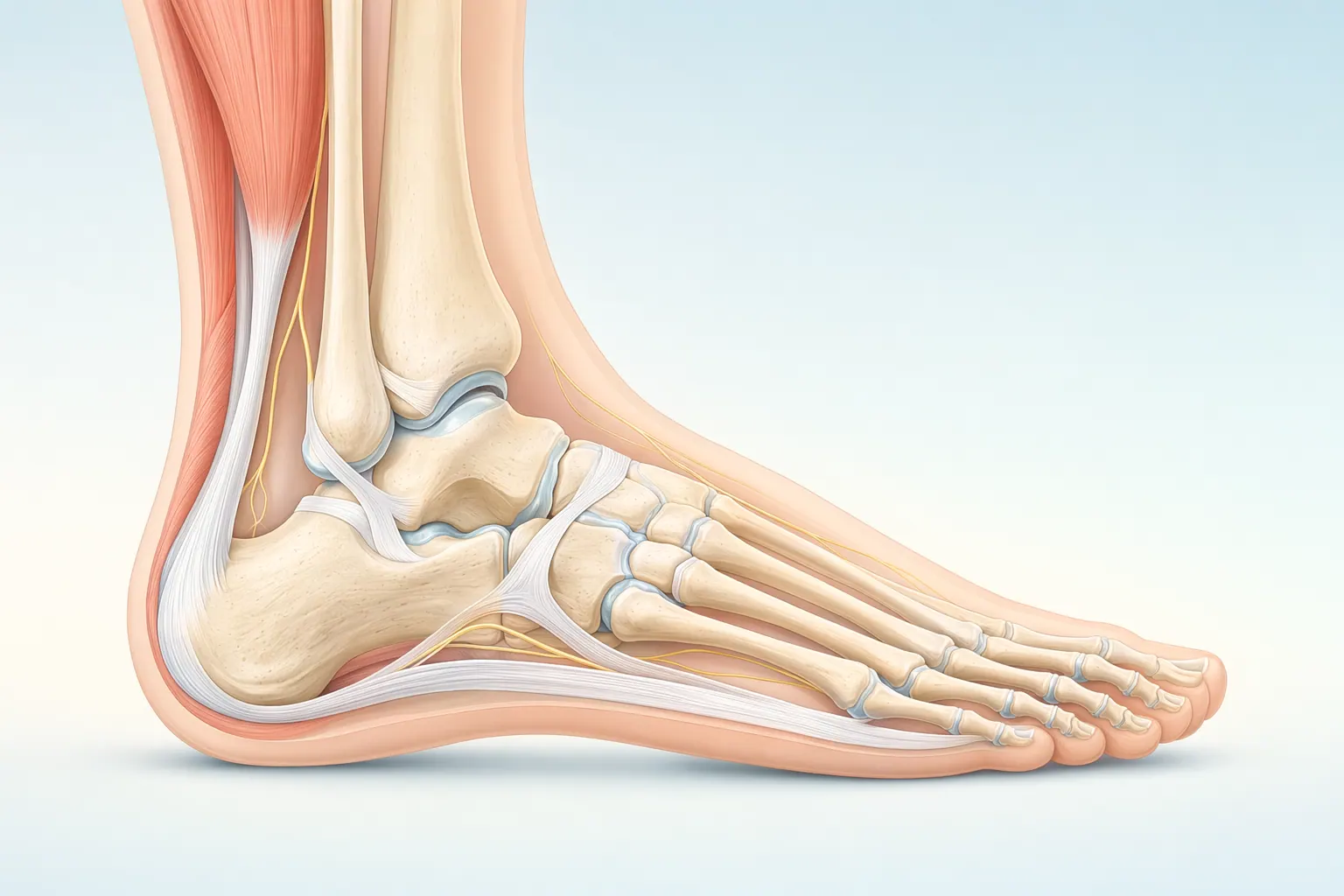
The foot and ankle have 26 bones, more than 30 joints, and over 100 ligaments and tendons. The plantar fascia spans the bottom of the foot, the Achilles tendon anchors the calf to the heel, and the ankle is a hinge that handles every step you take. Most foot and ankle problems trace back to overload, alignment, or footwear that doesn’t match the way your foot is built.
Surgery is done in an operating room, usually under general or regional anesthesia. In broad strokes, here is what happens:\n\n- Access the joint — your surgeon makes an incision over the front of the ankle to reach the worn tibiotalar joint.\n- Remove the damaged surfaces — the arthritic ends of the tibia and talus are precisely cut away using alignment guides so the new parts sit correctly.\n- Place the implant — a metal component is fitted to the tibia and another to the talus, with a plastic bearing set between them so the joint can move smoothly.\n- Correct alignment if needed — if the ankle or hindfoot is crooked, your surgeon may balance ligaments or address nearby deformity so the new joint loads evenly.\n- Close and protect — the incision is closed and the ankle is placed in a splint or cast to protect the healing skin and soft tissue.\n\nAhead of surgery we confirm the diagnosis with an exam and imaging (on-site X-rays at most offices, and a CT or MRI when more detail is needed), and we review your circulation, skin, and overall health, since these affect healing.
Foot & Ankle care is highly technique-dependent. Volume, training, and judgment together determine the outcome you actually feel six months later.
Our foot & ankle specialists move stepwise — start with the least-invasive option that fits your situation, escalate only when it doesn't.
If most of these match your situation, an evaluation with a foot & ankle specialist is the next step.
These signs typically point toward an in-person evaluation with a foot & ankle specialist.
Your first visit is built to give you an answer the same day, not just another referral.
Recovery is rarely a straight line — but a clear plan with measurable milestones makes the path predictable.
In the first two weeks we focus on protecting the foot & ankle, calming inflammation, and restoring basic motion.
Targeted physical therapy rebuilds strength, mobility, and confidence in the foot & ankle.
Once function is restored, the focus shifts to keeping you there — and catching any recurrence early.
We talk through the risks and benefits with every patient — informed consent is a conversation, not a form.
Every orthopedic intervention carries a small set of standard risks. We screen, prepare, and monitor for these on every patient.
Some risks are tied to the structures we're treating in the foot & ankle. We discuss these in detail at your visit so you can weigh them against the benefits.
At LAOSS, our foot & ankle specialists combine advanced surgical expertise with a patient-first approach. From minimally invasive arthroscopic techniques to reconstruction, fracture care, and arthritis management, our physicians bring decades of experience to every case. Trusted across Los Angeles, our team is dedicated to restoring mobility, relieving pain, and helping you return to the activities you love.
The most important conversation in ankle arthritis surgery is replacement versus fusion, and it deserves more than a quick yes-or-no.\n\nA total ankle replacement keeps the ankle moving, which can make walking feel more natural and may reduce extra stress on the nearby foot joints over time. It tends to suit lower-demand patients with reasonable alignment, good bone, and healthy soft tissue. An ankle fusion gives up ankle motion but is extremely durable and time-tested, and it's often the stronger choice for younger or heavier-demand patients, heavy-labor jobs, severe deformity or bone loss, or certain medical situations.\n\nAt LAOSS we lay both options on the table honestly — including who tends to do well with each and what the trade-offs are — so the decision reflects your goals, not a default. With same- or next-day appointments at eight Los Angeles-area offices and on-site imaging, you can get clear answers without waiting weeks. If non-surgical care still has room to work, we'll say so; surgery is for when it doesn't.
Book a visit with a foot & ankle specialist at any of our eight Los Angeles–area offices.