Common foot & ankle concerns we treat
- Pain that limits walking, standing, or sleep
- Stiffness, swelling, or reduced range of motion
- Sports injuries — acute or overuse
- Arthritis or post-traumatic joint changes
- Conditions other doctors couldn’t resolve
A pilon fracture is a break of the distal tibia (and often the fibula) that drives down into the weight-bearing surface of the ankle joint, usually from a high-energy fall or crash. Because the joint cartilage and surrounding soft tissue are both injured, it needs prompt, specialized care — available with same-day or next-week evaluations across our eight LA-area offices.

Surgical and non-surgical options at LAOSS.
A pilon fracture (also called a tibial plafond fracture) is a break at the very bottom of the shinbone (tibia) where it forms the roof of the ankle joint. Unlike a simple ankle sprain or a fracture off to the side, a pilon fracture pushes axial force straight up through the talus into the joint surface — so it typically damages both the bone and the cartilage, and often the skin and soft tissue around it.
These are serious injuries, and honest expectations matter: the great majority of pilon fractures need surgery to rebuild the joint surface and hold the bone in alignment while it heals. The conservative steps below (splinting, elevation, strict non-weight-bearing) are usually the early protective phase before surgery — not a substitute for it — though truly non-displaced fractures in select patients can sometimes be managed in a cast under close monitoring.
Below, we walk through the anatomy involved, the symptoms and causes we see most, how we confirm the diagnosis with X-ray and CT, and the staged surgical approach that gives the ankle its best chance to heal and move again.
This injury is a fracture at the base of the tibia (the largest of the two bones in the lower leg). Pilon fractures involve the weight-bearing surface of the tibia, and typically occur just above the ankle. In many cases, when the tibia is fractured, the thinner bone in the lower leg (called the fibula) is also broken.
Animations licensed from ViewMedica · Swarm Interactive
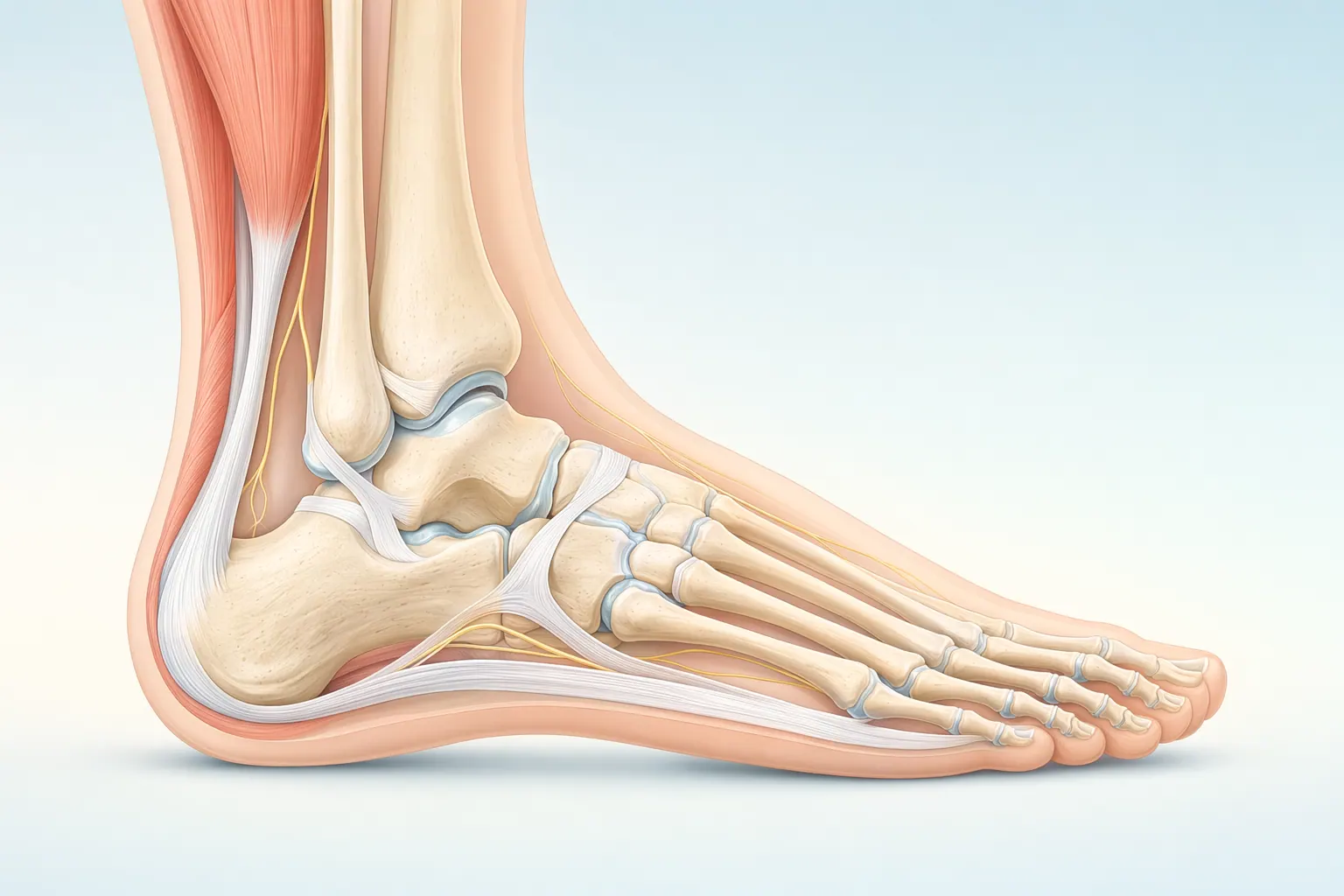
The foot and ankle have 26 bones, more than 30 joints, and over 100 ligaments and tendons. The plantar fascia spans the bottom of the foot, the Achilles tendon anchors the calf to the heel, and the ankle is a hinge that handles every step you take. Most foot and ankle problems trace back to overload, alignment, or footwear that doesn’t match the way your foot is built.
You want answers, fast — and we’re built to give them. Most patients leave their first LAOSS visit with a clear diagnosis and a written plan, not another referral chain.
Here’s what your initial visit for pilon fracture typically looks like:
Schedule your evaluation with a trusted Greater Los Angeles orthopedic expert today.
Once we’ve confirmed the diagnosis, the next step is matching the right treatment to your situation. We start with the least-invasive option that fits — and escalate only when it doesn’t.
Non-surgical options designed to relieve pain, restore movement, and avoid the OR when possible.
Procedures performed by board-certified foot & ankle surgeons when conservative care isn’t enough.
Foot & Ankle care is highly technique-dependent. Volume, training, and judgment together determine the outcome you actually feel six months later.
Our foot & ankle specialists move stepwise — start with the least-invasive option that fits your situation, escalate only when it doesn't.
If most of these match your situation, an evaluation with a foot & ankle specialist is the next step.
These signs typically point toward an in-person evaluation with a foot & ankle specialist.
Your first visit is built to give you an answer the same day, not just another referral.
Recovery is rarely a straight line — but a clear plan with measurable milestones makes the path predictable.
In the first two weeks we focus on protecting the foot & ankle, calming inflammation, and restoring basic motion.
Targeted physical therapy rebuilds strength, mobility, and confidence in the foot & ankle.
Once function is restored, the focus shifts to keeping you there — and catching any recurrence early.
We talk through the risks and benefits with every patient — informed consent is a conversation, not a form.
Every orthopedic intervention carries a small set of standard risks. We screen, prepare, and monitor for these on every patient.
Some risks are tied to the structures we're treating in the foot & ankle. We discuss these in detail at your visit so you can weigh them against the benefits.
At LAOSS, our foot & ankle specialists combine advanced surgical expertise with a patient-first approach. From minimally invasive arthroscopic techniques to reconstruction, fracture care, and arthritis management, our physicians bring decades of experience to every case. Trusted across Los Angeles, our team is dedicated to restoring mobility, relieving pain, and helping you return to the activities you love.
A pilon fracture is not an injury to wait on — the timing of treatment and the condition of the soft tissue strongly influence the result. At LAOSS, our board-certified orthopedic trauma and foot & ankle specialists evaluate acute fractures quickly, with on-site X-ray and coordinated CT to map the joint surface, so you have a clear plan instead of a referral chain.
From the protective early phase through surgery and rehabilitation, you'll have a coordinated team and a direct line back to your specialist. Many pilon fractures are work-related, and our office can help navigate the workers' comp and authorization steps so your care isn't delayed. With same- or next-week appointments at eight Los Angeles-area offices, expert care is close to home.
Book a visit with a foot & ankle specialist at any of our eight Los Angeles–area offices.