Los Angeles Orthopedic

Arthroscopic vs Open rotator cuff repair.

Same repair, two ways in. Arthroscopic is the modern default for most tears. Open and mini-open are still the right call for massive retracted tears, revisions, and complex anatomy. The honest answer at LAOSS is that tear size, tendon retraction, and muscle quality drive the decision more than the technique itself.

Arthroscopic vs open rotator cuff repair comparison at LAOSS — board-certified Los Angeles shoulder surgeons across eight offices
Live · Now Accepting

Two approaches, one shoulder.

Tear size and biology drive the call — not the technique label.

15+
Years caring
Same-day appointments
Often available
★★★★★
4.9 · 7,500+ reviews

What patients ask us most

  • Will I get the same outcome from either approach?
  • How big a tear is too big for arthroscopic?
  • How long until I can lift overhead again?
  • Will I get my full strength back?
  • What happens if my repair re-tears?

What sets LAOSS apart

  • Surgeons fluent in both arthroscopic and open repair — not just one
  • Decision based on your tear pattern and biology, not surgeon preference
  • Same-day discharge for arthroscopic repair at most offices
  • Coordinated PT through your in-network provider for the full 6-month rehab
Key takeaways
  • Arthroscopic repair is the modern standard of care for most rotator cuff tears — 3–4 small portals, suture anchors into bone, same-day discharge.
  • Open and mini-open repair use a 4–6 cm incision with the deltoid split (not detached) — still the right call for massive retracted tears (>5 cm), revisions, and patches/grafts.
  • Healing rate and long-term function are similar for small-to-medium tears regardless of approach. Re-tear risk tracks tear size and muscle quality, not technique.
  • Arthroscopic recovers faster in the first 6 weeks (less soft-tissue disruption); both converge by 4–6 months. Return to overhead or heavy lifting is ~6 months for both.
  • The honest decision driver: tear size, tendon retraction, fatty infiltration grade, and your activity goals — discussed with the MRI in front of us.
Overview

Arthroscopic vs open: same repair, different way in.

Both arthroscopic and open rotator cuff repair are doing the same fundamental job — pulling a torn tendon back to its bony footprint on the humerus and anchoring it there with sutures so it can heal. The difference is the corridor the surgeon uses to get there.

Arthroscopic repair is done through 3–4 small portals, each about 5 mm. A camera goes through one, instruments through the others. Suture anchors are driven into the bone of the greater tuberosity, and the torn tendon is sutured back to its footprint — the same construct you'd use in an open case. There's no need to cut through the deltoid muscle to get to the cuff. That single fact is what drives the faster early recovery and lower rate of post-op stiffness.

Open repair uses a 4–6 cm incision over the top of the shoulder. The deltoid is split along its fibers (in the mini-open variant) or partially detached (in the classic open, now rarely used) to expose the rotator cuff directly. The surgeon sees and feels the tear under direct vision, which is an advantage for massive retracted tears, complex revisions, and anatomies that don't behave well arthroscopically.

At LAOSS, our shoulder surgeons are trained in both. The conversation at your visit isn't "arthroscopic vs open" in the abstract — it's which approach gives your specific tear the best biological chance of healing.

Patient education

Watch: How rotator cuff repair works

This short video walks through what the rotator cuff is, what a tear looks like, and how the tendon is anchored back to bone — the same construct whether the repair is done arthroscopically or open.

Animations licensed from ViewMedica · Swarm Interactive
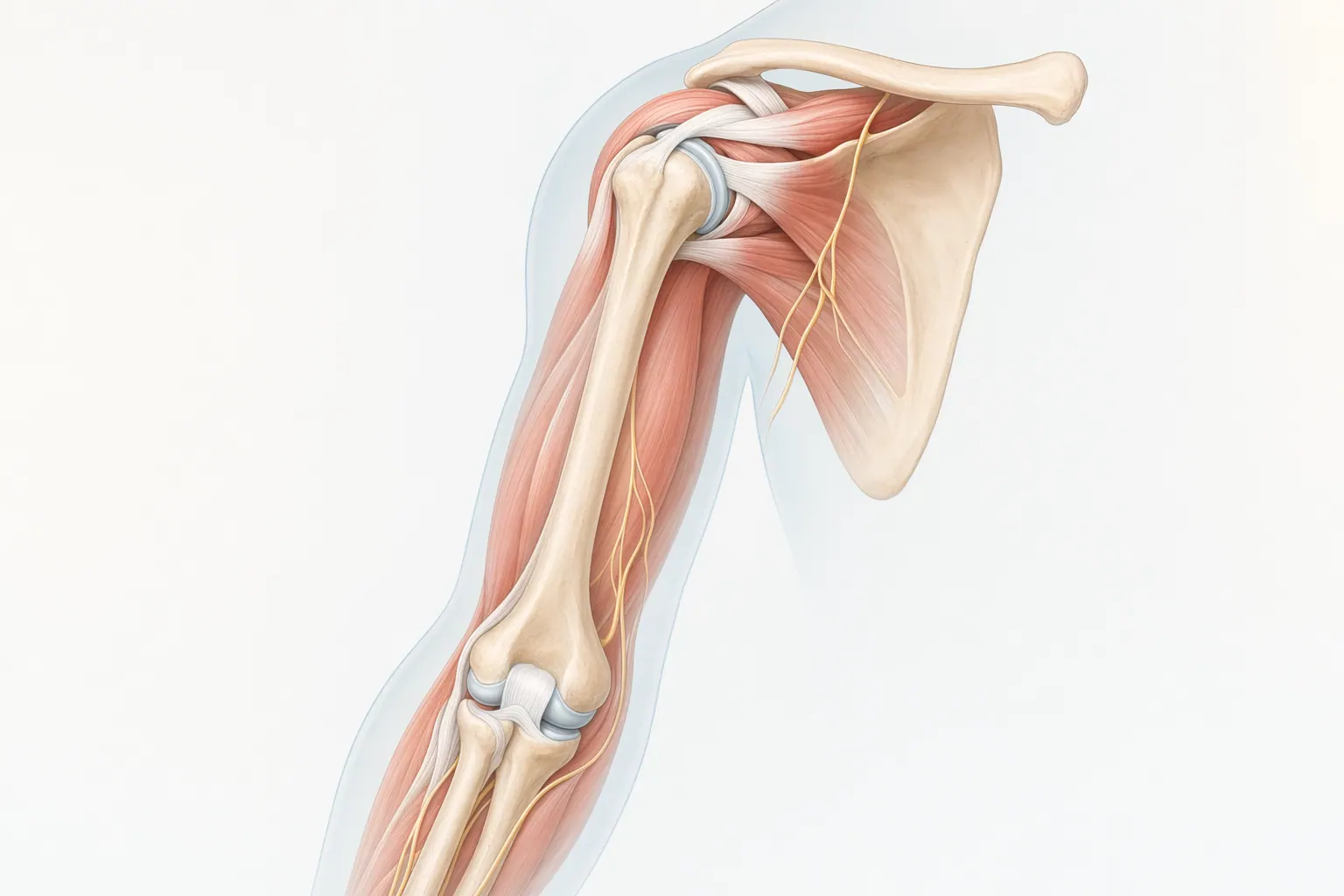
Anatomical illustration of the shoulder showing the rotator cuff tendons attaching to the greater tuberosity of the humerus
Both approaches re-anchor the torn tendon to the same footprint on the humerus using the same suture-anchor constructs.
Anatomy

What the rotator cuff actually does.

The rotator cuff is four tendons — supraspinatus, infraspinatus, teres minor, and subscapularis — that wrap the head of the humerus and connect it to the scapula. Their job is fine-tuned shoulder motion: lifting overhead, rotating, and stabilizing the joint through every reach. When a tendon tears off its footprint on the greater tuberosity, the repair pulls it back and anchors it with sutures driven into the bone. Arthroscopic and open repair both use the same suture-anchor constructs — the difference is whether the surgeon works through portals with a camera or through a small incision with direct vision.

When each approach makes sense

Picking the right corridor for your tear.

Symptoms

Common symptoms

  • Small or medium tear (<3 cm), good tendon quality — arthroscopic
  • Large tear (3–5 cm) without significant retraction — arthroscopic
  • Massive tear (>5 cm) with retracted tendon — open or mini-open often better
  • Revision repair (previous repair failed) — open often gives better exposure
  • Tear requires patch augmentation or graft — open is typical
  • Subscapularis tear with retraction — open or mini-open commonly preferred
  • Concurrent labrum, biceps, or AC joint work — arthroscopic handles it in one setting
  • Patient priority on faster early recovery and less stiffness — arthroscopic
Causes

Common causes

  • Tear size and tendon retraction — the single biggest decision driver
  • Muscle quality on MRI (fatty infiltration grade) — predicts healing
  • Whether tendon can be mobilized back to its footprint without tension
  • Need for patch, graft, or superior capsular reconstruction
  • Surgeon's case volume and comfort with each technique
  • Whether other shoulder pathology needs to be addressed in the same setting
Decision framework

How LAOSS surgeons choose.

There's no single answer that fits every shoulder — but the decision usually breaks down along four axes: tear pattern, tissue biology, what else needs fixing, and recovery priorities.

Tear pattern. Small to large tears (up to ~5 cm) with reasonable tendon mobility are almost always done arthroscopically today. Massive retracted tears, especially those pulled back to the level of the glenoid, are where open or mini-open earns its keep — the surgeon can mobilize the tendon under direct vision, release adhesions, and use rotator interval slides without the technical demands of doing it through a scope.

Tissue biology. This is the part that surprises patients. Re-tear rates correlate more strongly with tear size and muscle quality (specifically the fatty infiltration grade on MRI) than with whether the repair was done arthroscopically or open. A massive tear with Goutallier grade 3–4 fatty infiltration has a high re-tear rate either way; a small tear with healthy muscle has a low re-tear rate either way. The approach doesn't override the biology.

Concurrent pathology. If you have a labrum tear, biceps problem, AC joint arthritis, or loose body that also needs attention, arthroscopy handles all of it in one setting through the existing portals. Open repair would require separate exposure or staging.

Recovery priorities. Arthroscopic repair has a faster early recovery — less deltoid disruption means less post-op stiffness and an easier first 6 weeks. By 4–6 months, the two approaches converge. If your job demands an earlier return to non-overhead activity (desk work, light driving), arthroscopic gives you a few weeks of edge. If you're already planning to be out for 6 months regardless, the early-recovery advantage matters less.

Technique

Arthroscopic vs open, side by side.

Both procedures are outpatient at LAOSS for most patients — same-day discharge. The internal mechanics are where they diverge.

Conservative care
Step 1

Arthroscopic repair

The modern standard. Done through 3–4 small portals with a camera and instruments. Same suture-anchor constructs as open — just delivered through a scope.

  • 3–4 portals, each ~5 mm — no major muscle dissection
  • Camera through one portal, instruments through the others
  • Suture anchors driven into the greater tuberosity
  • Tendon sutured back to footprint with single- or double-row construct
  • Less deltoid disruption = less post-op stiffness, faster early recovery
  • Handles concurrent labrum, biceps, AC joint work in the same setting
Surgical care
When needed

Open / mini-open repair

The historic gold standard. A 4–6 cm incision with the deltoid split along its fibers gives direct visual access to the cuff — still the right call for specific cases.

  • 4–6 cm incision over the top of the shoulder
  • Deltoid split along its fibers (mini-open) — not detached
  • Direct visualization of the tear and footprint
  • Same suture-anchor constructs as arthroscopic
  • Better exposure for massive retracted tears and revisions
  • Allows easier patch augmentation, graft work, or capsular reconstruction
Recovery timeline

What each recovery looks like.

Tendon biology — not technique — sets the overall rehab clock. Both repairs need 4–6 weeks of immobilization for the tendon to heal to bone. The early weeks are where the approaches diverge.

Arthroscopic

Arthroscopic — faster early phase

Less soft-tissue dissection means less post-op stiffness and a quicker return to light daily activity. The overall rehab schedule still spans 6 months.

  • Outpatient, same-day discharge for most patients
  • Sling for 4–6 weeks to protect the repair
  • Gentle passive range of motion starting ~week 2
  • Active motion at 6 weeks, light strengthening at 12 weeks
  • Return to non-overhead work in 2–4 weeks for desk jobs
  • Return to overhead or heavy lifting at ~6 months
Open

Open / mini-open — slower early phase

The deltoid split needs time to heal, which adds a few weeks of stiffness in the first 1–2 months. Long-term function is equivalent.

  • Outpatient or 1-night stay depending on case complexity
  • Sling for 4–6 weeks — same as arthroscopic
  • Passive motion starts slightly later (~weeks 2–3) to protect deltoid
  • Active motion at 6–8 weeks, strengthening at 12–14 weeks
  • Return to non-overhead work in 4–6 weeks for desk jobs
  • Return to overhead or heavy lifting at ~6 months
Outcomes

What the data actually says.

We won't oversell arthroscopic and we won't dismiss open. Here's the honest read on the orthopedic literature.

Outcomes

Healing and function

Published trials show similar long-term function and patient-reported outcomes for small-to-medium tears, regardless of approach. Differences favor arthroscopic in the first few months and disappear by 6–12 months.

  • Small/medium tears: ~85–95% structural healing for both approaches
  • Massive tears: healing rates drop to 50–70% regardless of approach
  • Pain relief and functional scores converge by 6–12 months
  • Arthroscopic has lower rates of post-op stiffness in the first 3 months
  • Open has slightly better exposure for revisions and complex anatomy
Re-tear risk

Re-tear risk drivers

Re-tear is the number one concern after rotator cuff repair. The biggest predictors are biological — not which technique was used.

  • Tear size at the time of repair (bigger = higher re-tear rate)
  • Tendon retraction and tissue quality
  • Fatty infiltration grade of the rotator cuff muscle (Goutallier)
  • Patient age and smoking status
  • Compliance with the post-op rehab protocol
  • Approach (arthroscopic vs open) is NOT a top driver
Candidacy

Which approach fits me?

These checklists are a starting point — the final decision happens at your visit with the MRI and exam findings in front of us.

Arthroscopic

You're an arthroscopic candidate if

Arthroscopic repair is the right first move for most modern rotator cuff repairs. It's the default unless something specific pulls us toward open.

  • Tear size is small, medium, or large (up to ~5 cm)
  • Tendon is mobile and can be brought back to its footprint
  • MRI shows reasonable muscle quality (Goutallier 0–2)
  • Concurrent labrum, biceps, or AC joint work needs addressing
  • You prioritize a faster early recovery and less stiffness
  • First-time repair (not a revision)
Open

You're an open or mini-open candidate if

Open repair earns its place in specific scenarios where direct visualization, easier mobilization, or graft work matters more than minimally invasive access.

  • Massive retracted tear (>5 cm) requiring careful mobilization
  • Revision repair after a failed prior procedure
  • Subscapularis tear with significant retraction
  • Repair needs a patch, graft, or superior capsular reconstruction
  • Irreparable tear pattern requiring tendon transfer planning
  • Anatomic features that make arthroscopic visualization difficult
ImportantNot every rotator cuff tear needs surgery. Many partial tears and some full-thickness tears in older patients with low demands do well with structured physical therapy, activity modification, and image-guided injections. We discuss the non-surgical path at every evaluation — surgery is a decision, not a default.
Rehab

The 6-month rehab roadmap.

Rehab is where the repair becomes a working shoulder. The protocol is nearly identical for both approaches — protect the repair early, restore motion, then build strength.

01Weeks 0–6 · Protect

Immobilization phase

The tendon needs to heal to bone. Sling protects the repair while gentle passive motion prevents stiffness.

  • Sling at all times except for showering and exercises
  • Passive range of motion (therapist or your other arm moves it)
  • No active lifting, reaching, or pushing with the operated arm
  • Ice for pain and swelling, scheduled pain control
02Weeks 6–12 · Restore

Active motion phase

The sling comes off. You start moving the arm under your own power — but no resistance yet. The goal is full painless range of motion.

  • Discontinue sling at 4–6 weeks per surgeon
  • Active assisted, then active range of motion
  • Scapular mechanics and posture work
  • Light functional activity below shoulder level
03Months 3–6+ · Rebuild

Strengthening phase

Progressive loading rebuilds rotator cuff and deltoid strength. Return to overhead work, sport, and heavy lifting is staged carefully.

  • Progressive rotator cuff and scapular strengthening
  • Sport- or job-specific re-training
  • Return to overhead or heavy lifting at ~6 months
  • Return to throwing sports at 6–9 months
When to consider non-surgical

Surgery isn't always the answer.

Plenty of rotator cuff tears do well without surgery — and we'll tell you when yours is one of them.

Partial-thickness tears in patients with mild symptoms often respond to a structured PT program focused on rotator cuff and scapular strengthening. Adding an image-guided cortisone injection can quiet inflammation while the rehab does its work. PRP is another option for select partial tears, particularly in active patients trying to avoid surgery.

Full-thickness tears in older, lower-demand patients can also do well non-operatively when the tear is small, the muscle quality is preserved, and the functional limits are manageable. The trade-off is that the tendon doesn't reattach on its own — you're managing the symptoms, not repairing the anatomy.

When surgery becomes the right call: progressive weakness, tear enlargement on serial imaging, function that keeps eroding despite 3–6 months of structured rehab, or a tear pattern that's known to enlarge over time. Delaying repair indefinitely can let the muscle atrophy and fatty-infiltrate to the point that repair is no longer reliable — so the timing conversation matters.

At your LAOSS visit, we'll review the MRI with you, frame the trade-offs honestly, and lay out both paths. If non-surgical is the right move, we'll start there. If repair is the right move, we'll explain why — and walk through whether arthroscopic or open fits your specific tear.

Risks & considerations

Side-by-side risk profile.

Both repairs are well-tolerated when performed by experienced shoulder surgeons. The risk profiles are similar — with a few approach-specific differences.

Arthroscopic

Arthroscopic considerations

Minimally invasive access reduces some risks and introduces a few specific ones tied to the portals and fluid management.

  • Post-op stiffness (frozen shoulder) — lower than open but still possible
  • Re-tear, especially for large or massive tears
  • Portal-site soreness or small scars
  • Fluid extravasation into surrounding soft tissue (transient)
  • Infection (rare with modern technique and prophylaxis)
  • Nerve irritation near portals (rare, usually transient)
Open

Open / mini-open considerations

Direct exposure introduces its own risk pattern — most notably deltoid healing and a slightly higher early stiffness rate.

  • Deltoid soreness and slower early recovery from the split
  • Higher rate of post-op stiffness in the first 3 months
  • Re-tear (similar long-term rate to arthroscopic for matched tears)
  • Visible incision scar (4–6 cm)
  • Infection (rare with modern technique and prophylaxis)
  • Axillary nerve injury (rare, technique-dependent)
Your care team

Meet your shoulder surgeons at LAOSS.

Rotator cuff repair at LAOSS is performed by board-certified, fellowship-trained sports medicine and shoulder surgeons — each fluent in both arthroscopic and open repair, each choosing the approach based on your tear pattern and biology, not a one-size-fits-all preference. The surgeon who evaluates you is the surgeon who performs the repair and follows your recovery. No hand-offs.

Patient reviews

What patients say about us.

★★★★★4.97,500+ Google reviews
Dr. Bastian did my rotator cuff repair. Whole experience from consult through recovery has been straightforward. Highly recommend his team.
Marcus Johnson
Long Beach, CA · 19 March 2025
Explore related care

Find care by body area.

Rotator cuff repair is a shoulder procedure — but if your pain isn't actually coming from the cuff, here's where else to look.

FAQ

Arthroscopic vs open — common questions

  • For small-to-medium tears with reasonable muscle quality, yes — long-term function, pain relief, and patient-reported outcomes converge between arthroscopic and open repair by 6–12 months in published trials. The differences favor arthroscopic in the first 3 months (less stiffness, faster return to light activity) and disappear by the end of the first year. For massive retracted tears, the approach matters less than the biology — re-tear rates run 30–50% either way, and the choice usually comes down to which approach gives the surgeon the best chance to mobilize and repair your specific tear pattern.
  • Arthroscopic rotator cuff repair has been the dominant technique for over a decade — it's what newer fellowship-trained shoulder surgeons train on most, and the suture-anchor technology has matured enough that almost any tear that's repairable can be repaired arthroscopically. That said, surgeons who only do arthroscopic sometimes default to it for tears that would be better served by open exposure — massive retracted tears, complex revisions, and cases needing patches or grafts. At LAOSS, our shoulder surgeons are trained in both, and the choice is driven by your tear, not by which technique the surgeon happens to be comfortable with.
  • There's no hard cutoff — published series report successful arthroscopic repair of massive tears (>5 cm) in experienced hands. The practical question is whether the tendon can be mobilized back to its footprint without excessive tension. If retraction is severe and the tissue won't reach, open exposure makes the mobilization, releases, and slide techniques easier. In general: tears under 3 cm are almost always arthroscopic; 3–5 cm are usually arthroscopic; massive (>5 cm) retracted tears are where surgeons increasingly consider open or mini-open, especially in revision cases or when patch augmentation is planned.
  • About 6 months for both approaches — that's set by tendon-to-bone healing biology, not by which technique was used. The protected phase runs 0–6 weeks (sling, no active lifting), active motion comes in at 6–12 weeks, light strengthening starts around 12 weeks, and progressive overhead and heavy lifting is staged from months 4–6. Athletes returning to throwing sports usually need 6–9 months. Arthroscopic patients return to non-overhead daily activity (desk work, light driving) a few weeks earlier than open patients because there's less deltoid soreness — but the overhead-lifting milestone is the same.
  • Most patients regain 85–100% of pre-injury strength for small-to-medium tears in healthy muscle, regardless of approach. Recovery is less complete for massive tears with significant fatty infiltration of the muscle on MRI — once that muscle change is established, the tendon can be repaired but the muscle itself doesn't fully recover its contractile properties. We review your MRI with you at evaluation so you have a realistic strength expectation before surgery. Rehab compliance matters as much as the repair itself — patients who complete the full 6-month rehab program do meaningfully better than those who stop at month 3 because they feel okay.
  • Re-tear is the most common complication after rotator cuff repair, and rates correlate with tear size and tissue biology more than with technique. Small tears re-tear in roughly 5–10% of cases; large tears in 20–30%; massive tears in 30–50%. Not every re-tear needs revision — some are asymptomatic and tolerated well functionally. When revision is warranted, options include revision repair (often open or mini-open for better exposure), patch augmentation, superior capsular reconstruction, tendon transfer, or — for irreparable cases in older patients — reverse total shoulder replacement. We discuss the realistic re-tear risk for your specific tear before surgery so you know what you're committing to.
  • Sometimes — and we'll tell you when that's the right call. Partial-thickness tears, small full-thickness tears in older lower-demand patients, and tears with good muscle quality can do well with a structured 3–6 month PT program focused on rotator cuff and scapular strengthening, often combined with an image-guided cortisone injection to quiet inflammation. PRP is another option for select partial tears. The risk of delaying repair indefinitely is that some tears enlarge over time and the muscle fatty-infiltrates to the point where surgical repair is no longer reliable. We use serial imaging and exam to track that — if the tear is stable and your function is acceptable, non-surgical care is reasonable. If the tear is enlarging or your function is eroding, that's when the surgery conversation moves forward.
  • At your LAOSS visit, we work through four things with your MRI in front of us: (1) tear size, location, and retraction — small/medium tears are almost always arthroscopic, massive retracted tears more often open; (2) tissue and muscle quality — fatty infiltration grade predicts healing regardless of approach; (3) what else needs fixing in the same setting — labrum, biceps, AC joint, or loose body work all favor arthroscopic; (4) your goals and recovery priorities — earlier return to non-overhead activity favors arthroscopic, but the 6-month overhead-lifting milestone is the same either way. We don't push a technique because it's trendy or because it's what we trained on — the recommendation matches your tear.
Ready when you are

Get an honest answer on which approach fits.

Book a visit at any of our eight Los Angeles-area offices. We'll review your MRI, examine your shoulder, and tell you straight whether arthroscopic, open, mini-open — or non-surgical care — is the right next step for your tear.
Booking now
21 specialists · 8 offices
Greater Los Angeles
On-site X-raySame visit
Most insurers acceptedIn-network
Call usBook online