Los Angeles Orthopedic

Anterior vs Posterior hip replacement
approach.

Direct anterior, posterior, and lateral are three doors to the same hip joint. They are not the same recovery and they are not the same surgical risk profile. Here is how LAOSS hip surgeons decide which approach fits your anatomy, your second hip, and your return-to-walking timeline.

LAOSS hip surgeon discussing anterior vs posterior hip replacement approach with a patient in Los Angeles
Live · Now Accepting

Approach matters less than the surgeon.

Early recovery favors anterior. One-year outcomes converge.

15+
Years caring
Same-day appointments
Often available
★★★★★
4.9 · 7,500+ reviews

What patients ask us most

  • Is anterior really a faster recovery?
  • Will I dislocate my hip if I do the posterior approach?
  • Do I have to follow posterior precautions for six weeks?
  • Why do some surgeons only do one approach?
  • Is there a weight limit for the anterior approach?

What sets LAOSS apart

  • Hip surgeons who perform both anterior and posterior approaches
  • Approach chosen for your anatomy, not for marketing
  • Same- or next-day evaluation at eight LA-area offices
  • On-site imaging; PT coordinated with your in-network provider
Key takeaways
  • Direct anterior (DAA) goes between muscles — no muscle cutting — and tends to give a faster first six weeks of walking with no posterior precautions and a lower historic dislocation risk (~0.5%).
  • Modern mini-posterior splits the gluteus maximus and releases the short external rotators, which are then repaired. It is the most-used approach worldwide, gives excellent visualization, and remains the workhorse for complex anatomy, revisions, and higher BMI patients.
  • Dislocation rates between the two have narrowed substantially with modern technique, dual-mobility constructs, and tendon repair. Surgeon experience is now a bigger predictor of dislocation than approach alone.
  • By one year, outcome studies show the two approaches are essentially equivalent. The biggest real-world difference is the first six to twelve weeks.
  • Lateral approach is a third option — strong dislocation prevention but a higher rate of persistent limp — and is less commonly used in modern practice.
Overview

Three approaches, one joint.

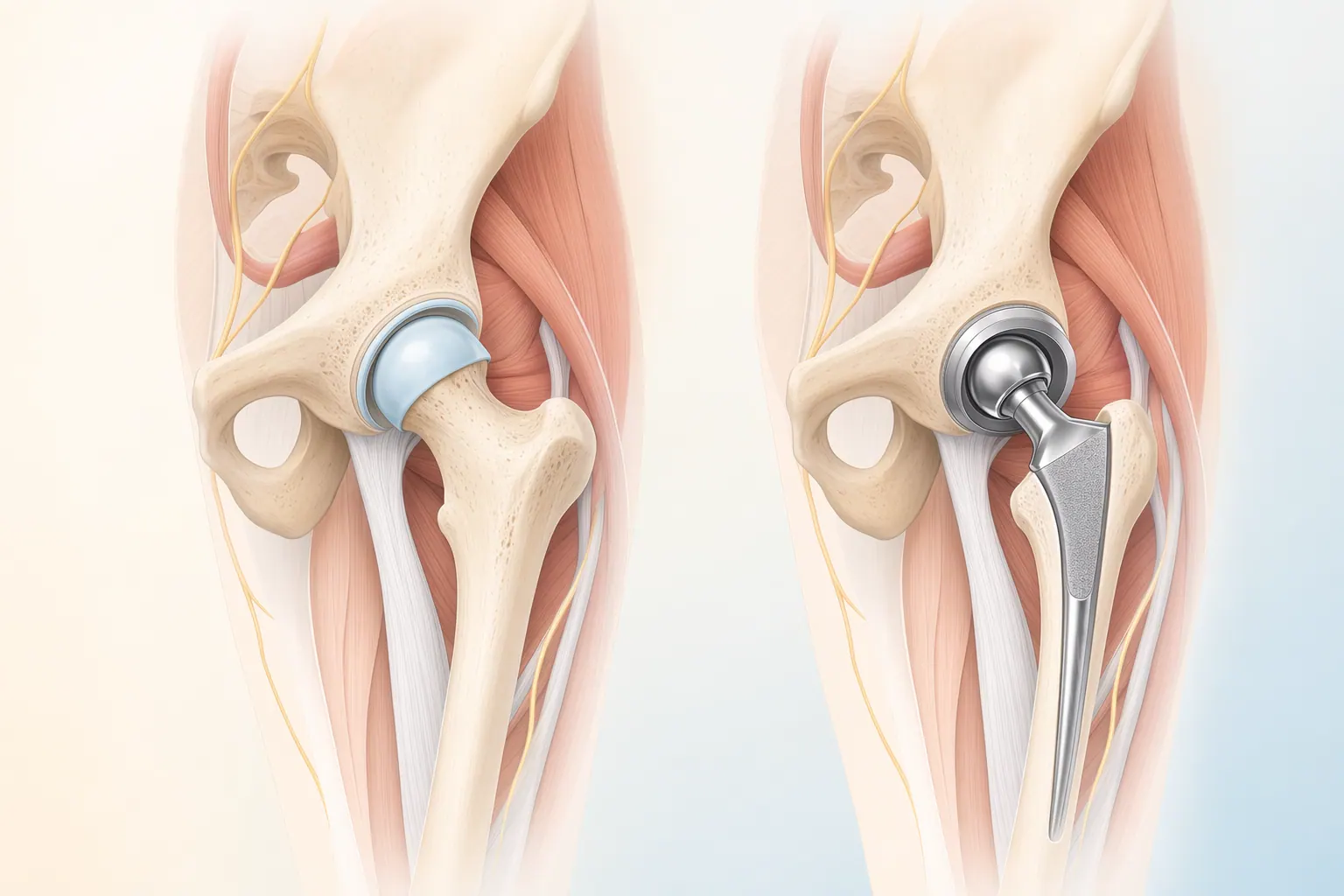
The hip is a deep ball-and-socket joint, and surgeons can reach it from the front, the back, or the side. The implant that ends up inside is the same. The route to get there — which muscles are moved, cut, or split, and which are spared — shapes the first weeks of recovery and a handful of specific risks.

Direct anterior approach (DAA) uses an incision over the front of the hip and works through the Hueter interval — a natural gap between the sartorius and the tensor fascia lata muscles. No muscle is cut. The patient is positioned supine, often on a specialized traction table (Hana, PROfx) or a standard table with a positioner, and the surgeon uses live fluoroscopy to confirm component position and leg length. Because the posterior soft-tissue envelope is left undisturbed, there are no posterior precautions after surgery and the early recovery tends to be faster.

Posterior approach (modern mini-posterior) uses an incision over the back of the hip. The surgeon splits the gluteus maximus along its fibers and releases the short external rotators — piriformis, obturator internus, gemelli — from their attachment on the femur. The released rotators are repaired at the end of surgery, and that repair is one of the biggest reasons modern posterior dislocation rates have dropped. The posterior approach gives the best visualization of any approach to the hip, which is why it remains the global workhorse for complex anatomy, revisions, simultaneous bilateral hips, and patients with higher BMI.

Lateral approach (direct lateral / anterolateral) splits the gluteus medius. It offers strong protection against dislocation but is associated with persistent abductor weakness and a higher rate of post-op limp, which is why it has fallen out of routine use in most modern practices. We mention it here because it remains a reasonable option for select revision and instability cases.

The honest summary: approach matters most in the first six to twelve weeks. Surgeon experience matters at every milestone. Studies that follow patients out to one year show the approaches converge — same function, same satisfaction, same X-rays. Where you start matters less than where you end up.


Patient education

Watch: Total Hip Replacement

Whether your surgeon uses the anterior or posterior approach, the end goal is the same — a smooth, stable, pain-free hip joint. This short video walks through the anatomy and the implant.

Animations licensed from ViewMedica · Swarm Interactive

Anatomical illustration of the hip joint showing the anterior, posterior, and lateral surgical approaches for total hip replacement
Anterior threads between muscles. Posterior splits one and repairs the rotators. Lateral splits the abductor.
Anatomy

Where the surgeon enters the hip.

Anterior surgery enters through the Hueter interval — the natural plane between the sartorius and the tensor fascia lata — sparing every muscle. Posterior surgery splits the gluteus maximus along its fibers and detaches the short external rotators, which are reattached at the end of the case. Lateral surgery splits the gluteus medius (one of the main abductor muscles), which gives a stable hip but a measurable rate of persistent limp. The implant that goes in is identical in all three. What differs is which soft tissues took the brunt of the case and how fast they recover.

Patient profile

When each approach makes sense.

Symptoms

Common symptoms

  • Highly motivated patient prioritizing fast return-to-walking — leans anterior
  • Single hip surgery in a patient with normal anatomy — leans anterior
  • Athletic, lean body habitus with good landmark palpation — leans anterior
  • Complex anatomy, dysplasia, prior osteotomy, or retained hardware — leans posterior
  • Revision of a prior total hip replacement — leans posterior
  • Simultaneous bilateral hip replacement — leans posterior
  • BMI in the higher ranges where anterior dissection becomes harder — leans posterior
  • History of dislocation or instability concern — dual-mobility cup plus posterior repair, or lateral
Causes

Common causes

  • What you want from the first six weeks — walker-free fast, or stable and visualized
  • Body habitus and the quality of palpable landmarks at the hip
  • Surgeon’s training, volume, and comfort with each approach
  • Whether you can comply with six weeks of posterior precautions if needed
  • Whether dual-mobility or constrained components are planned (often paired with posterior)
  • Anatomical surprises on imaging — dysplasia, retained hardware, severe deformity
How we choose

Approach selection is a conversation, not a default.

There is no universal best approach, and any surgeon who tells you otherwise is selling you something. At LAOSS the decision usually comes down to four axes: anatomy, recovery goals, surgeon fit, and what comes next on the other hip.

Anatomy. Standard arthritic anatomy in a lean-to-average frame is well-suited to either approach. As anatomy gets more complex — hip dysplasia, prior pelvic osteotomy, retained hardware, severe deformity, or revision — the posterior approach’s visualization advantage starts to matter more. Higher BMI patients are typically better served by a posterior approach because the anterior dissection runs through a thicker tissue plane that increases wound and nerve complication risk.

Recovery goals. If the highest priority is being walker-free fast and back to office work in two to three weeks, anterior tends to deliver that better. If the highest priority is reliable surgical visualization and a familiar postoperative protocol, posterior is the workhorse. By six to twelve weeks the gap closes. By one year, controlled studies show essentially no difference in function, satisfaction, or X-ray outcomes.

Surgeon fit. Surgeon experience predicts dislocation, fracture, and infection rates more reliably than the approach itself. The right approach is the one your surgeon does at high volume — and the wrong approach is one a surgeon adopts for marketing reasons before reaching competence on the learning curve. A high-volume posterior surgeon will give you better outcomes than a low-volume anterior surgeon, full stop.

Your second hip. Patients planning to have the contralateral hip done eventually — or simultaneous bilateral hips — are often better served with the posterior approach, especially if positioning supine on a traction table is difficult or if the surgeon prefers a single approach across both sides for consistency. The dislocation conversation also shifts: once one hip is done, body mechanics change in ways that can favor a stability-focused approach on the second side.

Picking a path

Direct anterior vs mini-posterior.

These are patient archetypes, not rules. Most patients are reasonable candidates for either approach — the lists below are where each one tends to shine.

Conservative care
Step 1

Direct anterior fits when

Front-of-hip surgery through the Hueter interval. Muscle-sparing, fluoroscopy-guided, no posterior precautions.

  • Single hip with standard arthritic anatomy
  • Motivated patient prioritizing fast return-to-walking and no precautions
  • Lean-to-average body habitus with palpable bony landmarks
  • Office worker hoping to be back at the desk in two to three weeks
  • Patient who cannot reliably comply with six weeks of posterior precautions
  • Patient who wants the lower historic dislocation rate baked in by approach
  • Surgeon comfortable on a traction table and past the learning curve
Surgical care
When needed

Mini-posterior fits when

Back-of-hip surgery splitting the gluteus maximus and repairing the short external rotators. The global workhorse for hip replacement.

  • Complex anatomy — dysplasia, prior osteotomy, retained hardware
  • Revision of a prior total hip replacement
  • Simultaneous bilateral hip replacement
  • Higher BMI where anterior dissection adds complication risk
  • Anatomical surprises that need surgical visualization to manage safely
  • Patient and surgeon comfortable with six weeks of posterior precautions
  • Plan to use dual-mobility or constrained components for stability
Early recovery

The first six weeks compared.

This is where the two approaches actually diverge in real life. The differences shrink quickly after week six and disappear by month six.

Anterior

After direct anterior

Most LAOSS DAA patients walk the day of surgery, drop the walker inside two weeks, and feel close to normal by week six.

  • Same-day discharge possible for most appropriately selected patients
  • Walker for 5–10 days on average, then cane briefly or none
  • No posterior precautions — normal sitting, bending, leg crossing allowed
  • Driving typically resumes at 2–3 weeks
  • Desk work at 2–3 weeks; physical work at 6–12 weeks
  • Thigh numbness from lateral femoral cutaneous nerve irritation is common and usually transient
Posterior

After posterior

Most LAOSS posterior patients walk the day of surgery, transition from walker to cane around week two, and are unaided by week four to six.

  • Same-day discharge or one-night stay are both routine
  • Walker for 1–3 weeks, then cane to unaided by 4–6 weeks
  • Posterior precautions for ~6 weeks (no crossing legs, no bending past 90°, no twisting toward operated side)
  • Driving typically resumes at 3–4 weeks
  • Desk work at 3–4 weeks; physical work at 6–12 weeks
  • Repaired short external rotators continue to heal across the first three months
These timelines are general. Your specific recovery depends on your starting fitness, body composition, pain tolerance, and rehab adherence. We give every LAOSS patient a personalized milestone plan.
Dislocation risk

What the actual numbers say.

Historic dislocation rates favored anterior. Modern technique has narrowed the gap to a point where surgeon experience matters more than approach.

Anterior

Direct anterior dislocation

The anterior approach leaves the posterior capsule and short external rotators intact, which is the main mechanical reason dislocation rates run low.

  • Historic registry rates around 0.3–0.7%
  • Posterior soft-tissue envelope undisturbed
  • No positional precautions postoperatively
  • Lower dislocation rate is one of the most durable advantages of DAA
  • Anterior dislocation can occur with extension plus external rotation (rare)
Posterior

Modern posterior dislocation

Historic numbers around 3–4% have dropped substantially with capsule and short-external-rotator repair, larger heads, and dual-mobility constructs.

  • Historic rates 3–4%, modern rates often 1–2% with repair
  • Dual-mobility constructs push the rate lower still
  • Larger femoral heads (36mm+) improve stability
  • Six weeks of posterior precautions reduce early dislocation events
  • Higher-risk patients (cognitive impairment, spine fusion) can use dual-mobility
Surgeon volume now predicts dislocation more reliably than approach. A high-volume posterior surgeon will deliver better stability than a low-volume anterior surgeon on the learning curve.
Precautions & restrictions

What you can and cannot do after surgery.

The precaution conversation is one of the most practical day-to-day differences between the two approaches. Here is how it actually plays out.

01Anterior · Weeks 0–6

No posterior precautions

Because the posterior soft-tissue envelope is undisturbed, there are no positional restrictions after a direct anterior hip replacement.

  • Sit in any chair, including low seats
  • Cross your legs, bend forward to tie shoes
  • Pick things up off the floor as soon as it feels comfortable
  • Soft restriction: avoid forced extension plus external rotation early
  • Avoid driving until you can react safely (usually 2–3 weeks)
02Posterior · Weeks 0–6

Standard posterior precautions

While the repaired short external rotators heal, three positions are restricted to protect against early dislocation.

  • Do not bend the hip past 90° (high seats, raised toilet seats help)
  • Do not cross the legs (a pillow between knees in bed helps)
  • Do not twist the operated leg inward
  • Avoid driving until you can react safely (usually 3–4 weeks)
  • Restrictions typically lift at the 6-week follow-up visit
03Both · Months 2+

Return to life

Once early healing is locked in, the practical day-to-day for an anterior and a posterior patient looks essentially identical.

  • Cycling, swimming, hiking, golf, doubles tennis routinely cleared
  • Most surgeons advise against habitual high-impact running long-term
  • Annual follow-up X-rays for the first several years
  • Direct line back to your surgeon if anything changes
  • Both approaches converge in function by 3–6 months
Candidacy

Which approach am I a candidate for?

Most patients are reasonable candidates for either approach. If most items in either column match your situation, that approach is worth a serious conversation at your evaluation.

Anterior

Direct anterior is a strong fit if

Anterior tends to deliver the fastest early recovery with no precautions — the question is whether your anatomy and goals match the profile.

  • Single hip with standard arthritic anatomy
  • Lean-to-average body habitus with palpable landmarks
  • High motivation to be walker-free fast
  • Office worker hoping to be back at the desk in 2–3 weeks
  • Cannot reliably comply with six weeks of precautions
  • Hip stability is a concern (lower baseline dislocation rate)
  • Surgeon comfortable on a traction table at high volume
Posterior

Posterior is a strong fit if

Posterior is the global workhorse and the right answer in many situations where anatomy or complexity argue against anterior.

  • Complex anatomy — dysplasia, prior osteotomy, retained hardware
  • Revision of a prior total hip replacement
  • Simultaneous bilateral hip replacement
  • Higher BMI where anterior dissection adds risk
  • Plan to use dual-mobility for stability protection
  • Comfortable with six weeks of posterior precautions
  • Patient (or surgeon) prefers the most-studied workhorse approach
ImportantIf you have had spine fusion, prior hip surgery, significant dysplasia, or a history of dislocation, the approach decision is more nuanced. These patients often benefit from dual-mobility components paired with a posterior approach — anterior is not automatically the safer answer in this group.
Recovery

Your hip recovery roadmap.

Whether you have anterior or posterior surgery, the broad timeline is similar. The differences in the first six weeks shrink quickly and disappear by month six.

01Days 0–14

Right after surgery

Most patients are walking with assistance the day of surgery. The first two weeks focus on pain control, wound healing, and restoring basic motion.

  • Same-day discharge possible for both approaches in well-selected patients
  • Walker transitioning to cane (anterior often faster off the walker)
  • DVT prophylaxis (blood thinner) per protocol
  • Wound checked at 10–14 days; sutures or staples removed
  • Posterior patients review precautions; anterior patients have none
02Weeks 2–8

Rehabilitation

Structured PT rebuilds gait, strength, and confidence. Anterior patients usually pull ahead in this window, then posterior patients catch up.

  • Progressive weight-bearing and gluteal strengthening
  • Gait retraining and single-leg balance work
  • Anterior: driving and desk work often by 2–3 weeks
  • Posterior: driving and desk work often by 3–4 weeks
  • Coordinated PT through your in-network provider
03Months 2+

Return to life

Once function is restored, the approach distinction stops mattering. Activity clearance is the same.

  • Cycling, swimming, hiking, golf, doubles tennis routinely cleared
  • Walking distance and stairs return to normal
  • Annual X-ray follow-up for the first several years
  • Direct line back to your surgeon if anything changes
  • By one year, outcomes between approaches are equivalent
Risks & considerations

Approach-specific risks to weigh.

Every hip arthroplasty carries baseline surgical risk. Each approach also carries a small set of risks that are specific to its anatomy.

Anterior

Direct anterior — specific concerns

Anterior risks cluster around the nerve and soft tissues at the front of the thigh and around the femur, especially during a surgeon’s learning curve.

  • Lateral femoral cutaneous nerve injury — thigh numbness, often transient
  • Trochanteric or calcar femur fractures if positioning or technique is imperfect
  • Wound healing concerns in higher-BMI patients (anterior tissue thicker)
  • Steeper surgeon learning curve than posterior
  • Requires fluoroscopy and (often) a specialized traction table
  • Anterior dislocation is rare but possible with extension and external rotation
Posterior

Posterior — specific concerns

Posterior risks center on the released short external rotators, the posterior capsule repair, and the historic stability profile.

  • Historic dislocation rate ~3–4%, modern with repair often 1–2%
  • Sciatic nerve sits close to the surgical field (rare injury)
  • Six weeks of posterior precautions required
  • Repaired short external rotators heal over the first three months
  • Anterior thigh numbness is not a concern
  • Familiar to almost every hip surgeon — lower learning-curve barrier
Your care team

Meet the LAOSS hip surgeons.

Dr. David Barba and Dr. Erik Dworsky are LAOSS’s hip & knee surgeons. Both perform anterior and posterior approaches — and the approach conversation is part of every pre-op visit, not a default chosen before we meet you.

We will tell you what your anatomy suggests, what your recovery goals support, and where the trade-offs land. We will not tell you anterior is universally better, because it is not. We will not tell you posterior is universally better, because that is also not true. The right approach is the one that fits your hip, your goals, and your surgeon’s high-volume practice. Dr. Sevag Bastian contributes the sports-medicine perspective for younger and more athletic patients whose preoperative pathology (labral disease, FAI) shapes the eventual surgical plan.

Patient reviews

What hip patients say about us.

★★★★★4.97,500+ Google reviews
Dr. Barba did my anterior hip replacement. I was walking the same day and back at my desk two and a half weeks later. The pre-op conversation about which approach to use was the most honest medical visit I have ever had.
Anthony Marchetti
Eagle Rock, CA · 14 January 2025
Explore related care

Find care by body area.

Jump to a nearby condition page and compare treatment paths across the body.

FAQ

Anterior vs posterior — common questions

  • In the first six weeks, generally yes. Direct anterior patients tend to walk unaided sooner, drop the walker faster, and return to driving and desk work a week or so ahead of posterior patients on average. The reason is anatomic — anterior surgery does not cut or detach muscle, so there is less soft-tissue healing to do. By six to twelve weeks the gap closes substantially, and by six months to a year the two approaches are essentially indistinguishable in function, strength, and patient-reported outcomes. So the honest answer is: anterior is meaningfully faster for the first six weeks and roughly equivalent at one year.
  • Less than you would have been twenty years ago. Historic posterior dislocation rates ran 3–4%; modern posterior technique with capsule and short-external-rotator repair, larger femoral heads, and dual-mobility constructs has dropped that to roughly 1–2% in experienced hands. Anterior dislocation rates remain a bit lower at roughly 0.3–0.7%. The difference is real but smaller than it used to be, and surgeon experience now predicts dislocation more reliably than approach. For most patients, dislocation should not be the deciding factor; for patients with prior dislocation, spine fusion, or cognitive impairment, we often pair posterior with a dual-mobility implant for added stability.
  • Yes, if you have a posterior approach. The three big ones are: do not bend the hip past 90°, do not cross the legs, and do not twist the operated leg inward. The reason is that the short external rotators that were released during surgery are repaired at the end and need protected healing for about six weeks. Practical adjustments — a raised toilet seat, a firm high chair, a pillow between the knees in bed — make the restrictions easy to live with. Most patients describe the precautions as more annoying than limiting. After direct anterior surgery, there are no posterior precautions because the posterior soft tissues were never disturbed.
  • Two reasons. First, hip arthroplasty is volume-sensitive, and surgeons rightfully concentrate their volume where they are most expert; doing one approach at a very high volume produces better outcomes than splitting attention across multiple approaches. Second, the surgical setup is different — anterior often uses a traction table and live fluoroscopy, while posterior uses standard lateral positioning — so most surgeons commit to the workflow they were trained on and built their team around. A surgeon who does only posterior is not behind the times; a surgeon who does only anterior is not chasing a fad. The question to ask is what their dislocation, fracture, and reoperation rates look like at their volume, not which approach they prefer.
  • There is no formal weight cutoff, but anatomy and tissue depth matter. Anterior surgery works through a thicker tissue plane in the front of the hip, and as BMI climbs, the wound becomes harder to manage and the lateral femoral cutaneous nerve becomes harder to protect. Many high-volume anterior surgeons start to lean posterior as BMI moves into the higher 30s and beyond. There is no single magic number — body habitus, distribution of soft tissue, and palpable landmark quality matter more than weight alone. At LAOSS we will examine you, look at your imaging, and tell you honestly whether anterior is still a strong choice for your specific anatomy.
  • Almost certainly not in any way you can feel. The published literature is consistent on this point: at six months to one year, controlled trials and registry data show essentially equivalent outcomes between anterior and posterior approaches in function scores, pain scores, X-ray component position, and patient-reported satisfaction. Anterior wins the first six weeks. Posterior catches up. By one year, the patient who had an anterior approach and the patient who had a posterior approach — same surgeon, same implant — are walking, working, and exercising the same way. Choose the approach that fits your anatomy, your goals, and your surgeon’s expertise; do not over-weight one-year outcome differences because the data does not support that they exist.
  • It depends on what was done on the first side and how it healed. Many patients reasonably choose to match — anterior on the first hip, anterior on the second — because the recovery is familiar and the body mechanics stay symmetric. Some patients switch approaches based on anatomy or surgeon recommendation, and that is also reasonable. For simultaneous bilateral replacement (both hips on the same day), posterior is more commonly used because positioning supine on a traction table for two hips at once is logistically harder. The right answer comes from a conversation with your surgeon about how the first hip healed, how the second hip looks on imaging, and what your activity goals are now.
  • At your LAOSS evaluation we work through four things: (1) your anatomy on exam and imaging — standard arthritic anatomy is fair game for either, complex or revision anatomy favors posterior; (2) your recovery goals — fastest possible early walking favors anterior, willingness to follow six weeks of precautions favors posterior; (3) your body habitus and other medical factors — higher BMI and certain anatomic surprises lean posterior; and (4) what comes next on the contralateral hip and any prior surgical history. We do not sell packages, we will not push an approach we do not believe fits your case, and we will tell you honestly when both approaches are equally reasonable so you can choose based on personal preference.
Ready when you are

Get an honest answer on approach.

Book a visit with a LAOSS hip surgeon at any of our eight Los Angeles-area offices. Bring your imaging if you have it — we will tell you which approach fits your anatomy, your recovery goals, and your life.

Booking now
21 specialists · 8 offices
Greater Los Angeles
On-site X-raySame visit
Most insurers acceptedIn-network
Call usBook online