Los Angeles Orthopedic

Hip Replacement vs Hip Resurfacing which is right
for you?

If you're weighing total hip replacement against hip resurfacing, the right answer depends on your age, sex, anatomy, and how active you want to stay. Both work — but they don't work equally well for everyone. Our LAOSS hip surgeons walk you through what each procedure actually does, who it's best for, and the trade-offs nobody mentions in the brochure.

LAOSS hip surgeon reviewing a hip X-ray with a patient comparing hip replacement and hip resurfacing options in Los Angeles
Live · Now Accepting

Honest comparison.

Two procedures, very different best-fit patients.

15+
Years caring
Same-day appointments
Often available
★★★★★
4.9 · 7,500+ reviews

What patients ask us most

  • Can I keep running, hiking, or playing tennis?
  • Will my implant outlast me, or will I need a revision?
  • Am I a candidate for resurfacing, or is THR the only option?
  • What's the real difference in recovery?
  • Should I worry about metal ions in my blood?

What sets LAOSS apart

  • Board-certified hip & knee surgeons who perform both procedures
  • Honest candidacy conversations — not every patient is a resurfacing candidate
  • Same- or next-day appointments at eight LA-area offices
  • On-site imaging; PT coordinated with your in-network provider
Key takeaways
  • Total hip replacement (THR) is the default for hip arthritis — it works for nearly everyone, lasts 15-25+ years, and has decades of outcome data behind it.
  • Hip resurfacing preserves more native bone and may allow higher activity levels, but it's best for a narrow group: men under 60 with large femoral heads, good bone quality, and no metal sensitivity.
  • FDA indications for resurfacing have narrowed since the 2010s because of metal-on-metal ion concerns, especially in women and smaller-framed patients.
  • Both procedures have similar 6-12 week recovery, but return-to-impact-sport tends to be more aggressive after resurfacing.
  • If THR fails, revision is straightforward. If resurfacing fails, the revision is usually a conversion to THR.
Overview

What's actually different about these two procedures?

Both procedures treat the same problem: a hip joint worn out by arthritis, dysplasia, or post-traumatic damage. They get there differently.

Total hip replacement (THR / THA) removes the worn-out head and neck of your femur and replaces them with a metal stem topped by a ceramic or metal ball. The arthritic socket is resurfaced with a metal cup lined with polyethylene or ceramic. It's the standard of care for hip osteoarthritis, and outcomes are excellent across virtually every age group and activity level. Modern THR can be done through an anterior, posterior, or lateral approach, and many LAOSS patients go home the same day.

Hip resurfacing preserves your femoral head and neck. Instead of removing bone, the surgeon caps the femoral head with a metal sphere and pairs it with a metal acetabular cup. Because more native bone stays in place, the femoral head ends up close to its normal size — which means a more stable joint with lower dislocation risk and often a more natural feel for active patients.

The catch: resurfacing is a metal-on-metal bearing. Since the early 2010s, FDA scrutiny and registry data have narrowed who's a good candidate — primarily because metal ions can be released into surrounding tissue and bloodstream, and women and smaller patients have shown higher complication rates. Today, resurfacing is best suited to men under 60 with large native femoral heads, normal bone density, and no metal sensitivity. Everyone else does better with THR.

Patient education

Watch: Total Hip Replacement

This surgery replaces your damaged hip joint with implants that move like the ball and socket of a healthy hip. A total hip replacement can restore your hip function and reduce your pain.

Animations licensed from ViewMedica · Swarm Interactive

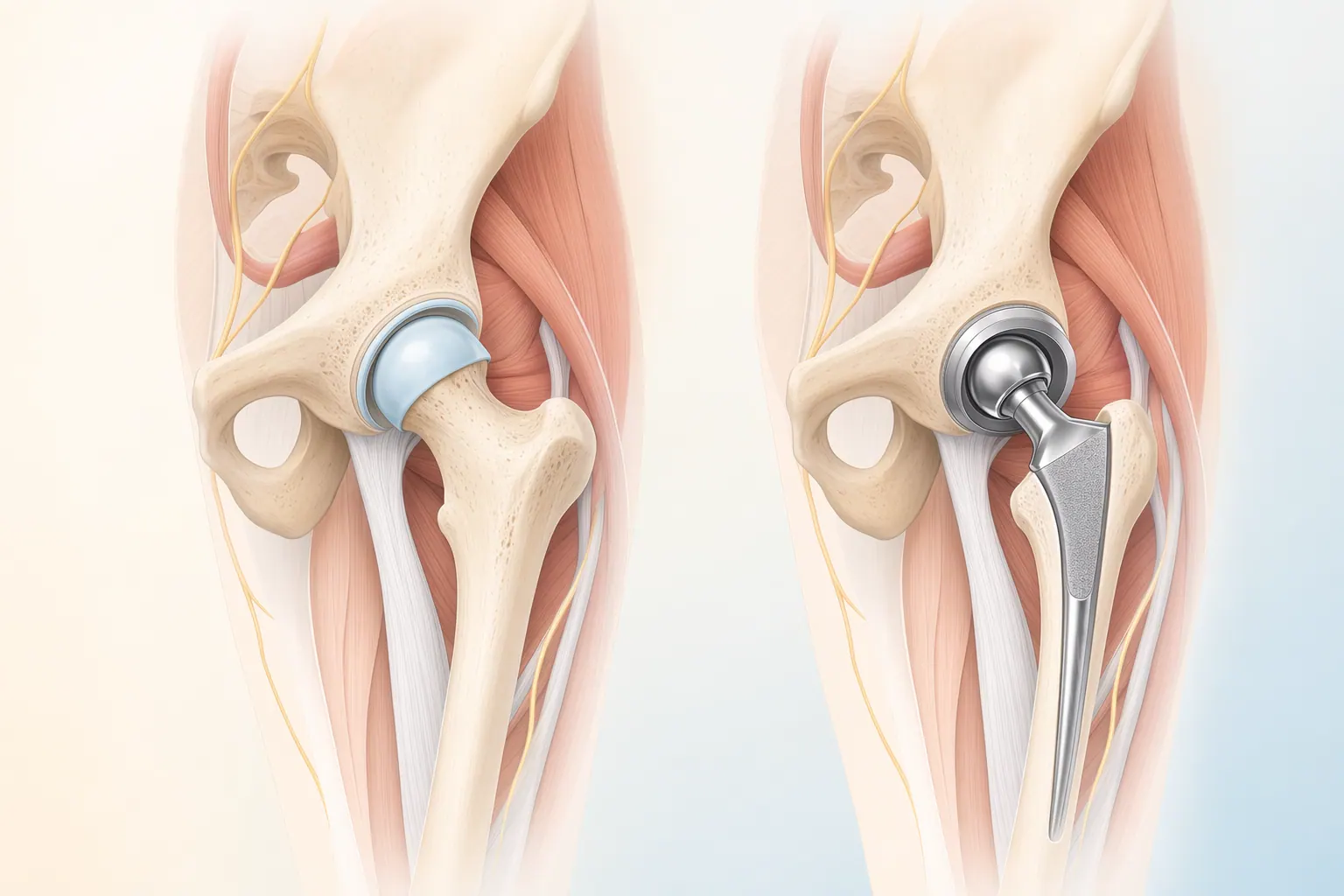
Anatomical illustration comparing total hip replacement and hip resurfacing — bone preservation differences
Two paths, same joint — THR removes the head and neck of the femur; resurfacing caps them.
Anatomy

Inside the hip joint.

The hip is a ball-and-socket joint. The 'ball' is the femoral head, the 'socket' is the acetabulum. THR replaces both sides of the joint with a stemmed metal implant and a polyethylene-lined cup. Resurfacing keeps the femoral head and neck intact, capping the ball with a metal sphere and resurfacing the socket with a metal cup. How much native bone is preserved is the biggest anatomical difference between the two operations.

Self-orient

When hip replacement makes sense.

Symptoms

Common symptoms

  • Groin or hip pain that limits walking, sleep, or putting on shoes
  • Stiffness that won't let you bend down to tie laces or sit comfortably
  • Imaging that shows bone-on-bone joint space loss
  • Loss of internal rotation on physical exam
  • Pain not relieved by NSAIDs, injections, weight loss, or PT
  • Reduced walking distance over the last 12-24 months
  • Limp or Trendelenburg gait that won't resolve
  • Sleep disruption from hip pain (a strong predictor of surgical benefit)
Causes

Common causes

  • Osteoarthritis (by far the most common reason for either procedure)
  • Post-traumatic arthritis after a fracture, dislocation, or labral injury
  • Inflammatory arthritis (rheumatoid, psoriatic, ankylosing spondylitis)
  • Avascular necrosis (osteonecrosis of the femoral head)
  • Hip dysplasia or femoroacetabular impingement that has progressed
  • Failure of conservative care after at least 3-6 months of structured PT and injections
Diagnostics

How we decide which procedure fits

Deciding between THR and resurfacing isn't a coin flip — it's a series of specific questions our hip surgeons answer at your evaluation.

The exam: Where exactly is the pain? Groin and lateral hip pain pointing toward intra-articular disease, or buttock pain that might be lumbar in origin? How much internal rotation is left? Is the leg shortened? Is there a meaningful Trendelenburg gait?

Imaging: Weight-bearing AP and lateral X-rays show the joint space, the femoral head shape, the acetabular coverage, and any cysts or bone loss. For resurfacing candidacy specifically, we measure femoral head size, look for cysts in the head and neck, and assess overall bone quality. Patients with large head cysts or poor bone density aren't resurfacing candidates.

Patient profile: Age, sex, activity goals, and any metal sensitivity history all factor in. We'll order metal ion baseline testing in some cases. We talk through what "return to activity" actually means for you — there's a difference between wanting to walk pain-free and wanting to keep running marathons at 55.

Most LAOSS patients leave their first evaluation with imaging in hand, a clear diagnosis, and a written plan that names both options when both are reasonable.


Choosing a path

Resurfacing-first vs total replacement-first.

Both paths start with the same conservative-care foundation. Where they diverge is the surgical decision — and that decision depends much more on who you are than on which procedure sounds better.

Conservative care
Step 1

Resurfacing-first patient

A narrow profile, but a good fit when it applies. We screen carefully — not every active patient is a resurfacing candidate.

  • Man, typically under 60 (some surgeons extend to mid-60s for younger biological age)
  • Large native femoral head (generally >50mm)
  • Good bone density and no significant cysts in the femoral head/neck
  • No history of metal sensitivity or allergy
  • High activity goals — running, court sports, heavy manual labor
  • Normal renal function (metal ion clearance matters)
  • Willing to do annual metal ion surveillance long-term
Surgical care
When needed

Total replacement-first patient

The default for the vast majority of hip arthritis patients — and the right call in many situations where resurfacing once seemed appealing.

  • Any patient over 60-65, or with reduced bone density
  • Women of any age (consistently higher complication rates with resurfacing)
  • Smaller-framed patients with smaller femoral heads
  • Patients with metal sensitivity, kidney disease, or planned pregnancy
  • Patients with femoral head cysts, avascular necrosis, or dysplasia
  • Anyone whose primary goal is reliable pain relief and walking, not high-impact sport
  • Patients who want the most well-studied, revisable option
Bone preservation

How much native bone you keep.

The biggest anatomical difference between THR and resurfacing — and the trade-off you weigh against everything else.

Resurfacing

Hip resurfacing — bone-conserving

Resurfacing keeps your femoral head and neck. The surgeon caps the ball with a metal sphere instead of removing it. For a 50-year-old who may need another procedure decades from now, that conserved bone matters.

  • Femoral head and neck preserved
  • Large femoral head (close to native size) reduces dislocation risk
  • More natural joint mechanics for some patients
  • If revision is needed, conversion to THR is generally feasible
  • Best suited to men under 60 with normal anatomy
THR

Total hip replacement — universal fit

THR removes the femoral head and neck and replaces them with a stemmed implant. You give up bone, but you gain universality — THR works for almost any patient anatomy, age, or activity level.

  • Femoral head and neck removed, stem placed into the femur
  • Polyethylene/ceramic bearing — no metal-on-metal ion concern
  • Works across age, sex, body size, and bone density
  • Modern bearings last 20-30 years in most patients
  • Decades of registry data behind every implant choice
Recovery & return to sport

How fast you get back — and to what.

Day-to-day recovery is similar. Where the procedures differ is the ceiling of activity you can push toward at the end of rehab.

THR

After total hip replacement

Most LAOSS THR patients walk the day of surgery, drop the walker within 2-3 weeks, and return to normal life inside 6-12 weeks. Same-day discharge is possible for many.

  • Same-day discharge possible for many anterior approach patients
  • Walker or cane for 1-3 weeks, then unaided walking
  • Driving typically resumes at 2-4 weeks
  • Desk work at 2-4 weeks; physical work at 6-12 weeks
  • Most surgeons advise against high-impact running long-term, but cycling, swimming, hiking, golf, doubles tennis are routine
  • Full return to recreation: 3-6 months
Resurfacing

After hip resurfacing

Early recovery looks similar to THR. Where it diverges is what we let you do at the 6-month mark and beyond — resurfacing patients can usually push back to higher-impact sport.

  • Hospital stay typically 1 night
  • Walker or cane for 1-3 weeks, then unaided walking
  • Driving typically resumes at 2-4 weeks
  • Return to running and court sports often cleared at 4-6 months
  • Lower dislocation risk than THR — fewer positional restrictions
  • Annual metal ion blood testing thereafter as part of standard surveillance
Recovery timelines are general guidance — your specific timeline depends on your starting fitness, body composition, surgical approach, and rehab adherence. Your LAOSS surgeon will give you a personalized milestone plan.
Durability & revision

Which one lasts longer — and what happens if it fails?

Both implants are designed to last decades. But registry data and patient profile drive different real-world outcomes.

01THR

Total hip replacement

Modern THR implants — highly cross-linked polyethylene on ceramic or metal heads — show 90%+ survivorship at 15-20 years in registry data.

  • Typical lifespan: 15-25+ years with modern bearings
  • Younger, more active patients wear faster
  • Failure modes: polyethylene wear, loosening, infection, dislocation
  • Revision is well-established and usually one staged operation
  • Most patients never need a revision
02Resurfacing

Hip resurfacing

When properly indicated (right patient, right implant, experienced surgeon), modern resurfacing shows comparable survivorship at 10-15 years. Outside ideal candidacy, results drop sharply.

  • Survivorship strongly depends on patient selection
  • Women and smaller patients show higher revision rates
  • Failure modes: femoral neck fracture, metal ion reaction (ALTR/pseudotumor), loosening
  • Revision is conversion to THR — generally straightforward
  • Annual metal ion testing detects problems early
03Either

If a revision is needed

Hip implants of both kinds are revisable. The key is catching the problem early — which is why LAOSS surgeons want you in for surveillance even when you feel fine.

  • Annual or biennial follow-up X-rays for the first 5-10 years
  • Metal ion testing for all resurfacing patients
  • New onset groin pain after a quiet period — always call us
  • Most revisions are planned, not emergencies
  • Outcomes after revision are good in experienced hands
Surgeon expertise

Why the surgeon matters more than the implant.

Why experience matters

Hip arthroplasty is one of the most volume-sensitive procedures in orthopedics. Surgeon volume predicts outcome more reliably than implant brand or surgical approach.

  • Component positioning is everything — millimeters and degrees matter
  • Resurfacing in particular is unforgiving of imperfect positioning
  • Honest candidacy screening prevents bad outcomes downstream
  • Same surgeon for evaluation, surgery, and follow-up

The LAOSS approach

We do both procedures — but we recommend resurfacing only when the patient truly fits the profile. The default is THR because THR is the right answer for most people.

  • Board-certified hip & knee surgeons (Dr. Barba, Dr. Dworsky)
  • Sports medicine input from Dr. Bastian for athletic patients
  • Same- or next-day evaluation at eight LA-area offices
  • Coordinated PT through your in-network provider
Candidacy

Which one am I a candidate for?

If most of the items in either column match your situation, an evaluation with a hip specialist is the next step. Many patients qualify for THR but not resurfacing — that's the norm, not the exception.

Resurfacing

Likely a resurfacing candidate if

A narrow but real group of patients does very well with resurfacing — typically younger, larger-framed, active men.

  • Man, under 60 (or biologically younger 60-65)
  • Large femoral head on imaging (typically >50mm)
  • Good bone density on DEXA or imaging review
  • No known metal sensitivity or allergy
  • High activity goals — running, court sport, manual labor
  • Normal kidney function and no plan for pregnancy
  • Comfortable with annual surveillance long-term
THR

THR is likely the right call if

Most hip arthritis patients fall here — and THR isn't a compromise, it's the gold standard for nearly all comers.

  • Woman of any age, or man over 60-65
  • Reduced bone density or femoral head cysts
  • Smaller body frame or smaller femoral head
  • History of metal sensitivity, kidney disease, or planned pregnancy
  • Avascular necrosis or significant deformity
  • Primary goal is pain relief and walking, not impact sport
  • Prefer the most-studied, most-revisable option
ImportantSeek urgent evaluation for sudden severe hip or groin pain, inability to bear weight, fever after a recent procedure, or any sign of infection. New groin pain in a previously quiet hip implant always warrants a call.
Recovery

Your hip recovery roadmap.

Whether you choose THR or resurfacing, the first 8 weeks look similar. The differences show up around the 4-6 month mark when we clear higher-impact activity.

01Days 0–14

Right after surgery

Most patients are walking with assistance the day of surgery. The first two weeks focus on pain control, wound healing, and restoring basic motion.

  • Same-day discharge possible for many patients
  • Walker or crutches transitioning to a cane
  • DVT prophylaxis (blood thinner) per protocol
  • Wound checked at 10-14 days; sutures or staples removed
  • Hip precautions discussed (more restrictive after posterior THR than after resurfacing)
02Weeks 2–8

Rehabilitation

Structured PT rebuilds gait, strength, and confidence. Most patients are walking unaided by 4-6 weeks and back to desk work within the same window.

  • Progressive weight-bearing and strengthening
  • Gait retraining and balance work
  • Driving usually cleared at 2-4 weeks (right hip later)
  • Return to desk work typically 2-4 weeks
  • Coordinated PT through your in-network provider
03Months 2+

Return to life

Once function is restored, the focus shifts to long-term activity goals — and that's where THR and resurfacing diverge.

  • THR: cycling, swimming, hiking, golf, doubles tennis routinely
  • Resurfacing: running and impact sport often cleared at 4-6 months
  • Annual X-ray follow-up for the first several years
  • Metal ion blood testing for resurfacing patients
  • Direct line back to your surgeon if anything changes
Risks & considerations

What to weigh before you decide.

Both procedures carry standard surgical risk plus a small set of risks specific to the bearing surface and the approach. We talk through all of these at your evaluation — informed consent is a conversation, not a form.

Both

Shared risks (THR & resurfacing)

Every hip arthroplasty carries the same baseline risks. We screen, prepare, and monitor for these on every patient.

  • Infection (under 1% with modern technique and prophylaxis)
  • Bleeding, DVT, or pulmonary embolism
  • Reaction to anesthesia
  • Leg-length discrepancy (more common after THR)
  • Nerve injury (rare)
  • Component loosening or wear over time
Resurfacing only

Resurfacing-specific concerns

Resurfacing carries risks that THR does not — these are the reasons FDA indications have narrowed and the reasons patient selection matters so much.

  • Metal ion release (cobalt, chromium) into bloodstream
  • Adverse local tissue reaction (ALTR) or pseudotumor
  • Femoral neck fracture after surgery
  • Higher complication rates in women and smaller patients
  • Annual surveillance with metal ion testing required
  • Not appropriate in metal sensitivity or kidney disease
Your care team

Meet the LAOSS hip surgeons

Dr. David Barba and Dr. Erik Dworsky are LAOSS's hip & knee surgeons — they perform both total hip replacement and, in carefully selected patients, hip resurfacing. Dr. Sevag Bastian handles sports-related hip pathology, including labral tears and femoroacetabular impingement that can feed into the surgical decision later.

We don't push every younger patient toward resurfacing because it sounds appealing — and we don't default every patient over 60 to THR without thinking. The right answer comes from a real evaluation with the right imaging in hand. Most patients leave their first LAOSS visit with both options named, the trade-offs explained, and a clear recommendation grounded in their specific anatomy and goals.

Patient reviews

What hip patients say about us.

★★★★★4.97,500+ Google reviews
Highly recommend Dr. Dworsky for hip replacement. Patient, thorough, and the recovery has been ahead of schedule. So glad I came here.
Felipe Ortiz
Lincoln Heights, CA · 2 December 2024
Explore related care

Find care by body area.

Jump to a nearby condition page and compare treatment paths across the body.

FAQ

Hip replacement vs resurfacing — common questions

  • After hip resurfacing, most appropriately selected patients are cleared to return to running, court sports, and other high-impact activities at 4-6 months — the larger preserved femoral head and reduced dislocation risk are part of why resurfacing appeals to high-demand patients. After total hip replacement, most surgeons clear patients for cycling, swimming, hiking, golf, doubles tennis, and skiing, but advise against habitual high-impact running long-term because it accelerates bearing wear. That said, many THR patients run recreationally without obvious problems. Your LAOSS surgeon will give you a personalized clearance based on your implant, your goals, and how your hip is recovering.
  • Because outcomes vary dramatically by patient profile. Registry data going back to the early 2010s consistently shows that hip resurfacing performs well in men under 60 with large native femoral heads, normal bone density, and no metal sensitivity — and performs poorly in women, smaller-framed patients, older patients, and anyone with bone-quality issues. The FDA narrowed approved indications in response. At LAOSS we'll tell you honestly whether you fit the resurfacing profile; many patients who ask about it find that total hip replacement is the better answer for their specific situation.
  • Hip resurfacing is a metal-on-metal bearing — a cobalt-chromium femoral cap articulating against a cobalt-chromium acetabular cup. As the surfaces move, microscopic metal particles and ions are released into surrounding tissue and the bloodstream. In most appropriately selected patients these levels stay low and clinically silent, but in some patients (especially women, smaller patients, and those with poorly positioned components) they can trigger adverse local tissue reactions, pseudotumor formation, or systemic concerns. Standard surveillance for any resurfacing patient includes annual or biennial cobalt and chromium blood tests and routine imaging. Patients with known metal allergy or kidney disease are not resurfacing candidates.
  • When properly indicated, both implants show 90%+ survivorship at 10-15 years in modern registry data. Total hip replacement has longer-term data — modern bearings (highly cross-linked polyethylene on ceramic or metal heads) routinely deliver 20-30 years of function. Hip resurfacing survivorship is highly dependent on patient selection: in the ideal candidate (younger man, large head, experienced surgeon) results are excellent; outside ideal candidacy, revision rates climb. For most patients the more honest answer is that THR is the more universally durable option, while resurfacing can match or exceed it in the right person.
  • Yes — both are revisable. If a total hip replacement fails (typically from wear, loosening, or rare infection), revision surgery is a well-established procedure, usually a single staged operation, with good outcomes in experienced hands. If a hip resurfacing fails, revision generally means converting it to a standard total hip replacement — because the femoral head and neck were preserved at the index surgery, the revision is usually straightforward and similar to a primary THR. The key in either case is catching the problem early through routine surveillance, which is why your LAOSS surgeon will keep you on a follow-up schedule even when you feel completely fine.
  • Probably not, despite the common worry. Most modern airport metal detectors are calibrated for higher-density metal masses than hip implants present, and most patients with either THR or resurfacing pass through without alerting. If you do trigger a detector, a brief secondary screening resolves it. You don't need a special card or letter to travel — TSA does not issue or require them — but if it makes you more comfortable, your LAOSS surgeon can provide a note documenting your implant for your records.
  • Day-to-day, recovery looks similar. Both procedures: walking with assistance the day of surgery, walker or crutches for 1-3 weeks, transition to a cane, then unaided walking around 4-6 weeks. Driving typically resumes at 2-4 weeks. Desk work returns at 2-4 weeks; physical work at 6-12 weeks. The divergence shows up at the 4-6 month mark — that's when resurfacing patients are usually cleared to return to running and high-impact sport, while THR patients are cleared for low- and moderate-impact activity. Total time to feel "normal" again is typically 3-6 months for both, with continued improvement out to a year.
  • There's no hard upper age limit for total hip replacement — we routinely operate on patients into their 80s and 90s if they're medically fit, because the quality-of-life benefit is enormous. Hip resurfacing has a softer upper limit: most surgeons reserve it for patients under 60-65, because bone quality tends to drop with age and the femoral neck fracture risk after resurfacing climbs in older bone. On the lower end, both procedures are reasonable for younger patients with end-stage hip arthritis when conservative care has failed — but if you're 40 and looking at decades of implant life, that's where the bone-preserving argument for resurfacing (in eligible men) carries weight. Your LAOSS surgeon will factor age into the recommendation but won't use it as a single deciding factor.
Ready when you are

Get an honest answer.

Book a visit with a LAOSS hip surgeon at any of our eight Los Angeles–area offices. Bring your imaging if you have it — we'll tell you which procedure actually fits, and which doesn't.

Booking now
21 specialists · 8 offices
Greater Los Angeles
On-site X-raySame visit
Most insurers acceptedIn-network
Call usBook online