Common foot & ankle concerns we treat
- Pain that limits walking, standing, or sleep
- Stiffness, swelling, or reduced range of motion
- Sports injuries — acute or overuse
- Arthritis or post-traumatic joint changes
- Conditions other doctors couldn’t resolve
Lateral ankle ligament reconstruction tightens or rebuilds the worn-out ligaments on the outside of the ankle so it stops giving way and rolling. Our fellowship-trained and experienced foot and ankle specialists perform this repair across eight Los Angeles-area offices, with on-site imaging and a conservative-first approach before any surgery is recommended.

Surgical and non-surgical options at LAOSS.
The ankle is held steady on its outer side by a small group of ligaments — mainly the anterior talofibular ligament (ATFL) and the calcaneofibular ligament (CFL), which run from the end of the fibula (the outer ankle bone) to the talus and heel bone. These are the ligaments injured in a classic "rolled ankle." Most sprains heal well with bracing and rehab. But when they heal stretched out or never fully heal, the ankle can become chronically unstable — it gives way on uneven ground, rolls easily, and feels untrustworthy.
Lateral ankle ligament reconstruction is the surgery that fixes this instability. The goal is to restore normal tension to the outer ligaments so the ankle stops shifting where it shouldn't. It is considered only after a fair trial of non-surgical care — typically several months of bracing plus physical therapy aimed at the peroneal muscles and balance (proprioception) — has not stopped the recurrent rolling.
This is not the same as treating a fresh sprain. It is a planned procedure for an ankle that has been unstable for a while, confirmed on exam by a loose, positive anterior drawer or talar tilt test and supported by MRI or stress imaging. Because cartilage injuries inside the joint often travel with long-standing instability, the surgery is frequently combined with a look inside the joint using a camera.
This surgery corrects an unstable ankle. It tightens one or more ligaments that support your ankle. It helps people who've had repeated ankle sprains. It can also help people who have certain foot deformities.
Animations licensed from ViewMedica · Swarm Interactive
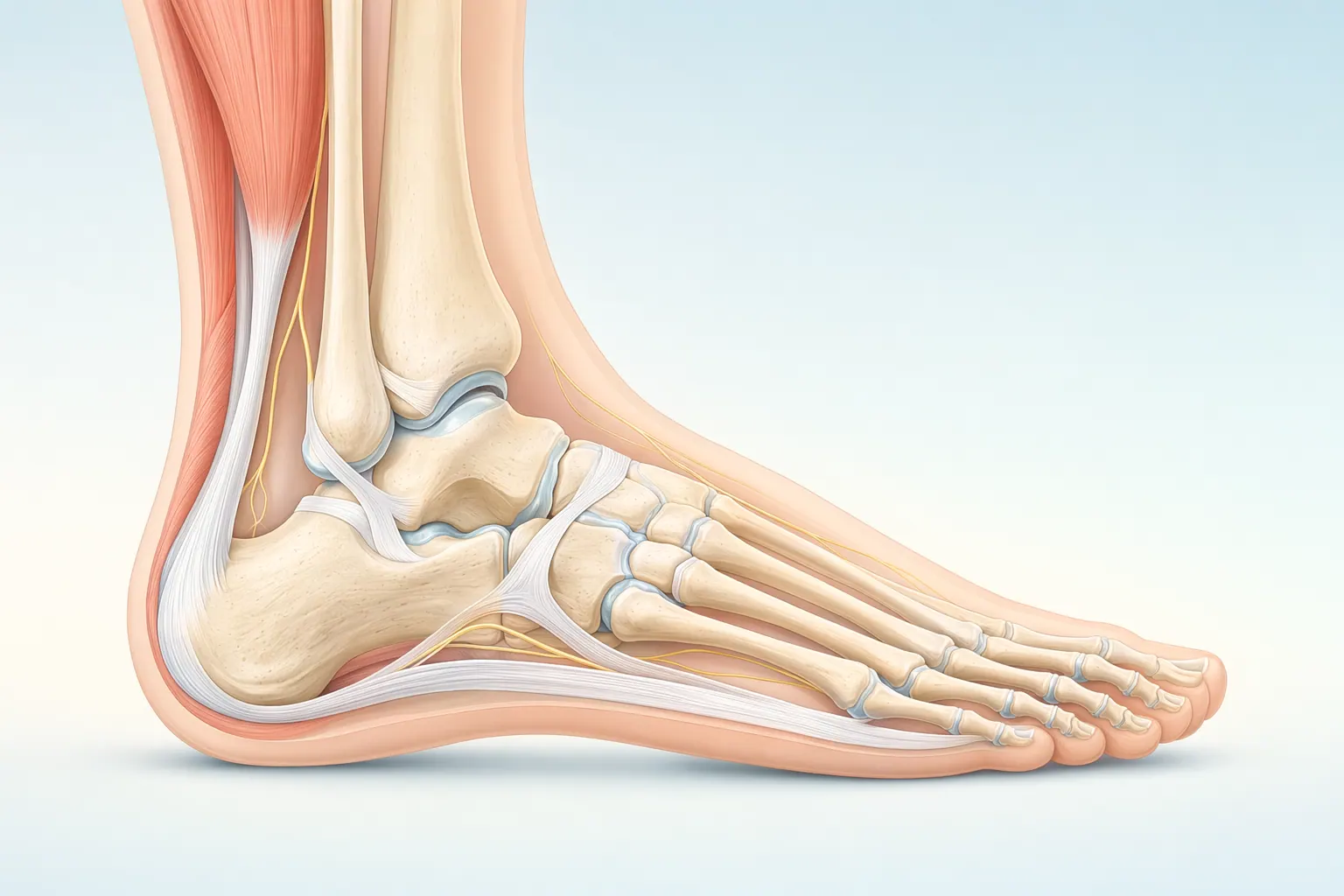
The foot and ankle have 26 bones, more than 30 joints, and over 100 ligaments and tendons. The plantar fascia spans the bottom of the foot, the Achilles tendon anchors the calf to the heel, and the ankle is a hinge that handles every step you take. Most foot and ankle problems trace back to overload, alignment, or footwear that doesn’t match the way your foot is built.
The procedure is done under anesthesia, usually as a same-day outpatient surgery. The exact steps depend on how much healthy ligament tissue remains.
The incisions are closed, and the ankle is placed in a splint or boot before you go home the same day.
Foot & Ankle care is highly technique-dependent. Volume, training, and judgment together determine the outcome you actually feel six months later.
Our foot & ankle specialists move stepwise — start with the least-invasive option that fits your situation, escalate only when it doesn't.
If most of these match your situation, an evaluation with a foot & ankle specialist is the next step.
These signs typically point toward an in-person evaluation with a foot & ankle specialist.
Your first visit is built to give you an answer the same day, not just another referral.
Recovery is rarely a straight line — but a clear plan with measurable milestones makes the path predictable.
In the first two weeks we focus on protecting the foot & ankle, calming inflammation, and restoring basic motion.
Targeted physical therapy rebuilds strength, mobility, and confidence in the foot & ankle.
Once function is restored, the focus shifts to keeping you there — and catching any recurrence early.
We talk through the risks and benefits with every patient — informed consent is a conversation, not a form.
Every orthopedic intervention carries a small set of standard risks. We screen, prepare, and monitor for these on every patient.
Some risks are tied to the structures we're treating in the foot & ankle. We discuss these in detail at your visit so you can weigh them against the benefits.
At LAOSS, our foot & ankle specialists combine advanced surgical expertise with a patient-first approach. From minimally invasive arthroscopic techniques to reconstruction, fracture care, and arthritis management, our physicians bring decades of experience to every case. Trusted across Los Angeles, our team is dedicated to restoring mobility, relieving pain, and helping you return to the activities you love.
An ankle that keeps rolling is more than an inconvenience. Each episode of giving way risks a new sprain, and repeated instability is strongly linked to cartilage wear on the talus over time — which is much harder to fix than the ligaments themselves. Restoring stability protects the joint, not just your confidence on stairs and trails.
At LAOSS, our foot and ankle specialists treat this the same way every time: conservative care first. Many people who think they need surgery turn out to do well with a focused bracing-and-therapy program targeting the peroneal muscles and balance. We reserve reconstruction for ankles that stay unstable despite a genuine effort at rehab, and we confirm the diagnosis with a hands-on exam and imaging before recommending the operating room.
When surgery is the right call, technique and judgment matter. Repairing your own tissue when it is healthy, reconstructing with a graft when it isn't, and checking the joint surface at the same time are the decisions that determine how the ankle feels a year later. Care is available across eight Los Angeles-area offices, with same- or next-day appointments and on-site imaging at most locations.
Book a visit with a foot & ankle specialist at any of our eight Los Angeles–area offices.