Los Angeles Orthopedic
Foot & Ankle · Conditions A–Z

Peroneal Tendon Injuries outer-ankle tendons

Peroneal tendon injuries affect the two tendons that run behind the bony bump on the outside of your ankle, ranging from inflammation and tears to tendons that slip out of place. Same-day or next-day evaluations across eight LA-area offices.

Los Angeles orthopedic specialist evaluating a patient for peroneal tendon injuries — LAOSS board-certified care across eight LA offices
Live · Now Accepting

Experts in foot & ankle care.

Surgical and non-surgical options at LAOSS.

15+
Years caring
Same-day appointments
Often available
★★★★★
4.9 · 7,500+ reviews

Common foot & ankle concerns we treat

  • Pain that limits walking, standing, or sleep
  • Stiffness, swelling, or reduced range of motion
  • Sports injuries — acute or overuse
  • Arthritis or post-traumatic joint changes
  • Conditions other doctors couldn’t resolve

What sets LAOSS apart

  • Same- or next-day appointments at eight Los Angeles–area offices
  • On-site imaging; PT coordinated with your in-network provider
  • Conservative-first care, surgery only when needed
  • Board-certified specialists, not generalists
Key takeaways
  • Peroneal tendon injuries involve the two tendons behind the outer ankle bone and include tendinitis, tenosynovitis, tears, and tendons that subluxate (slip out of their groove).
  • Most cases improve with conservative care: immobilization in a boot or brace, activity modification, and targeted physical therapy with your in-network provider.
  • Tendon tears and recurrent dislocation that don't settle with bracing may need surgical repair or groove-deepening — we explain every option and recovery timeline.
  • On-site imaging at most offices and same-day appointments across eight Los Angeles-area locations.
Overview

What is peroneal tendon injuries?

Peroneal tendon injuries affect the peroneus longus and peroneus brevis — two tendons that travel down the outside of the lower leg, wrap behind the bony bump on the outer ankle (the lateral malleolus), and help turn the foot outward and stabilize it against rolling inward. These injuries cover a spectrum: irritation and swelling of the tendon sheath (tenosynovitis), degeneration of the tendon itself (tendinosis), longitudinal splits or tears, and tendons that slip forward out of their groove (subluxation or dislocation), often after the retaining ligament behind the ankle is torn.\n\nMost peroneal tendon problems respond well to conservative care — a period of immobilization in a walking boot or brace to calm the tendons, activity modification, anti-inflammatory measures, and a structured physical therapy program to rebuild strength and balance. When a tendon is significantly torn, or when it keeps snapping out of place despite bracing, the next-step procedures below may be the right call.\n\nBelow, we walk through the anatomy involved, the symptoms and causes we see most often, how we diagnose peroneal tendon injuries, and the full range of treatment options — from the simplest to the most involved.

Patient education

Watch: Peroneal Tendon Injuries

This is a swelling and thickening of the peroneal tendons. These tendons travel from the lower leg to the foot. They pass along the outer side of the ankle. Tendinosis is a long-term problem.

Animations licensed from ViewMedica · Swarm Interactive
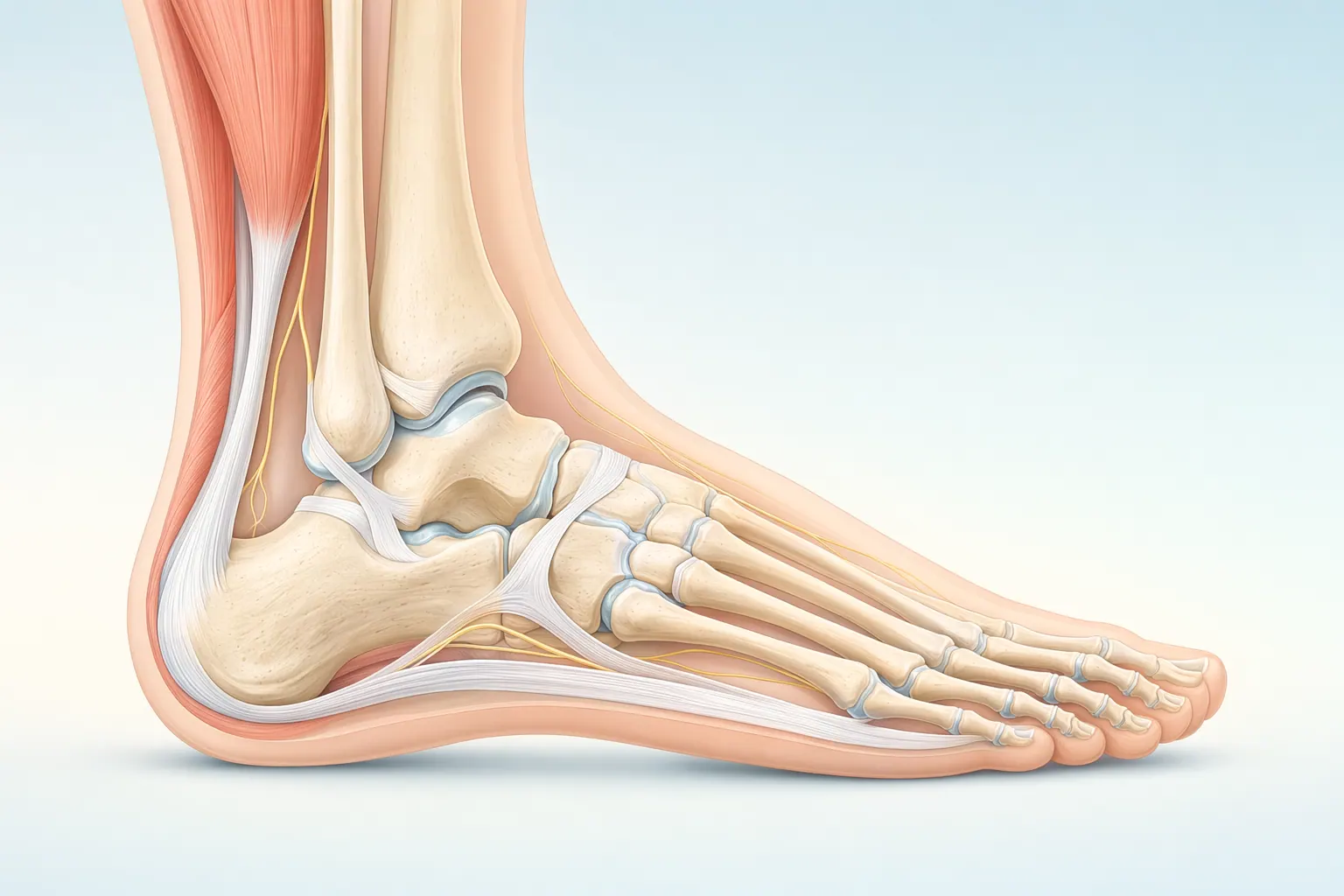
Anatomical illustration of the foot and ankle showing the tibia, talus, calcaneus, and plantar fascia
Anatomy of the foot & ankle — tibia, talus, calcaneus, metatarsals, and the plantar fascia.
Anatomy

Inside the foot & ankle.

The foot and ankle have 26 bones, more than 30 joints, and over 100 ligaments and tendons. The plantar fascia spans the bottom of the foot, the Achilles tendon anchors the calf to the heel, and the ankle is a hinge that handles every step you take. Most foot and ankle problems trace back to overload, alignment, or footwear that doesn’t match the way your foot is built.

Self-orient

When peroneal tendon injuries shows up.

Symptoms

Common symptoms

  • Pain and swelling along the outside of the ankle, behind the bony bump
  • Pain that worsens with activity and eases with rest
  • A snapping or popping sensation behind the outer ankle bone
  • Weakness or instability when turning the foot outward or on uneven ground
  • Tenderness that follows the tendons up toward the calf
  • Recurrent ankle rolling or a feeling of giving way
Causes

Common causes

  • Acute ankle sprains, especially repeated inversion (rolling-in) injuries
  • Overuse from running, dancing, or sports with cutting and pivoting
  • A high-arched (cavus) foot that overloads the outer-ankle tendons
  • A shallow groove behind the ankle that lets tendons slip out of place
  • Sudden forceful contraction during a fall or push-off (tearing the retinaculum)
  • Age-related tendon degeneration
Diagnostics

How we diagnose peroneal tendon injuries

You want answers, fast — and we’re built to give them. Most patients leave their first LAOSS visit with a clear diagnosis and a written plan, not another referral chain.

Here’s what your initial visit for peroneal tendon injuries typically looks like:

  • Detailed history — when it started, what makes it better or worse, what you’ve already tried
  • Focused exam of the foot & ankle — range of motion, stability, strength, specific provocation tests
  • On-site imaging at most offices: X-ray for bone, ultrasound or MRI when soft-tissue detail is needed
  • A written plan with options ranging from conservative care to surgical procedures, in plain English

Schedule your evaluation with a trusted Greater Los Angeles orthopedic expert today.

Treatment options

How we treat peroneal tendon injuries at LAOSS

Once we’ve confirmed the diagnosis, the next step is matching the right treatment to your situation. We start with the least-invasive option that fits — and escalate only when it doesn’t.

Conservative care
Step 1

Conservative care first

Non-surgical options designed to relieve pain, restore movement, and avoid the OR when possible.

  • Immobilization in a walking boot or cast to rest the tendons
  • Bracing, ankle stabilizers, or taping for support
  • Activity modification and a temporary break from aggravating sports
  • NSAIDs and ice to control pain and swelling
  • Physical therapy for peroneal strengthening, balance, and proprioception
  • Lateral-post orthotics or footwear changes for high-arched feet
Surgical care
When needed

Surgical options when needed

Procedures performed by board-certified foot & ankle surgeons when conservative care isn’t enough.

  • Tenosynovectomy — cleaning out inflamed tendon-sheath tissue
  • Primary repair or tubularization of a longitudinal tendon tear
  • Tenodesis (joining the damaged tendon to the healthy one) for unsalvageable tears
  • Superior peroneal retinaculum repair for recurrent subluxation
  • Fibular groove deepening to keep the tendons seated
  • Allograft or tendon transfer for extensive, irreparable tears
Surgeon expertise

Why experience matters.

Why experience matters

Foot & Ankle care is highly technique-dependent. Volume, training, and judgment together determine the outcome you actually feel six months later.

  • Precise diagnosis from imaging and exam
  • Conservative-first care that avoids unnecessary surgery
  • Surgical technique refined over thousands of cases
  • On-site imaging + coordinated PT through your in-network provider

The LAOSS approach

Our foot & ankle specialists move stepwise — start with the least-invasive option that fits your situation, escalate only when it doesn't.

  • Same-day imaging at most offices
  • PT coordinated in your insurance network
  • Board-certified surgeons performing the procedures themselves
  • Direct access to your specialist between visits
Candidacy

Am I a candidate?

If most of these match your situation, an evaluation with a foot & ankle specialist is the next step.

You may be

You may be a candidate if

These signs typically point toward an in-person evaluation with a foot & ankle specialist.

  • Pain, swelling, or tenderness along the outside of your ankle that hasn't settled in a few days
  • A snapping or popping behind the outer ankle bone when you move your foot
  • Repeated ankle rolling or a feeling that the ankle gives way
  • Outer-ankle pain that lingered after an ankle sprain you thought had healed
  • Difficulty turning the foot outward or pushing off without pain
Evaluation

What evaluation includes

Your first visit is built to give you an answer the same day, not just another referral.

  • Detailed history — onset, mechanism, what makes it better or worse
  • Hands-on exam focused on the affected joint or region
  • On-site imaging at most offices (X-ray, ultrasound)
  • Clear plan with options ranging from conservative to surgical
  • Same-day or next-day scheduling for any follow-up tests
ImportantSeek urgent evaluation for sudden severe pain, an open wound or exposed bone, foot or ankle deformity after trauma, loss of sensation, or any sign of infection (fever, spreading redness, or swelling).
Recovery

Your foot & ankle recovery roadmap.

Recovery is rarely a straight line — but a clear plan with measurable milestones makes the path predictable.

01Days 0–14

Right after care

In the first two weeks we focus on protecting the foot & ankle, calming inflammation, and restoring basic motion.

  • Activity modification with clear do/don’t guidance
  • Ice, elevation, and pain control as needed
  • Gentle range-of-motion within safe limits
  • Follow-up scheduled to track healing
02Weeks 2–8

Rehabilitation

Targeted physical therapy rebuilds strength, mobility, and confidence in the foot & ankle.

  • Progressive strengthening and neuromuscular work
  • Manual therapy and soft-tissue treatment
  • Sport- or job-specific movement re-training
  • Coordinated PT through your in-network provider
03Months 2+

Long-term care

Once function is restored, the focus shifts to keeping you there — and catching any recurrence early.

  • Return-to-activity plan with measured benchmarks
  • Home program tailored to your sport or job
  • Maintenance visits or imaging if symptoms change
  • Direct line back to your specialist if needed
Risks & considerations

What to weigh before you decide.

We talk through the risks and benefits with every patient — informed consent is a conversation, not a form.

General

General considerations

Every orthopedic intervention carries a small set of standard risks. We screen, prepare, and monitor for these on every patient.

  • Infection (rare with modern technique and prophylaxis)
  • Bleeding or bruising at the treatment site
  • Reaction to anesthesia or medications
  • Need for additional procedures in some cases
Specific

Foot & Ankle-specific considerations

Some risks are tied to the structures we're treating in the foot & ankle. We discuss these in detail at your visit so you can weigh them against the benefits.

  • Temporary stiffness or weakness during recovery
  • Incomplete pain relief in a small percentage of cases
  • Nerve or vessel irritation near the treatment area
  • Need for follow-up therapy to fully restore function
Your care team

Meet our foot & ankle doctors in the Greater Los Angeles area

At LAOSS, our foot & ankle specialists combine advanced surgical expertise with a patient-first approach. From minimally invasive arthroscopic techniques to reconstruction, fracture care, and arthritis management, our physicians bring decades of experience to every case. Trusted across Los Angeles, our team is dedicated to restoring mobility, relieving pain, and helping you return to the activities you love.

Specialists

Meet your foot & ankle specialists.

4 providers
About this care

Reliable peroneal tendon pain relief starts here

Don't let outer-ankle pain or a snapping tendon be something you just push through — left unaddressed, peroneal tendon injuries can progress from inflammation to a tear and lead to ongoing ankle instability. At LAOSS, expert care is close to home. With same- or next-day appointments at multiple Los Angeles locations, you'll never wait weeks or months for answers, and on-site imaging means we can often confirm what's going on at your first visit.\n\nWhether you need bracing and physical therapy or a tendon repair, you'll receive coordinated, personalized care from diagnosis through return to activity. Call or schedule online today to begin your recovery with a trusted foot & ankle specialist in Los Angeles.

Patient reviews

What patients say about us.

★★★★★4.97,500+ Google reviews
Wonderful staff. The MA was so kind to my elderly mom and the doctor explained everything twice so she’d remember. Felt like we were treated like family.
Patricia Aguilar
Cerritos, CA · 6 January 2025
Explore related care

Find care by body area.

Jump to a nearby condition page and compare treatment paths across the body.

FAQ

Common peroneal tendon injuries questions

  • We start with a focused exam of the outer ankle, checking for tenderness, swelling, strength turning the foot outward, and whether the tendons snap or slip out of their groove. X-rays are usually done in-office to rule out fracture, and MRI or ultrasound is added when we need to see tendon tears or inflammation in detail.
  • Most peroneal tendinitis and tenosynovitis cases improve with immobilization, bracing, and physical therapy — surgery is not the first step. We reserve repair, groove-deepening, or retinaculum surgery for significant tears or tendons that keep dislocating despite conservative care, and we explain every option first.
  • Snapping or popping behind the lateral malleolus often means the peroneal tendons are subluxating — slipping forward out of their groove because the retaining ligament (superior peroneal retinaculum) is stretched or torn. This should be evaluated, since recurrent dislocation can damage the tendon over time and frequently needs more than rest to fully resolve.
  • With conservative care, many people improve over 6 to 12 weeks of bracing and rehab, though high-arched feet and recurrent instability can take longer. After surgical repair, expect a period of immobilization followed by progressive physical therapy, with return to sport typically several months out depending on the procedure.
Ready when you are

Don’t wait on pain.

Book a visit with a foot & ankle specialist at any of our eight Los Angeles–area offices.

Booking now
21 specialists · 8 offices
Greater Los Angeles
On-site X-raySame visit
Most insurers acceptedIn-network
Call usBook online