Los Angeles Orthopedic
General · Conditions A–Z

Osteoporosis bone weakening

Osteoporosis is a condition of weakened, brittle bones that fracture more easily — often silent until a fracture occurs, and treatable with medication, nutrition, and weight-bearing activity. Same-day or next-week evaluations across eight LA-area offices.

Los Angeles orthopedic specialist evaluating a patient for osteoporosis — LAOSS board-certified care across eight LA offices
Live · Now Accepting

Experts in orthopedic care.

Surgical and non-surgical options at LAOSS.

15+
Years caring
Same-day appointments
Often available
★★★★★
4.9 · 7,500+ reviews

Common orthopedic concerns we treat

  • Pain that limits walking, lifting, or sleep
  • Stiffness, swelling, or reduced range of motion
  • Sports injuries — acute or overuse
  • Arthritis or post-traumatic joint changes
  • Conditions other doctors couldn't resolve

What sets LAOSS apart

  • Same- or next-day appointments at eight Los Angeles–area offices
  • On-site imaging; PT coordinated with your in-network provider
  • Conservative-first care, surgery only when needed
  • Board-certified specialists, not generalists
Key takeaways
  • Osteoporosis is one of many orthopedic conditions our specialists evaluate every day.
  • Treatment is medical: bone-strengthening medication, calcium and vitamin D, weight-bearing exercise, and fall prevention — surgery treats fractures, not osteoporosis.
  • When a procedure is the right call, we explain every option, recovery timeline, and return-to-activity milestone.
  • On-site imaging at most offices and same-day appointments across eight Los Angeles–area locations.
Overview

What is osteoporosis?

Osteoporosis is a condition of weakened, brittle bones that fracture more easily — often silent until a fracture occurs, and treatable with medication, nutrition, and weight-bearing activity. Symptoms can develop gradually or after a specific injury, so early evaluation matters when function starts to decline.

Osteoporosis itself is treated medically, not surgically — bone-strengthening medication such as bisphosphonates, calcium and vitamin D, weight-bearing and resistance exercise, and an honest look at fall risk, with medication management coordinated through your primary care physician. Where our surgeons come in is the fractures osteoporosis causes — wrist, hip, and spine — including kyphoplasty for painful compression fractures and fixation or replacement for hip fractures, always paired with a bone-health plan to prevent the next break.

Below, we walk through the anatomy involved, the symptoms and causes we most often see, how we diagnose osteoporosis, and the full range of treatment options — from the simplest to the most involved.

Patient education

Watch: Osteoporosis

As you get older, your bones may get weaker. This is called "osteoporosis." Weak bones are more likely to break. Osteoporosis can be a problem for anyone, but it is more common in women.

Animations licensed from ViewMedica · Swarm Interactive
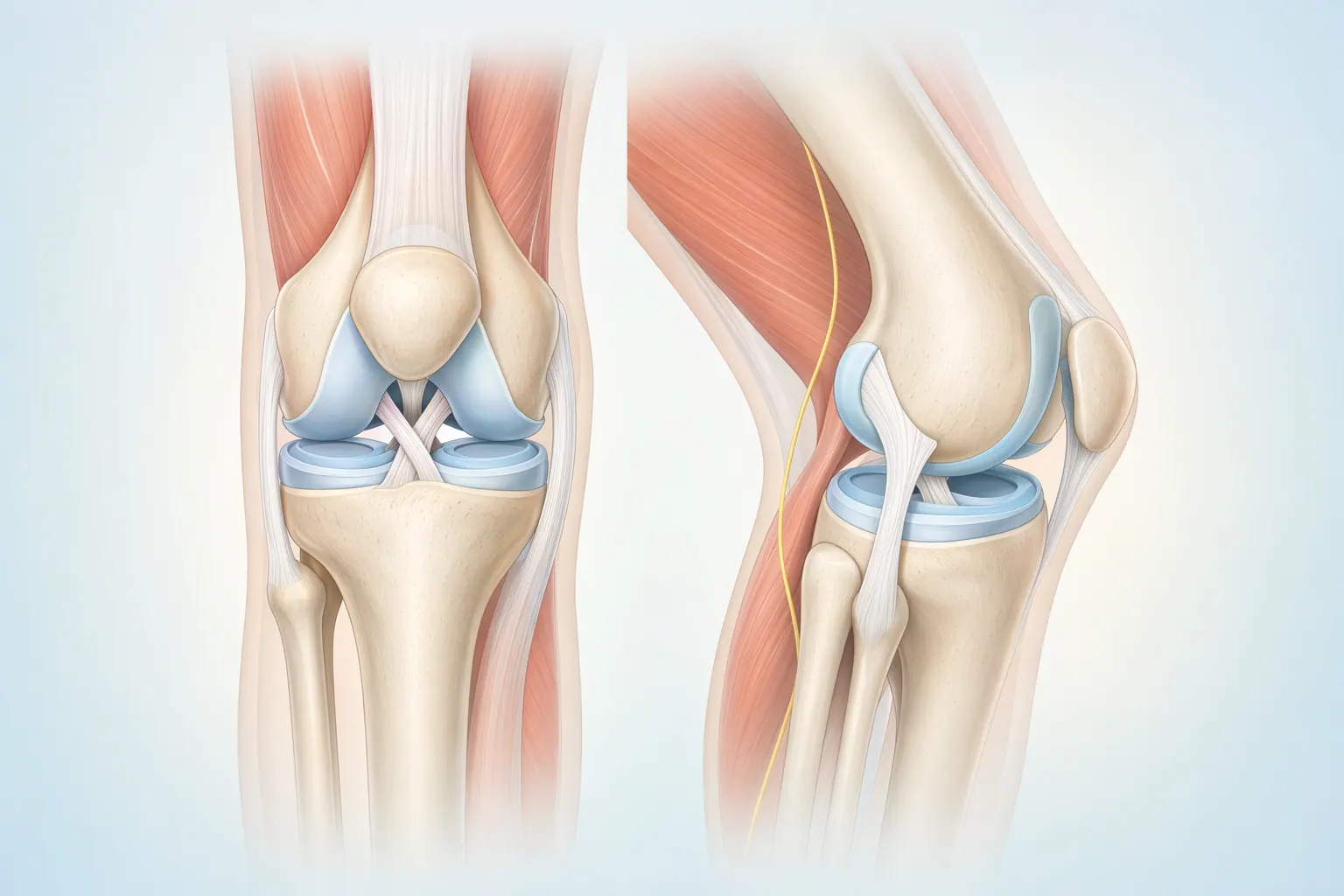
Anatomical illustration of a joint showing cartilage, ligaments, and surrounding muscle
General orthopedic anatomy — joints, ligaments, tendons, and muscle.
Anatomy

Inside the musculoskeletal system.

Most musculoskeletal pain comes down to one of four tissues: bone, cartilage, ligament/tendon, or muscle. The right care starts with the right diagnosis — figuring out which tissue is hurt, why, and how much. From there the plan is built around the specific condition, your goals, and what you actually do day to day.

Self-orient

When osteoporosis shows up.

Symptoms

Common symptoms

  • Often asymptomatic until a fracture occurs
  • Back pain from compression fractures
  • Loss of height over time
  • Stooped posture (kyphosis)
Causes

Common causes

  • Postmenopausal estrogen decline
  • Age-related bone loss
  • Long-term steroid use
  • Calcium, vitamin D, or protein deficiency
Diagnostics

How we diagnose osteoporosis

You want answers, fast — and we're built to give them. Most patients leave their first LAOSS visit with a clear diagnosis and a written plan, not another referral chain.

Here's what your initial visit for osteoporosis typically looks like:

  • Detailed history — when it started, what makes it better or worse, what you've already tried
  • Focused exam of the affected area — range of motion, stability, strength, specific provocation tests
  • Bone-density testing (DEXA) — the standard for diagnosing osteoporosis and tracking treatment — plus X-rays when a fracture is suspected
  • A written plan covering medication, nutrition, exercise, and fall prevention, in plain English

Schedule your evaluation with a trusted Greater Los Angeles orthopedic expert today.

Treatment options

How we treat osteoporosis at LAOSS

Once we've confirmed the diagnosis, the next step is matching the right treatment to your situation. We start with the least-invasive option that fits — and escalate only when it doesn't.

Conservative care
Step 1

Treating the bone loss

The goal is fewer fractures — medication and lifestyle measures together cut fracture risk substantially.

  • Bone-strengthening medication (bisphosphonates and newer agents), coordinated with your physician
  • Calcium and vitamin D optimization
  • Weight-bearing and resistance exercise programs
  • Fall-prevention review — vision, balance, home hazards
  • DEXA bone-density monitoring to track response
Surgical care
When needed

Treating fractures when they happen

Osteoporosis itself is never operated on — but the fractures it causes sometimes are.

  • Kyphoplasty for painful spinal compression fractures
  • Fracture fixation for wrist, hip, and other fragility fractures
  • Joint replacement when a hip fracture requires it
  • A post-fracture bone-health plan to prevent the next break
Surgeon expertise

Why experience matters.

Why experience matters

Orthopedic care is highly technique-dependent. Volume, training, and judgment together determine the outcome you actually feel six months later.

  • Precise diagnosis from imaging and exam
  • Conservative-first care that avoids unnecessary surgery
  • Surgical technique refined over thousands of cases
  • On-site imaging + coordinated PT through your in-network provider

The LAOSS approach

Our orthopedic specialists move stepwise — start with the least-invasive option that fits your situation, escalate only when it doesn't.

  • Same-day imaging at most offices
  • PT coordinated in your insurance network
  • Board-certified surgeons performing the procedures themselves
  • Direct access to your specialist between visits
Candidacy

Am I a candidate?

If most of these match your situation, an evaluation with a orthopedic specialist is the next step.

You may be

You may be a candidate if

These signs typically point toward an in-person evaluation with a orthopedic specialist.

  • Pain or stiffness in the affected area that lasts more than a few days
  • Swelling, instability, or noticeable change in function
  • Symptoms that limit walking, lifting, sleep, or work
  • Previous treatment that didn't fully resolve the problem
  • Imaging or exam findings that suggest an underlying issue
Evaluation

What evaluation includes

Your first visit is built to give you an answer the same day, not just another referral.

  • Detailed history — onset, mechanism, what makes it better or worse
  • Hands-on exam focused on the affected joint or region
  • On-site imaging at most offices (X-ray, ultrasound)
  • Clear plan with options ranging from conservative to surgical
  • Same-day or next-day scheduling for any follow-up tests
ImportantSeek urgent evaluation for sudden severe pain, numbness, progressive weakness, loss of bowel or bladder control, or any sign of infection (fever, increasing redness or swelling).
Recovery

Your orthopedic recovery roadmap.

Recovery is rarely a straight line — but a clear plan with measurable milestones makes the path predictable.

01Days 0–14

Right after care

In the first two weeks we focus on protecting the affected area, calming inflammation, and restoring basic motion.

  • Activity modification with clear do/don't guidance
  • Ice, elevation, and pain control as needed
  • Gentle range-of-motion within safe limits
  • Follow-up scheduled to track healing
02Weeks 2–8

Rehabilitation

Targeted physical therapy rebuilds strength, mobility, and confidence in the affected area.

  • Progressive strengthening and neuromuscular work
  • Manual therapy and soft-tissue treatment
  • Sport- or job-specific movement re-training
  • Coordinated PT through your in-network provider
03Months 2+

Long-term care

Once function is restored, the focus shifts to keeping you there — and catching any recurrence early.

  • Return-to-activity plan with measured benchmarks
  • Home program tailored to your sport or job
  • Maintenance visits or imaging if symptoms change
  • Direct line back to your specialist if needed
Risks & considerations

What to weigh before you decide.

We talk through the risks and benefits with every patient — informed consent is a conversation, not a form.

General

General considerations

Every orthopedic intervention carries a small set of standard risks. We screen, prepare, and monitor for these on every patient.

  • Infection (rare with modern technique and prophylaxis)
  • Bleeding or bruising at the treatment site
  • Reaction to anesthesia or medications
  • Need for additional procedures in some cases
Specific

Orthopedic-specific considerations

Some risks are tied to the structures we're treating. We discuss these in detail at your visit so you can weigh them against the benefits.

  • Temporary stiffness or weakness during recovery
  • Incomplete pain relief in a small percentage of cases
  • Nerve or vessel irritation near the treatment area
  • Need for follow-up therapy to fully restore function
Your care team

Meet our orthopedic doctors in the Greater Los Angeles area

At LAOSS, our orthopedic specialists combine advanced surgical expertise with a patient-first approach. From minimally invasive arthroscopic techniques to joint replacement and arthritis management, our physicians bring decades of experience to every case. Trusted across Los Angeles, our team is dedicated to restoring mobility, relieving pain, and helping you return to the activities you love.

About this care

Reliable Osteoporosis pain relief starts here

Don't let osteoporosis be something you just power through. At LAOSS, expert care is close to home. With same- or next-day appointments at multiple Los Angeles locations, you'll never wait weeks or months for answers. Our team offers comprehensive treatment from diagnosis through recovery. Whether you need a bone-health plan, fracture care, or both, you'll receive coordinated, personalized care every step of the way.

Call or schedule online today to begin your recovery with a trusted orthopedic specialist in Los Angeles. Relief, confidence, and renewed strength are within reach.

Explore related care

Find care by body area.

Jump to a nearby condition page and compare treatment paths across the body.

FAQ

Common osteoporosis questions

  • Osteoporosis is diagnosed with a DEXA scan — a quick, painless bone-density test — often prompted by a fracture from a minor fall, height loss, or screening guidelines. Plain X-rays show fractures but cannot measure bone density reliably. We also review medications and risk factors that accelerate bone loss.
  • No — osteoporosis itself is treated with medication, nutrition, exercise, and fall prevention, not surgery. Surgery treats the fractures osteoporosis can cause: kyphoplasty for painful spinal compression fractures, or fixation and joint replacement for hip and wrist fractures. After any fragility fracture, treating the underlying bone loss is essential to prevent the next one.
  • If orthopedic pain lasts more than a few days, limits movement, or interferes with daily activities, it's time to see a doctor. Sudden injuries, swelling, or weakness should be evaluated right away.
  • If you have a PPO plan, no referral is needed — book directly with any of our specialists. HMO plans require a referral from your PCP. If you are unsure, call us at (323) 264-7600 and our team will walk you through it.
Ready when you are

Don't wait on pain.

Book a visit with a orthopedic specialist at any of our eight Los Angeles–area offices.
Booking now
21 specialists · 8 offices
Greater Los Angeles
On-site X-raySame visit
Most insurers acceptedIn-network
Call usBook online